

Ted Kooser’s poetry
Poems from “Delights and Shadows”:
“Walking on Tiptoe”
Long ago we quit lifting our heels
like the others – horse, dog, and tiger –
though we thrill to their speed
as they flee. Even the mouse
bearing the great weight of a nugget
of dog food is enviably graceful.
There is little spring to our walk,
we are so burdened with responsibility,
all of the disciplinary actions
that have fallen to us, the punishments,
the killings, and all with our feet
bound stiff in the skins of the conquered.
But sometimes, in the early hours,
we can feel what it must have been like
to be one of them, up on our toes,
stealing past doors where others are sleeping,
and suddenly able to see in the dark.
“At the Cancer Clinic”
She is being helped toward the open door
that leads to the examining rooms
by two young women I take to be her sisters.
Each bends to the weight of an arm
and steps with the straight, tough bearing
of courage. At what must seem to be
a great distance, a nurse holds the door,
smiling and calling encouragement.
How patient she is in the crisp white sails
of her clothes. The sick woman
peers from under her funny knit cap
to watch each foot swing scuffing forward
and take its turn under her weight.
There is no restlessness or impatience
or anger anywhere in sight. Grace
fills the clean mold of this moment
and all the shuffling magazines grow still.
“Tattoo”
What once was meant to be a statement –
a dripping dagger held in the fist
of a shuddering heart – is now just a bruise
on a bony old shoulder, the spot
where vanity once punched him hard
and the ache lingered on. He looks like
someone you had to reckon with,
strong as a stallion, fast and ornery,
but on this chilly morning, as he walks
between the tables at a yard sale
with the sleeves of his tight black T-shirt
rolled up to show us who he was,
he is only another old man, picking up
broken tools and putting them back,
his heart gone soft and blue with stories.
“Dishwater”
Slap of the screen door, flat knock
of my grandmother’s boxy black shoes
on the wooden stoop, the hush and sweep
of her knob-kneed, cotton-aproned stride
out to the edge and then, toed in
with a furious twist and heave,
a bridge that leaps from her hot red hands
and hangs there shining for fifty years
over the mystified chickens,
over the swaying nettles, the ragweed,
the clay slope down to the creek,
over the redwing blackbirds in the tops
of the willows, a glorious rainbow
with an empty dishpan swinging at one end.
“Depression Glass”
It seemed those rose-pink dishes
she kept for special company
were always cold, brought down
from the shelf in jingling stacks,
the plates like the panes of ice
she broke from the water bucket
winter mornings, the flaring cups
like tulips that opened too early
and got bitten by frost. They chilled
the coffee no matter how quickly
you drank, while a heavy
everyday mug would have kept
a splash hot for the better
part of a conversation. It was hard
to hold up your end of the gossip
with your coffee cold, but it was
a special occasion, just the same,
to sit at her kitchen table
and sip the bitter percolation
of the past week’s rumors from cups
it had taken a year to collect
at the grocery, with one piece free
for each five pounds of flour.
Arts and Entertainment
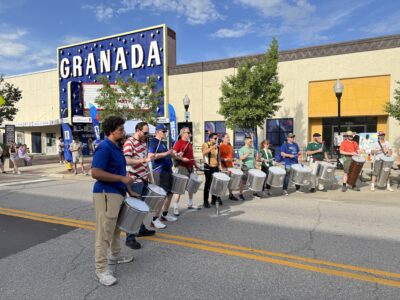
Photos: Lawrence begins World Cup festivities with downtown block party
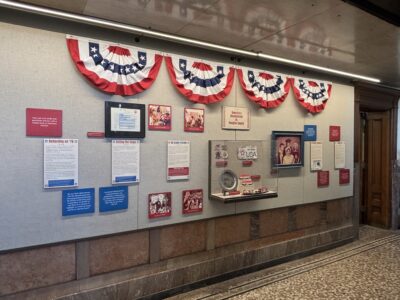
Watkins Museum to open special exhibit detailing how Douglas County celebrated America’s Bicentennial

Go, See, Do: Kaw River Roots Festival, markets and more
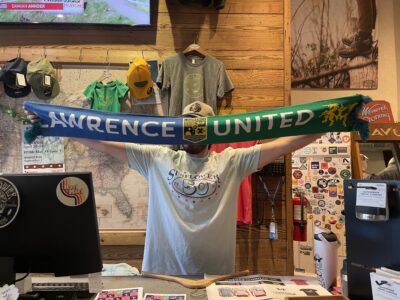
Soccer gear honoring Lawrence history’s all-star team is now on sale as part of city’s public art exhibition
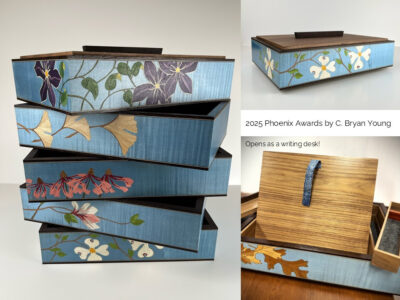
Nominations, call for artists open for Lawrence’s 2026 Phoenix Awards