Court choice darling of right
Bush nominates Samuel Alito to Supreme Court
Washington ? In nominating pre-eminent conservative federal appeals court Judge Samuel A. Alito Jr. to the Supreme Court Monday, President Bush repaired a breach with conservatives, but set the stage for a grinding battle with Senate Democrats.
Quickly moving to put the failed Harriet Miers nomination behind him, Bush praised the 55-year-old New Jersey native’s sterling academic qualifications, solid conservative credentials and “extraordinary breadth of experience” as an appellate lawyer, prosecutor and, for the past 15 years, appeals court judge. Conservative critics had harshly criticized Miers as unqualified for the court, leading to her withdrawal four days ago.
“I’m confident that the United States Senate will be impressed by Judge Alito’s distinguished record, his measured judicial temperament and his tremendous personal integrity,” said Bush, who urged the Senate to vote on the nomination by the end of the year.
But leading Democrats immediately expressed skepticism about the nomination and refused to rule out the prospect of a filibuster to block Alito from replacing retiring Justice Sandra Day O’Connor, who holds the critical fifth vote on a host of controversial social issues. They said Alito would change the court’s direction on issues such as abortion, religion and civil rights.
Some took a hard line. Sen. Edward Kennedy, D-Mass., said Bush “took the nation a step backwards” with the nomination. Sen. Charles Schumer, D-N.Y., said the choice was “sad” and “likely to divide America.” Senate Minority Leader Harry Reid, D-Nev., said Bush, in not nominating a woman or minority, was turning the court into an “old boy’s club.”
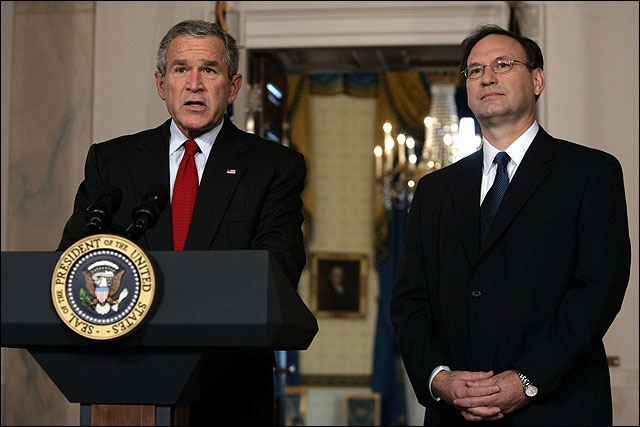
President Bush, left, announces Judge Samuel Alito as his Supreme Court justice nominee in the Cross Hall of the White House Monday in Washington.
Republicans countered with forceful support, vowing to push the nomination forward. They predicted Alito’s intellectual strength would carry him through his meetings with senators and confirmation hearings before the Senate Judiciary Committee.
“The president has nominated someone with a long history of excellence,” Sen. Jeff Sessions, R-Ala., a member of the Judiciary Committee, said in an interview. “While some might disagree with a ruling here or there, everyone will be impressed with his clarity of thought and fairness.”
Spin machines activated
Well-funded interest groups on the left and right, which have raised tens of millions of dollars to try to influence the confirmation process, burst into action Monday within minutes of Bush’s announcement with advertising buys and by blanketing Washington with press releases and self-selected lists of experts to shape opinion.
Opposition to Alito is likely to center around a handful of opinions that upheld abortion regulations and curtailed congressional power. In those cases, Alito interpreted previous Supreme Court rulings and reached a conservative result.
Samuel Alito
Born: 1950 in Trenton, N.J.
Education: Princeton University, 1972; Yale Law School, 1975
Career: Judge on the 3rd U.S. Circuit Court of Appeals, nominated by former President Bush, 1990-present; U.S. attorney, 1987-1990; deputy assistant U.S. attorney general, 1985-1987; assistant to the U.S. solicitor general, 1981-1985; assistant U.S. attorney, 1977-1981; law clerk to the 3rd U.S. Circuit Court of Appeals, 1976-1977
Judicial philosophy: Some liberals have dubbed him “Scalito” or “Scalia lite” for his similarly conservative views and pointedly written rulings. Women’s rights groups point to a Pennsylvania law he voted to uphold requiring women to tell their husbands before having an abortion. The Supreme Court struck down the law in 1992.
On abortion, he wrote a dissent in a 1991 case that would have upheld a Pennsylvania law requiring women to notify their husbands before obtaining an abortion unless they were worried about their safety or believed the husband was not the baby’s father. Alito, applying Supreme Court cases, said the law contained so many exceptions that it was not an unconstitutional “undue burden” on a woman’s right to an abortion.
Judge ‘Scalito’
Alito, the son of Italian immigrants, made his first appearance in the Supreme Court in 1982, when he argued a case on behalf of the Reagan administration while working in the office of the solicitor general. He would eventually argue 12 cases before the high court, winning 10.
On Monday, he said he still remembered the “sense of awe” when he stepped to the lectern to argue his case before the nine justices. He returned recently for the funeral of Chief Justice William Rehnquist, and he said he was struck by that same feeling – not because of the imposing marble building – but because the court stands for “our dedication as a free and open society to liberty and opportunity.”
But for the White House to return Alito to the court as the nation’s 110th justice, it must first wage a bruising, potentially divisive battle with Senate Democrats that could halt much of the rest of the legislative agenda.
Speaking of the Democratic threat of a filibuster, Sen. Lindsey Graham, R-S.C., a member of the influential “gang of 14,” the group of senators that struck a deal to avert such a procedural showdown, said Alito deserved an up or down vote. Graham said Alito’s nomination did not rise to the level of “extraordinary circumstances” that would trigger a filibuster.
Alito was tagged with the moniker “Scalito,” because he shares Justice Antonin Scalia’s intellect and Italian heritage. But the comparisons stop there. In style, he is self-effacing, restrained and low key, in contrast to the often bombastic and biting Scalia.
“He’s not one to lead any revolution,” said former clerk Monica Powell Dolin. “Judge Alito is not someone who wants to call attention to himself or advance an ideological agenda. He’s much more in the mold of a reasonable, pragmatic and principled judge in search of the right answer.”
Rousing reactions
Reaction to Alito was in marked contrast to that of Miers, when Bush announced her nomination four weeks ago. Conservative lawyers and pundits were harshly critical of that choice, saying she lacked the intellectual firepower to counter court liberals like Justices Ruth Bader Ginsburg and Stephen Breyer.
On Monday, those groups celebrated, saying Bush had hit a “home run” with the nomination of Alito, who graduated from Princeton University and Yale Law School and held top jobs in government as a prosecutor, Justice Department lawyer and U.S. attorney for New Jersey before joining the U.S. Court of Appeals for the 3rd Circuit.
For their part, liberal interest groups had held their fire on Miers, but came out swinging against Alito. Ralph Neas, head of the People for the American Way, promised a “massive national campaign” against him. Women’s groups that support abortion rights announced marches in protest.
Quick decision
Bush settled on Alito immediately after Miers withdrew her nomination. He had interviewed him in the White House in July, after O’Connor announced her retirement, but opted to nominate federal Judge John Roberts instead.
When Rehnquist died, Bush moved Roberts into that vacancy. Again, Alito was at the top of the list to replace O’Connor, but Bush concluded he wanted to nominate a woman and tapped Miers instead.
Bush phoned Alito on Friday afternoon to discuss the nomination, just before the special counsel announced the indictment of a top aide to Vice President Dick Cheney. The White House then consulted with Senate Judiciary Committee Chairman Arlen Specter, R-Pa., several times over the weekend, but did not notify other Senate leaders until Monday morning.
The choice had come down to Alito and Judge Michael Luttig, of the Richmond, Va.-based federal appeals court. The two had been leading finalists when Bush first selected Roberts and again last month, when Miers got the nod.
In giving Alito the edge over Luttig, sources close to the process said Bush and Alito simply “hit it off” in a lengthy interview. White House advisers also believed Alito would not be as controversial as the more outspoken Luttig.
National

Unhealthy air quality in California city as huge warehouse fire burns for 3rd day

Judge orders Trump administration to restore National Park changes at sites that ‘disparaged’ US
Teens’ reading and math scores have stagnated, US test results show
WASHINGTON (AP) — Younger students have regained ground academically after the pandemic's disruptions while older ...
Lawyers for man accused of killing Charlie Kirk try to block death penalty

Trump’s name poised to come off Kennedy Center