

Student hopes to link wildflower plantings with bee survival
Study's a KU Honey-do
It is an idea that Jennifer Hopwood believes is worth buzzing about: Wildflowers planted on Kansas roadsides could play a key role in preserving the state’s 100 species of bees.
“We have hundreds of thousands of miles of roadsides in Kansas,” Hopwood said. “We could be preserving lots of insect species.”
The Kansas University graduate student in ecology and evolutionary biology is embarking on a study this summer to determine whether wildflowers planted alongside Kansas roads lead to a healthier bee population.
The research focuses on six of the eight wildflower restoration sites established by the Kansas Department of Transportation. Hopwood plans to measure the number of bees at those six sites and compare the figures with six roadsides that have only weeds.
Bee populations worldwide are on the decline, and Hopwood said having more wildflower plantings could help boost numbers. Bees pollinate flowers and other plants, which helps the entire ecosystem.
Most of the roadside restoration areas are in northeastern Kansas, with one along the Kansas Turnpike near Topeka and another between Lawrence and Kansas City on Kansas Highway 10.
“I would love it if this project could lead to more roadside restoration,” Hopwood said. “I don’t know if the results will be able to tell them anything about the specific seed mixes, and whether or not certain seeds encourage native bees.”
The research, which Hopwood said she hoped to turn into her master’s thesis, recently received a $10,000 grant from the National Fish and Wildlife Foundation and Anheuser-Busch.
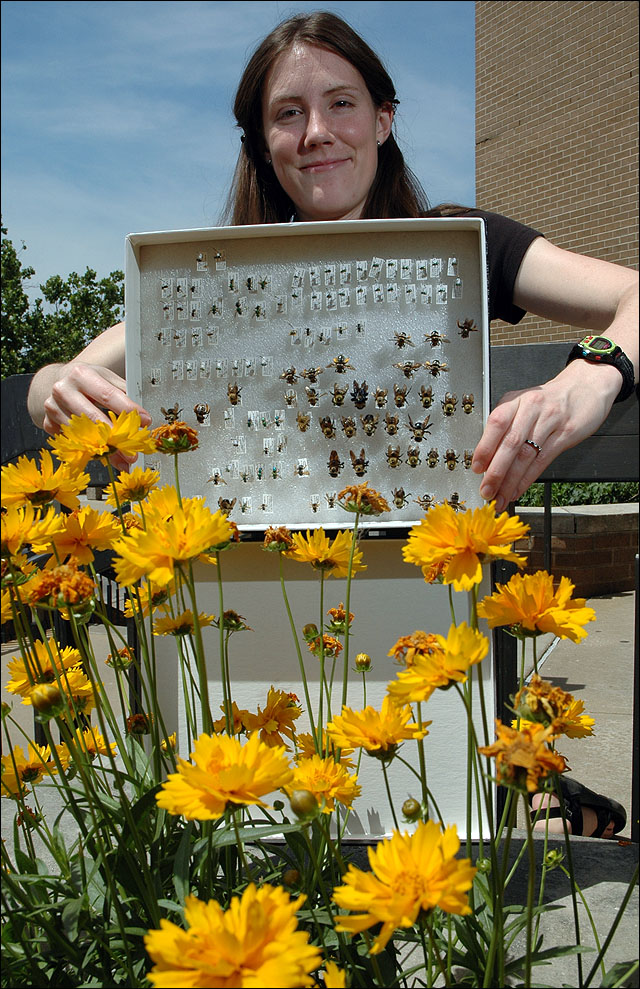
Jennifer Hopwood, a Kansas University graduate student, has received a grant to research whether returning northeast Kansas roadsides to native wildflowers would increase bee populations.
Chip Taylor, the KU professor who is Hopwood’s adviser, said the research was among a group of similar projects under way across the Midwest.
“A lot of us are lobbying nationwide to get departments of transportation to modify their policies with regard to roadside management, and converting roadsides to native wildflowers,” Taylor said. “Most of these are covered in fescue or brome (grass). Wildlife don’t flourish in fescue or brome.”
Scott Shields, the KDOT official responsible for the wildlife restoration projects, couldn’t be reached for comment last week.
Taylor said having more roadside wildflowers had the potential for helping other wildlife, including quail. He noted that 2 percent to 4 percent of all land in the United States north and east of Kansas is from the edge of the road to the edge of a field.
“Nature does a wonderful job,” he said. “But once we mess it up, it’s difficult to get it back to where it should be.”
State Government
State legislators push back against federal energy regulators ending competitive bids
TOPEKA — Two Kansas legislators asked federal energy regulators to ensure competitive bidding occurs on ...
Senate confirms 1st of 3 Kansas nominees to U.S. District Court
Corporate income tax collections falling sharply in Kansas; Republican, Democratic leaders disagree on what it means
TOPEKA — Corporate income tax collections in Kansas have almost halved since last year, while other sources trend ...
Candidate’s campaign manager created website with documents used to attack rival
TOPEKA — Kansas U.S. Senate candidate Patrick Schmidt’s campaign manager left his digital footprint on ...
GOP secretary of state files to run for governor
