KU touts results of tuition increase
In many corners of the Kansas University campus, it’s tough to tell the state is in tight budget times.
New faculty are being hired. Computers are being installed. Salaries for student workers, teaching assistants, faculty and some staff are up.
And students are paying for it all.
This school year marked the halfway point of a doubling of KU tuition rates over five years. KU leaders say they’re convinced the investments made with the tuition money will transform the university for generations to come.
“We’re a school on the move instead of a school that’s getting budgets slashed,” said Kathleen McCluskey-Fawcett, senior vice provost. “If it hadn’t happened, we would be financially strapped.”
At KU, base tuition rates have increased from $2,333 per year in the 2001-2002 school year to $4,163 this year, for an undergraduate Kansas resident taking 15 credit hours. All schools — except the College of Liberal Arts and Sciences and the School of Social Welfare — also have school-specific additional tuition of $12 to $107.95 per credit hour, and all students are required to pay fees of $287 a semester.
KU will propose another large tuition increase to the Kansas Board of Regents on Thursday. Though officials won’t say exactly how much the new rates will be until then, tuition is expected to be around $4,840 for the 2005-2006 year for resident undergraduates.
The Board of Regents in 2002 asked each of the six state universities to develop a five-year plan for tuition. The request was due, in part, to a decline in state funding over time. State appropriations over time had declined from $6,469 per student in 1985 to $5,800 in 2000.
Additional money raised was to provide “enhancements” to the universities and not replace funds cut by the state.
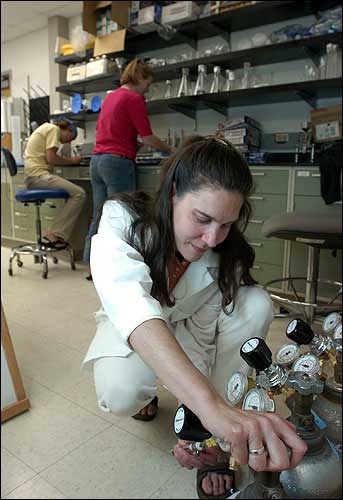
Sharon Billings, assistant professor of ecology and evolutionary biology, works in her lab at KU. She says money from tuition increases at KU made her lab possible.
In presenting their plan, KU focused on a $50 million gap in funding between the university and the average budgets of “peer” universities selected by the state. School leaders also noted that KU’s tuition was the fourth cheapest in the Big 12.
Some students protested the initial proposal in 2002. But no organized opposition has formed since then, and it’s difficult today to find many students opposing the increases.
Dallas Rakestraw, co-chairman of the committee that recommended how to spend the $43 million that will be generated by the plan over five years, said he thought students were getting a fair deal.
“I think at the beginning of any massive undertaking, there are major concerns,” said Rakestraw, now a second-year law student. “I think looking at it now, halfway through it, it’s met the expectations that were set and perhaps exceeded it. I think all people can agree the tuition enhancement has improved our university.”
The investments
The increases have produced $26 million for KU projects through the end of the current fiscal year. In addition, $6.6 million — or 20 percent of the money collected — has gone to need-based financial aid.
| Kansas University is midway through a five-year plan to more than double tuition rates.KU is spending the extra money on “enhancements” designed to advance the university toward Chancellor Robert Hemenway’s goal of becoming a top-25 public university. But some students are feeling the pinch of rising costs.Today, part one of three: Officials say the more than $26 million pumped into campus programs so far — with an additional $17 million on the way — will transform campus for generations to come. |
Leaders vowed from the beginning that the money would be spent on “enhancements” instead of replacing lost dollars from the state. David Shulenburger, provost and executive vice chancellor, once said that promise left leaders sometimes feeling “schizophrenic” because they were cutting budgets while adding money in other areas.
Among the areas that have benefited from the tuition money:
- New faculty positions ($3.5 million). Forty-two new faculty members have been hired through this school year, and 100 will be hired by the end of the five-year plan.
| Through July 1, the five-year tuition plan at Kansas University has generated $26.06 million for university projects. In addition, about $6.6 million has gone to need-based financial aid.Here’s how the spending breaks down for the first three years of the plan:Technology — $4.8 millionNew faculty — $3.5 millionFaculty salary increases — $3.5 millionGraduate teaching assistant salary increases — $3 millionDepartment operating expenses — $3 millionLibraries — $1.8 millionUnclassified staff salary increases — $1.6 millionNew faculty startup funds — $1.5 millionNew staff positions — $1 millionGraduate research assistant tuition waivers — $750,000Classroom improvements — $500,000New teaching assistant and lecturer positions — $450,000Student employee salary increases — $300,000Other program support — $360,000 |
New positions have been spread throughout the university, but special focus has been made on the life sciences and faculty with an international emphasis. An additional $1.5 million has been spent on start-up packages for new faculty, such as purchasing lab equipment and hiring research assistants.
- Salary increases ($8.4 million total). Faculty and unclassified staff have received an additional 2 percent raise on average because of the tuition funds. Graduate teaching assistants have received a 10 percent increase for each of the past three years, and most student hourly workers received a 50 cent raise to their hourly wages.
- Technology ($4.8 million). New equipment has been installed in labs, and most university computers are now on a schedule to be replaced every three to four years.
Two committees — a student Tuition Advisory Committee and the Planning and Resources Committee of University Governance — each year make recommendations for specific projects to fund.
“Really the criteria has been what’s going to take KU to the next level,” said Lindy Eakin, vice provost for finance and administration. “We’ve wanted to build on our strengths and figure out where we have capacity to move programs up in quality.”
‘Pleased as punch’
Craig Martin said he has seen that improvement in his department.
Martin is chairman of the division of biological sciences, which has added five faculty members to the 35 it already had.
“We love it,” he said. “We’re pleased as punch. I’m very much a pro-student faculty member, but I honestly believe at the beginning of the program tuition was too low for the value of the education they were getting.”
Among the new biology faculty members is Sharon Billings, an assistant professor of ecology and evolutionary biology. Billings’ research focuses on how global change affects plants and soils.
She said the faculty start-up money available to get her lab going — which will amount to hundreds of thousands of dollars in the end — was key in her decision to come to KU.
“We need to have the resources available to do the things you’re trained in,” she said. “Like the old saying goes, there’s nothing like the right tool for the job.”
‘Quantum leap’
Steve Munch, a junior who left office as student body president in April, said students were seeing a trickle-down effect from their larger bills.
He points to new staff in the Freshman-Sophomore Advising Center, teaching assistant and student salaries and more faculty as being the areas that most touch students’ lives.
“The list goes on and on,” he said. “There are so many areas that have been affected on campus.”
Though the plan raises rates for five years, that money will be built into the university’s base budget after 2007. That, in Vice Provost Eakin’s view, gives the plan a legacy that will affect campus for years to come.
“For the University of Kansas, I think this is a defining moment in time,” he said. “This is a quantum leap.”
KU

U.S. labor secretary tours KU Innovation Park in Lawrence, says it’s a key pipeline for cybersecurity and biomedical talent
‘It’s pretty scary’: KU students, professors find a job market that has grown tougher for recent college grads
Military aircraft to fly over Lawrence ahead of KU vs. Baylor game
‘This isn’t just childcare’: Hilltop closure brings community together to brainstorm solutions

KU researchers win $1.8M grant to study program designed to help parents who adopt children