

Exhibit displays Chanel creations
New York ? Gabrielle “Coco” Chanel gave the fashion world some of its most stylish and instantly recognizable looks. There’s the “little black dress,” the skirt suit with braided trim and gold buttons, the quilted handbag that hangs from a chain.
But perhaps Chanel’s greatest contribution to the world of fashion was the idea of timelessness.
In an industry seemingly obsessed with trends, Chanel underscored her uniqueness — aside from being a strong-willed woman in a man’s world — by designing garments that purposely couldn’t be identified by date.
A dress from a Chanel collection of the 1920s can stand beside a dress from today and it’s hard to tell which one is older. Is it the dropped-waist dress in pale yellow satin adorned with a camellia corsage or is it the gray silk satin dress with a covered buttons streaming down the back?
Fans of fashion get the opportunity to play this guessing game at the Metropolitan Museum of Art’s new exhibit, “Chanel.” It’s a lively presentation, taken out of the Met’s Costume Institute’s traditional lower-level space and put on the main floor in a maze of white modules that is further jazzed up with video wallpaper pulsing camellias, one of Chanel’s signature details.
‘Exhibition of an evolution’
The show opened Thursday. It was organized by curators Harold Koda and Andrew Bolton of The Costume Institute with input from Karl Lagerfeld, and is not a chronological retrospective. Instead, it features 63 outfits grouped together by iconic looks. One vignette features ivory wool boucle signature suits, one with a skirt that hits below the knee, one at the knee and a micro-miniskirt that barely grazes the hip.
“It’s an exhibition of an evolution,” said Lagerfeld, Chanel’s designer since 1983 and himself a fashion trailblazer. “It’s an evolution of Chanel, which has stayed in fashion for nearly 100 years. No one else can say that.”
One of the best examples of the two designers’ styles coming together is a 1986 evening suit by Lagerfeld that puts the pattern of the Chanel quilted bag, introduced in 1955, onto a black, silk organza jacket and skirts, using embroidered paillettes. There are gold and black beads edging the cuffs, neckline and front to mimic the purse’s corded chain.
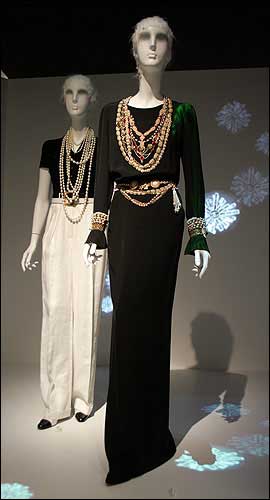
Chanel outfits are shown at the Metropolitan Museum of Art in New York. The dress is part of the exhibit Chanel, which opened Thursday.
Chanel’s continuity lies not only in its designs, but also in its handiwork. The gold lace gown embroidered with magenta and green sequins in a leaf pattern that opens the exhibit and is featured on the accompanying book is a Lagerfeld interpretation of a gown that Coco Chanel wore in a 1936 photo. Both designers worked with the same embroiderer, Francois Lesage.
“It’s not a fake. It’s still Chanel. I’m the only one who can do legal fake Chanels,” Lagerfeld said with a laugh, acknowledging the ubiquitous knockoffs sold on street corners around the globe.
Lagerfeld, who glided through a museum preview in skinny black pants, a high-neck white shirt, dark sunglasses and leather driving gloves, encouraged the Met to use the gown as the centerpiece. It’s not the usual “Chanel,” he said, but it still emphasizes her affinity with simple shapes, impeccable construction and her ability to make something sexy without ever showing too much skin.
“It would have been too easy to do a suit,” he told The Associated Press.
The key to the French house’s success is its ability to update its most famous pieces, playing to the zeitgeist while making sure everything that bears the Chanel label pays homage to its history, Andrew Bolton, associate curator, explained. “She was the canon of modern dress. She employed the icons consistently throughout her career, and she maintained modernity by avoiding becoming obsolete.”
Feminine without frills
Chanel understood that women didn’t want to be bound in corsets and wires — that they wanted to be feminine without being frilly and they wanted to look fashionable not fussy. She was among the first designers to employ comfortable jersey fabrics and to embrace sportswear, especially nautical looks such as a sailor-collar, two-piece knit day dress in ivory wool with navy grosgrain trim.
Chanel had “retired” from fashion after her lacy romantic collections of the 1930s that were the precursor the 1960s’ bohemian look. But it didn’t last. Her heralded comeback came in the early 1950s because she thought the highly stylized clothes from such designers as Christian Dior and Cristobal Balenciaga were off the mark, according to Hamish Bowles, Vogue’s European editor at large. Chanel continued to work until her death in 1971.
Arts and Entertainment

Photos: Lawrence begins World Cup festivities with downtown block party
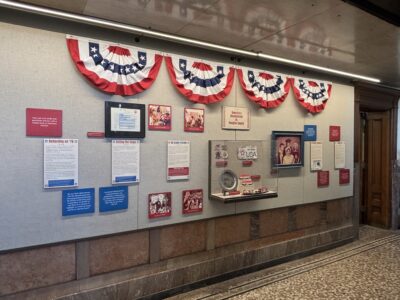
Watkins Museum to open special exhibit detailing how Douglas County celebrated America’s Bicentennial

Go, See, Do: Kaw River Roots Festival, markets and more

Soccer gear honoring Lawrence history’s all-star team is now on sale as part of city’s public art exhibition

Nominations, call for artists open for Lawrence’s 2026 Phoenix Awards