

Take a number, get in longer line
Anti-terrorism measure may mean slower processing of driver's licenses
Kansas residents may have a little bit more time to ponder the country’s war on terrorism — through longer lines at state driver’s license offices.
Congress is expected to approve a bill next week that creates tough new requirements for how states are allowed to issue driver’s licenses, hoping it becomes more difficult for terrorists to create false identities.
It might also be slightly more difficult for ordinary citizens to cut through red tape.
“There is every chance of longer lines,” predicted Alan Anderson, chief of the state’s driver’s license bureau.
Reactions were mixed on the line Wednesday at Lawrence’s Department of Motor Vehicles.
Gavin Rondeau, of Lawrence, said the principle behind the bill bothered him more than any additional wait times.
“I think it sounds really foolish,” Rondeau said. “If a terrorist is already committed enough to commit an act, I don’t think requiring something like a birth certificate is going to make much difference. It is kind of like closing the barn door after the cows are already out.”
But the legislation has strong support, in part, because several of the 9-11 hijackers used driver’s licenses as identification when checking in for their flights.
New rules
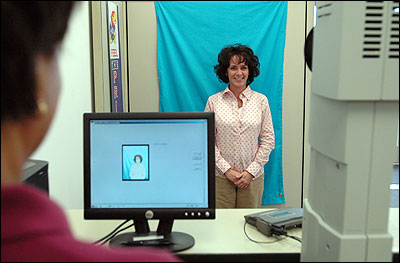
Caitlin Sheehe, of Lawrence, poses for her driver's license photo at Lawrence's Department of Motor Vehicles station, 1035 N. Third St. Federal legislation -- in an effort to combat terrorism -- may soon lengthen the process for getting a license.
The new regulations would for the first time create national standards for the issuance of ordinary driver’s licenses. Historically, that is an area the states have been allowed to control.
The provisions, which are part of the bill HR 418, would require states to receive proof of citizenship or legal presence, proof of an address and proof of a Social Security number. It also would require the state to store a digital image of the face of each applicant.
Anderson said Kansas currently was meeting those requirements.
But the state is not saving copies of any documents that applicants show clerks to verify their identities. Under the new law, Anderson said, the state would either have to start requiring clerks to go to a copy machine and copy each document or come up with some other sort of scanning system.
Either alternative is likely to add some wait time for the average consumer.
| The federal legislation would require states to receive proof of citizenship or legal presence, proof of an address and proof of a Social Security number. It also would require the state to store a digital image of the face of each applicant. Kansas meets these requirements.But under the proposed law, the state would either have to start requiring clerks to copy each document or come up with some other sort of scanning system, which will create additional costs for the state. |
It also will create additional costs for the state, although the amount isn’t yet known, said Carmen Alldritt, the state’s director of vehicles.
“It would take both additional money and staffing,” Alldritt said.
She said the state would begin to get a handle on the costs after the bill was approved and Congress appointed a rules committee that will write specific guidelines.
Last year the state began issuing redesigned driver’s licenses that are tougher to counterfeit, implemented a computer “facial recognition” program designed to spot when an applicant’s name doesn’t match photo descriptions, and began tapping into the federal government’s database to verify each Social Security number.

 Kansas Department of Revenue: Driver’s License Information
Waiting in line for his new license, Lawrence resident James Berry said he could wait in line longer if it meant preventing another attack.
“Standing in lines doesn’t bother me. I was in the Army for 20 years,” said Berry, who is a retired lieutenant colonel. “What I can tell you is that too many people get away with too much today. It is not right the way it is now.”
— JW wire services contributed to this report.
| Representatives and Republican Sens. Sam Brownback and Pat Roberts did not return phone calls seeking comments on the bill.Christie Appelhanz, a spokeswoman for Rep. Dennis Moore, D-Kan., said he had previously spoken against the changes. Moore had said they would create “unfunded mandates” for the states and he had concerns whether they would improve national security.Rep. Jim Ryun, R-Kan., voted for the bill when it passed the House in February, according to his congressional Web site. |
State Government
State legislators push back against federal energy regulators ending competitive bids
TOPEKA — Two Kansas legislators asked federal energy regulators to ensure competitive bidding occurs on ...
Senate confirms 1st of 3 Kansas nominees to U.S. District Court
Corporate income tax collections falling sharply in Kansas; Republican, Democratic leaders disagree on what it means
TOPEKA — Corporate income tax collections in Kansas have almost halved since last year, while other sources trend ...
Candidate’s campaign manager created website with documents used to attack rival
TOPEKA — Kansas U.S. Senate candidate Patrick Schmidt’s campaign manager left his digital footprint on ...
GOP secretary of state files to run for governor
