

Rhyme and reason
Wordsmith Saul Williams puts a musical beat to his political activism
As an 18-year-old college student, budding poet Saul Williams took an internship on Capitol Hill. His days were confined to menial tasks such as making copies for Sen. David Pryor of Arkansas.
“I learned how to really get exactly what I wanted from a Xerox machine,” Williams jokes, “and I didn’t want to grow up to be a carbon copy of the sort of people I was interacting with.”
Mission accomplished.
Since his school days earning a philosophy degree at Morehouse College and a master’s in acting at New York University, the multitasking Williams has gone on to be something of a renaissance man.
His rising fame on New York’s cafe poetry scene led to a starring role in the 1998 film “Slam,” playing a D.C. drug dealer whose life is transformed through wordplay. The picture went on to win major awards at the Cannes and Sundance Film Festivals.
Since then, the performer has appeared in a slew of films and television shows and has released three books of poetry. Lately, he’s applied his verbal gifts to the world of music. His self-titled sophomore album finds him experimenting with “industrial punk-hop,” while continuing to deliver the kind of mesmerizing, socially active lyrics that have shaped his reputation.
“I freestyled a great deal of the album,” says Williams, calling while escorting his 4-year-old son around the Los Angeles Zoo.
“It’s different because with (2001’s debut record) ‘Amethyst Rockstar’ I took poems that I’d written beforehand and wrote
music to accompany the poem. With this album I wrote the music first and then wrote song lyrics to go with the music. I let the music dictate where I would go lyrically.”
While the album touches on subjects from the war in Iraq to the materialism of hip-hop culture, Williams says not every topic is fair game. In fact, at the 11th hour he yanked a song from the final track order.
“It didn’t make it primarily because I felt like the song had its moments of insensitivity — to soldiers,” he reveals. “I felt like I wrote it in a moment of rage after all the stuff had come out about soldiers mistreating prisoners in Iraq. I wrote something while I was angry, put it down musically and it sounded awesome. But I was like, ‘I don’t need to go that route.'”
Instead, he included a tune called “Act III Scene 2 (Shakespeare)” on which he collaborates with former Rage Against the Machine singer Zack De La Rocha.
“I realized it would be more powerful to create a protest song that would make soldiers think rather than make them angry,” he says.
Dear hip-hop
While retailers inevitably file Williams’ new album in the hip-hop section, some of the material on the record takes pointed shots at the genre.
 Clips of audio interview with Saul Williams
 Do musicians have an obligation to help humanitarian causes or speak out politically?
For instance, the track “Telegram” fumes: “Telegram to Hip-Hop. Dear Hip-Hop. stop. This (expletive) has gone too far. stop. Please see that mixer and turntables are returned to Kool Herc. stop … The master of ceremonies have forgotten that they were once slaves and have neglected the occasion of this ceremony. stop. Perhaps we should not have encouraged them to use cordless microphones, for they have walked too far from the source and are emitting a lesser frequency. stop.”
Has hip-hop lost its relevance?
“Not at all,” Williams replies. “Hip-hop music is still a changing, growing art form, just like the African-American community in America is still a changing, growing people. Has youth lost its relevance?”
Although Williams is not particularly fond of the trappings that accompany hip-hop — from the materialistic bling-bling to the pervasive violence of the gangster lifestyle — he can relate to their seductive appeal.
“I understand what makes a young black man want to be a gangster,” he says. “A gangster is essentially someone who beats the system. A gangster is no different than a cowboy.
“Sometimes I do my own little exercise, and instead of accepting the fact (rappers) are talking to other black men, I imagine that they’re talking to the government in their lyrics. And in many ways they are, whether they realize it or not. Here we have the descendants of slaves talking about how they would never do ANYTHING for free.”
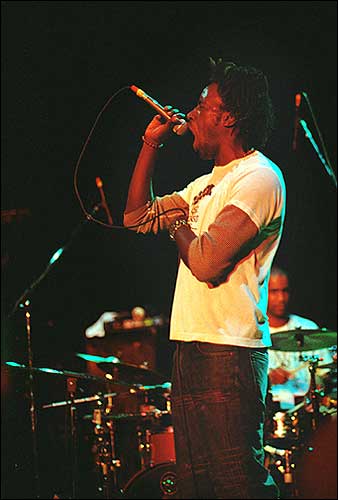
Saul Williams
Like most hip-hop acts, Williams travels with a stripped-down version of a band. For Sunday’s Lawrence show he will be accompanied by two atypical sidemen: a programmer/mixer who “does a lot of electronic gadgetry” and a viola player.
Williams promises “a blend of the modern and the classical.”
Rhythm, meter and timing
Regardless of whether he’s touring on a record, writing a book, making regular appearances on the UPN sitcom “Girlfriends” or acting in the current HBO movie “Lackwanna Blues,” Williams is perpetually honing his skill with words.
When writing, he’ll take inspiration from any number of sources, but often it stems from the words themselves.
“A lot of times it starts with me looking for a cool opening line,” he says. “Then I attach meaning to it afterward.”
| When: 8 p.m. SundayWhere: The Granada, 1020 Mass.Tickets: $12.50 (all ages)Ticket info: 842-1390 |
Unlike a more conventional singer who learns only a few verses in between “baby, baby” choruses, Williams’ spoken-word pieces and lyrics are remarkably dense with language. Although it’s easy to picture the lines organically flowing from the performer, he admits to working at memorizing them on occasion.
“The thing about writing a poem in particular is poems have a sense of internal rhythm and meter and timing,” he explains. “Oftentimes in order to write the following stanza, you have to read everything that comes before it. Just like if you were writing a song, you need to know the notes that preceded it in order to get to the next note. What I find is by the time I’ve gone through and repeated everything that has preceded the next line, that may have me reciting the poem 40, 50 or 100 times. By that time I usually have it committed to memory.”
Later this spring Williams will perform his third book — “Said the Shotgun to the Head” — with the Basel Symphony in Switzerland. It’s during such travels that he gets to see firsthand how differently the world views his home turf.
“Only 14 percent of the American population has passports,” he says, laughing. “Of that 14 percent, the majority of them that use those passports go to Jamaica, Barbados, Bermuda. The only other countries that have those sort of statistics are fundamentalist nations, where the people are not encouraged to travel, where the people have fear imposed on them and are taught that they live in the best nation imaginable, so why in the world would they want to go anywhere else?
“Now what country does that sound like: Afghanistan or America?”
Arts and Entertainment
Photos: Lawrence begins World Cup festivities with downtown block party
Watkins Museum to open special exhibit detailing how Douglas County celebrated America’s Bicentennial

Go, See, Do: Kaw River Roots Festival, markets and more

Soccer gear honoring Lawrence history’s all-star team is now on sale as part of city’s public art exhibition

Nominations, call for artists open for Lawrence’s 2026 Phoenix Awards