Rumsfeld says insurgency could go on for years
Washington ? Defense Secretary Donald Rumsfeld said Sunday he was bracing for even more violence in Iraq and acknowledged that the insurgency “could go on for any number of years.”
Defeating the insurgency may take as long as 12 years, he said, with Iraqi security forces, not U.S. and foreign troops, taking the lead and finishing the job.
The assessment comes on the heels of the latest Associated Press-Ipsos poll showing public doubts about the war reaching a high point – with more than half saying that invading Iraq was a mistake.
The top U.S. commander in the Middle East appealed for public support of the soldiers and their mission. “We don’t need to fight this war looking over our shoulder worrying about the support back home,” Gen. John Abizaid told CNN’s “Late Edition.”
In a deadly week for U.S. forces, an ambush on a convoy carrying female troops killed four Marines, including at least one woman. At least 1,735 members of the U.S. military have died since the war started in March 2003, according to an AP count.
On Sunday, bombings in Mosul and elsewhere in Iraq killed at least 47 people.
Rumsfeld, making the rounds of the Sunday talk shows, said insurgents wanted to disrupt the democratic transformation as Iraqi leaders draft a constitution and plan for elections in December to choose a full-term government.
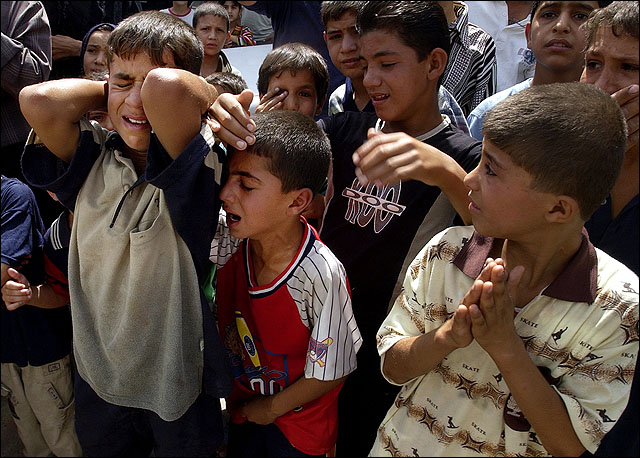
Abbas, far left, and his brother Hussein, second from left, cry during the funeral of their father, Fadil Udaa, during his funeral Sunday in the Sadr City district of Baghdad, Iraq. Udaa, a member of the municipal council in Sadr City, was found dead Saturday with his hands tied and shot in the head after he had been kidnapped by unidentified masked gunmen on Friday.
“I would anticipate you’re going to see an escalation of violence between now and the December elections,” the Pentagon chief told NBC’s “Meet the Press.” And after then, it will take a long time to drive out insurgents.
“Insurgencies tend to go on five, six, eight, 10, 12 years,” Rumsfeld said on “Fox News Sunday.”
“Coalition forces, foreign forces are not going to repress that insurgency. We’re going to create an environment that the Iraqi people and the Iraqi security forces can win against that insurgency,” he said.
Meeting with insurgents
A British newspaper reported Sunday that American officials recently met secretly with Iraqi insurgent commanders north of Baghdad to try to negotiate an end to the bloodshed.
Speaking generally, Rumsfeld said those kind of meetings “go on all the time” and that Iraqis “will decide what their relationships with various elements of insurgents will be. We facilitate those from time to time.”
Abizaid said U.S. and Iraqi officials “are looking for the right people in the Sunni community to talk to … and clearly we know that the vast majority of the insurgents are from the Sunni Arab community. It makes sense to talk to them.”
Echoing Rumsfeld, Abizaid made clear that “we’re not going to compromise” with Iraq’s most-wanted terrorist, Jordanian-born Abu Musab al-Zarqawi.
The contacts, the Pentagon leaders said, were intended to make it easier for the Shiite-led government to reach out to minority Sunnis.
Rumsfeld’s list
Before the war, Vice President Dick Cheney predicted that Iraqis freed from Saddam Hussein’s rule would greet American troops as liberators. Rumsfeld said Sunday he gave President Bush a list of about 15 things “that could go terribly, terribly wrong before the war started.”
He said they included Iraq’s oil wells being set on fire; mass refugees and relocations; blown-up bridges; and a moat of oil around Baghdad, the capital.
“So a great many of the bad things that could have happened did not happen,” Rumsfeld said.
Asked if his list included the possibility of such a strong insurgency, Rumsfeld said: “I don’t remember whether that was on there, but certainly it was discussed.”
Deadly Sunday
Suicide bombers struck a police headquarters, an army base and a hospital around Mosul on Sunday, killing 33 people in a setback to efforts to rebuild the northwestern city’s police force that was riven by intimidation from insurgents seven months ago.
At least 47 people were killed in attacks elsewhere in Iraq, including a U.S. soldier whose convoy was hit by a roadside bomb in Baghdad.
National
Lawyers for man accused of killing Charlie Kirk try to block death penalty
Trump’s name poised to come off Kennedy Center

Suspect in Texas shooting had fired at police days earlier, officials say
Man pleads guilty to killing a top Minnesota Democrat and her husband
New tornadoes outside Chicago as severe storms pummel the Midwest