Bush against withdrawal timetable
Washington ? In the ornate East Room of the White House, Iraq’s prime minister spoke of the painful price the United States has paid to drive Saddam Hussein from power and plant the seeds of democracy over the opposition of a determined insurgency.
“You have given us something more than money,” Ibrahim al-Jaafari told President Bush. “You have given us a lot of your sons, your children, that were killed beside our own children in Iraq. … This is more precious than any other kind of support we receive.”
Al-Jaafari, the leader of Iraq’s first democratically elected government in more than 50 years, appeared with Bush at a news conference amid growing anxiety about the war that has claimed the lives at of least 1,730 members of the U.S. military.
Nevertheless, Bush said the United States was not about to set a timetable for bringing home U.S. troops. “I’m not giving up on the mission,” the president said. “We’re doing the right thing.”
Iraq’s relentless violence and bloodshed have taken a heavy political toll on Bush and have raised alarms in Congress. Public doubts about the war have increased to some of their highest levels since the March 2003 invasion. Just over half of Americans now say the United States made a mistake going to war, and almost six in 10 say they don’t approve of the way Bush has handled Iraq, according to an AP-Ipsos poll.
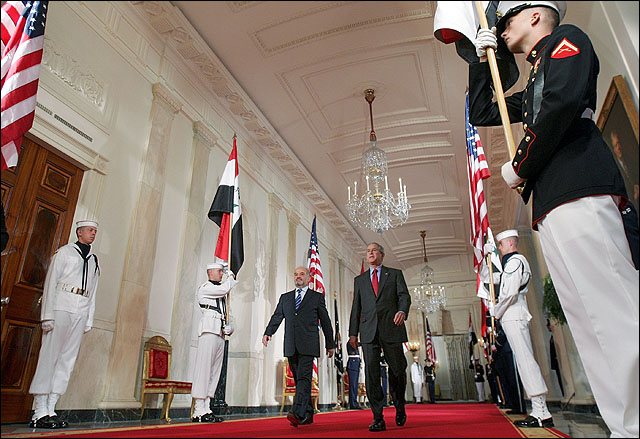
President Bush and Iraqi Prime Minister Ibrahim al-Jaafari, left, walk to the East Room of the White House to hold a joint press conference Friday in Washington. Bush assured al-Jaafari 'there are not going to be any timetables' for withdrawal of American forces.
Hoping to build public support, Bush will address the nation at 8 p.m. EDT Tuesday. He will speak from Fort Bragg, N.C., home of the Army’s elite 82nd Airborne Division, on the first anniversary of the transfer of power from the U.S.-led coalition to Iraq’s interim government.
Bush turned aside calls in Congress and elsewhere for setting a deadline for the pullout of U.S. troops.
“This is an enemy that will be defeated,” Bush pledged. “You don’t have to worry, Mr. Prime Minister, about timetables.”
“This is not the time to fall back,” al-Jaafari agreed.
The two leaders spoke in the East Room after news broke of a deadly car bombing against U.S. troops in Fallujah.
“The way ahead is not going to be easy,” Bush cautioned. The killings and suicide bombings show that the insurgents have no regard for human life, he said. “The enemy’s goal is to drive us out of Iraq before the Iraqis have established a secure, democratic government,” Bush said. “They will not succeed.”
Bush said he was optimistic about the training of Iraqi troops and moves toward democracy. “We’re making good progress,” the president said.
By Aug. 15, Iraq’s National Assembly is to unveil the draft of a constitution and within two months a ratification referendum is to be held. If approved, the constitution will provide the basis for general elections by Dec. 15.
Insisting his strategy is working, Bush said: “I’m not giving up on the mission. We’re doing the right thing, which is to set the foundation for peace and freedom. And I understand why the al-Qaida network, for example, is to terrified about democracy, because democracy is the opposite of what they believe.”
Bush said the United States faces an enemy that “wants to shake our will and get us to leave” by creating scenes of carnage that are shown on television.
“They know that it bothers people to see death and it does. It bothers me, it bothers American citizens, it bothers Iraqis,” he said.
Bush said setting a timetable for withdrawing U.S. forces would only prompt the insurgents to “wait us out. … You know, if you give a timetable you’re conceding too much to the enemy.”
With his job approval ratings among the worst since he took office, Bush was asked by a reporter if he were in a second-term slump that limited his political influence over the international and domestic agenda.
“A quagmire, perhaps?” Bush suggested with a smile. He went on to say that “this is a time of testing” and that that he had challenged Congress to take on tough issues. He blamed lawmakers for being hesitant to tackle issues that might make it harder for them to be re-elected.
National
Lawyers for man accused of killing Charlie Kirk try to block death penalty
Trump’s name poised to come off Kennedy Center

Suspect in Texas shooting had fired at police days earlier, officials say
Man pleads guilty to killing a top Minnesota Democrat and her husband
New tornadoes outside Chicago as severe storms pummel the Midwest