

Alamo Scouts reunite
WWII vets recall secret Pacific missions
Kansas City, Mo. ? A small and dwindling group of old soldiers whose crucial role in World War II remained obscure for years is gathered – perhaps for the last time – in Kansas City.
They came for barbecue, baseball and a visit to the Truman Library. But they also came to remember through each other one of the least-known chapters of the war that ended 60 years ago this summer.
They are a dozen of potentially fewer than 20 surviving members of the Alamo Scouts, the forerunners of the Army Special Forces “Green Berets.” They crept deep behind Japanese lines in the Southwest Pacific at enormous risk to gather intelligence that was vital to pushing the enemy back.
The Scouts’ work was top secret and reports were long classified so that even after the war their story remained largely untold. Their families had no idea. Most of them didn’t even know what the others had done until they reunited in 1980.
“This will probably be our final gathering,” said 81-year-old Robert L. Shirkey of Kansas City, an Alamo Scout who led five missions in Luzon, the Philippines.
There were many embraces Thursday as the Scouts and several family members met for lunch and a tour of the Liberty Memorial. Shirkey had a wristwatch with the Alamo Scout insignia for each veteran.
“This is terrific,” said 86-year-old Zeke McConnell of Seattle, who went on 13 Scout missions in 1944-45. “It feels like coming home.”
Birth of an elite force
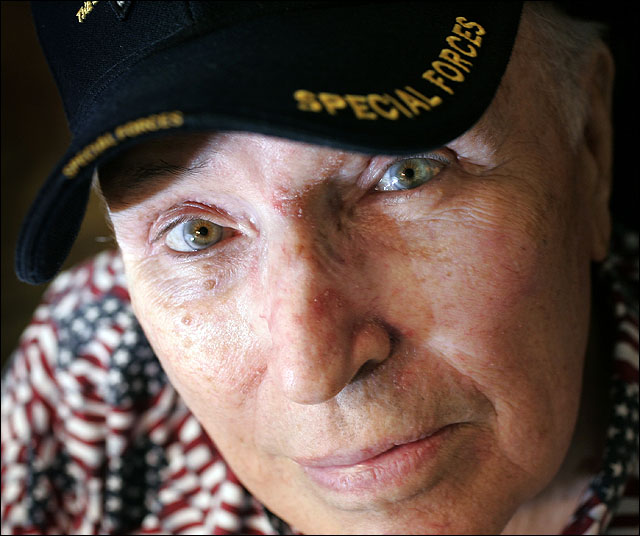
Alamo Scout Robert L. Shirkey of Kansas City during a visit to the Liberty Memorial Thursday in Kansas City.
The Japanese built airfields on many islands in their grab for territory. Gen. Douglas MacArthur wanted those airfields for his own island-hopping strategy to choke Imperial Japan’s supply lines. He also wanted his own intelligence operation – the Alamo Scouts.
The training was rigorous. Very few officers and enlisted men were chosen out of dozens of candidates in each class. There were only 138 operational Alamo Scouts in all, according to a 1995 book, Silent Warriors of World War II.
They slipped ashore in inflatable boats launched from submarines or PT boats. They learned to survive in the jungle and to kill silently. They stalked the enemy and reported back by Morse code that was itself encoded differently each day.
The Alamo Scouts performed more than 100 missions, some several weeks in length, and never lost a man in the field.
One of McConnell’s missions was to gauge Japanese troop strength at Manila in the Philippines. He and another scout lay concealed in the grass by the side of a road as enemy troop trucks went by. One truck broke down in front of them. They could hear curses in a foreign tongue.
“We couldn’t dare move,” McConnell recalled. “Yessir boy, that was close, and a little scary.”
A part of history
Galen C. Kittleson of Toeterville , Iowa, believes his biggest accomplishment was reconnaissance that led to the Jan. 30, 1945, raid of the Cabanatuan prison camp and the release of hundreds of Americans who otherwise might have been slaughtered.
Kittleson went home to Iowa after the war and started a family, but rejoined the military in 1956 and served in Vietnam. He is believed to be the only Alamo Scout to also become a Green Beret there. Later, all Alamo Scouts were made members of the Special Forces.
One of the biggest questions in the summer of 1945 was whether Japanese General Tomoyuki Yamashita, a fierce opponent who later was executed for war crimes, had returned from Japan to northern Luzon island.
Shirkey, who was from a large family farm in northeastern Kansas, and who lied about his age to join the Army, led the Scout mission to find out. They were 65 miles behind enemy lines, near Yamashita’s headquarters, when they captured a Japanese officer who confirmed that Yamashita had returned.
“At that time it probably didn’t mean too much to me, because I did not know … what was important about it,” Shirkey recalled this week. “Now that I do, it was a very, very thrilling thing to look back on my past and to realize I had done that, been a part of that intelligence tidbit which MacArthur dearly desired.”
Shirkey later served in Korea and retired in 1984 at the rank of major general. He received his Green Beret in a special ceremony at Fort Leavenworth in 2003.
For so many years the Alamo Scouts’ deeds were overlooked by history. Conrad Vineyard, of Fort Collins, Colo., said people would not believe his tales about the unit, so he began saying he was in the infantry. Then he finally came across a documentary on the Scouts.
“I sat down and cried,” he told his colleagues Thursday, “because it verified my life.”
State Government
State legislators push back against federal energy regulators ending competitive bids
TOPEKA — Two Kansas legislators asked federal energy regulators to ensure competitive bidding occurs on ...
Senate confirms 1st of 3 Kansas nominees to U.S. District Court
Corporate income tax collections falling sharply in Kansas; Republican, Democratic leaders disagree on what it means
TOPEKA — Corporate income tax collections in Kansas have almost halved since last year, while other sources trend ...
Candidate’s campaign manager created website with documents used to attack rival
TOPEKA — Kansas U.S. Senate candidate Patrick Schmidt’s campaign manager left his digital footprint on ...
GOP secretary of state files to run for governor
