Iraqi politician says rebel groups ready to negotiate
Baghdad, Iraq ? A Sunni Arab politician said Tuesday two insurgent groups were willing to negotiate with the government, possibly opening a new political front in embattled Iraq. But a string of coordinated deadly bombings signaled that militants remain fierce.
The former Cabinet minister said he had established contact with the groups which account for a large part of the Sunni insurgents and were responsible for attacks against Iraqis and foreigners, including assassinations and kidnappings.
It was the first public disclosure that such negotiations might be in the offing with specific groups, but independent confirmation was not possible. Al-Jaafari’s government declined comment.
At least 24 lives were claimed in the day’s violence, which included four explosions within seven minutes in and around Hawija, 40 miles southwest of Kirkuk, and the killings of a Sunni cleric and a foreign ministry employee. The fatalities pushed the death toll to 871 in the 5 1/2 weeks since the government was formed.
Former electricity minister Ayham al-Samarie told The Associated Press the Islamic Army in Iraq and the Army of Mujahedeen – or holy warriors – were ready to open talks with the Shiite-led government aimed at eventually joining the political process.
The claim appears consistent with comments from a senior Shiite legislator, Hummam Hammoudi, who told the AP last week the government had opened indirect channels of communication with some insurgent groups.
The contacts were “becoming more promising, and they give us reason to continue,” Hammoudi said without providing details.
Al-Samarie, an Illinois Institute of Technology graduate who has dual U.S. and Iraqi citizenship, said the two groups represent more than 50 percent of the “resistance.” He excluded the al-Qaida in Iraq group which has carried out some of the bloodiest attacks and is headed by a non-Iraqi, Jordanian-born Abu Musab al-Zarqawi.
U.S. military officials believe about 12,000 to 20,000 fighters, including supporters, make up the insurgency.
Offering a solution
Al-Samarie said he began contacting insurgent political leaders about five months ago. He did not meet any field commanders, he said, but would not name those he contacted or say who else joined in the meetings.
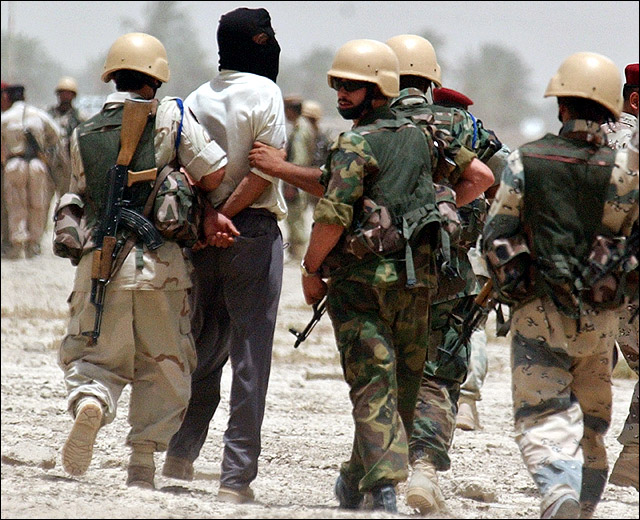
Soldiers from the Iraqi Army's 10th division arrest a suspect during a raid in the Nihran Omar area, some 40 miles north of Basra. At least 24 people died Tuesday during violence in Iraq.
“Guns will not solve the problem. Guns never solved any problems; it’s always politics that solves problems,” he said. “How can they (the government) solve the problem without talking to the resistance? The resistance exists and everyone knows it exists.”
Al-Samarie said he told the insurgent leaders they had to “come out to the political arena.”
“We told them that ‘no one knows what you want,”‘ he said, speaking in his home in an upscale Baghdad neighborhood. “‘You say you want the occupier to leave Iraq, but what do you want after that? You must have a political agenda.”‘
The insurgent leaders agreed “that the time has come for them to come out,” al-Samarie said.
The rebel groups
The Islamic Army in Iraq is a significant insurgent group that has claimed responsibility for attacks on U.S. and Iraqi forces as recently as in the last two weeks.
The group, most active in Baghdad and the region directly to the south, generally avoids bombings. Besides attacks against U.S. forces, it has claimed responsibility for assassinations of Iraqi government officials and the killings of an Italian journalist and Pakistani contractors. It released two French journalists in December 2004 after holding them for 124 days.
It claims thousands in its ranks and says its members are predominantly Iraqi. According to insurgent statements, the group has at times collaborated with the al-Qaida in Iraq network of Abu Musab al-Zarqawi and the Ansar al-Sunnah Army.
Less is known about the Mujahedeen Army, but it has claimed responsibility for scores of attacks, including the April downing of a helicopter carrying 11 civilians, among them six Americans, and the kidnapping of Indonesian journalists who were released unharmed in February.
The effort to begin talks comes at a delicate time for the government, criticized by Sunni Arab groups for deliberately targeting the minority in counterinsurgency campaigns such as the ongoing Operation Lighting in Baghdad.
Deaths in Iraq
As of Tuesday, at least 1,673 members of the U.S. military have died since the beginning of the Iraq war in March 2003, according to an Associated Press count. At least 1,284 died as a result of hostile action, according to the Defense Department. The figures include four military civilians.
The AP count is four lower than the Defense Department’s tally, last updated at 9 a.m. CDT Monday.
Since May 1, 2003, when President Bush declared that major combat operations in Iraq had ended, 1,532 U.S. military members have died, according to AP’s count. That includes at least 1,175 deaths resulting from hostile action, according to the military’s numbers.
The influential Sunni Association of Muslim Scholars said the operation, which has led to nearly 900 arrests, could spark sectarian strife. Now in its second week, the campaign involves thousands of Iraqi security forces and 7,000 U.S. troops, according to the U.S. military.
“We tried to reduce tension, but the government took another path. What is being done by the army during the raids and the arrests is only enhancing the culture of hatred,” said association spokesman Abdul-Salam al-Qubeisi.
Deadly day
In Hawija, the first explosion, caused by a roadside bomb, killed no one. But the next three killed 18, with the deadliest coming at a checkpoint in Dibis, on Hawija’s outskirts – which killed 10. At least 39 people were wounded.
“I was standing some distance from the checkpoint when I heard a big explosion and I was thrown onto the ground,” Lt. Sadiq Mohammed, 26, whose right leg was wounded, said from his hospital bed. “This is a terrorist act because real resistance should only target American troops, not Iraqis trying to protect their country.”
Near the Syrian border, an American-backed military operation zeroed in on insurgents in Tal Afar, sending tanks and Bradley fighting vehicles to patrol the narrow streets under the cover of helicopters, witnesses said. About 20 suspected insurgents were captured, Tal Afar police Capt. Amjad Hashim said.
Two U.S. Marines also died Monday after separate roadside bombings near Fallujah, the military said Tuesday. A U.S. soldier died of non-combat related injuries near Baghdad International Airport.
As of Tuesday, at least 1,673 U.S. military members have died since the Iraq war began in March 2003, according to an Associated Press count.
In Habaniya, 50 miles west of Baghdad, insurgents attacked a supply convoy carrying supplies to an American base, and local reporters said they saw at least seven bodies, all of which appeared to be Iraqi men in their 20s and 30s. The U.S. military and American diplomats said they were not aware of any Americans in the convoy.
National
Lawyers for man accused of killing Charlie Kirk try to block death penalty
Trump’s name poised to come off Kennedy Center
Suspect in Texas shooting had fired at police days earlier, officials say
Man pleads guilty to killing a top Minnesota Democrat and her husband
New tornadoes outside Chicago as severe storms pummel the Midwest