

Oscar winner Anne Bancroft dies at age 73
New York ? Anne Bancroft, who won the 1962 best actress Oscar as the teacher of a young Helen Keller in “The Miracle Worker” but achieved greater fame as the seductive Mrs. Robinson in “The Graduate,” has died. She was 73.
She died of uterine cancer on Monday at Mount Sinai Hospital, John Barlow, a spokesman for her husband, Mel Brooks, said Tuesday.
Bancroft was awarded the Tony for creating the role on Broadway of poor-sighted Annie Sullivan, the teacher of the deaf and blind Keller. She repeated her portrayal in the film version.
Yet despite her Academy Award and four other nominations, “The Graduate” overshadowed her other achievements.
Dustin Hoffman delivered the famous line when he realized his girlfriend’s mother was coming on to him at her house: “Mrs. Robinson, you’re trying to seduce me. Aren’t you?”
Bancroft complained to a 2003 interviewer: “I am quite surprised that with all my work, and some of it is very, very good, that nobody talks about ‘The Miracle Worker.’ We’re talking about Mrs. Robinson. I understand the world. … I’m just a little dismayed that people aren’t beyond it yet.”
Mike Nichols, who directed “The Graduate,” called Bancroft a masterful performer.
“Her combination of brains, humor, frankness and sense were unlike any other artist,” Nichols said in a statement. “Her beauty was constantly shifting with her roles, and because she was a consummate actress she changed radically for every part.”
Bancroft’s beginnings in Hollywood were unimpressive. Born Sept. 17, 1931, in the Bronx to Italian immigrant parents, she was signed by Twentieth Century-Fox in 1952 and given the glamour treatment. She had been acting in television as Anne Marno (her real name: Anna Maria Louise Italiano), but it sounded too ethnic for movies. The studio gave her a choice of names; she picked Bancroft “because it sounded dignified.”
After a series of B pictures, she escaped to Broadway in 1958 and won her first Tony opposite Henry Fonda in “Two for the Seesaw.” The stage and movie versions of “The Miracle Worker” followed. Her other Academy nominations: “The Pumpkin Eater” (1964); “The Graduate” (1967); “The Turning Point” (1977); “Agnes of God” (1985).
After an unhappy three-year marriage to builder Martin May, Bancroft married comedian-director-producer Brooks in 1964. They met when she was rehearsing a musical number, “Married I Can Always Get,” for the Perry Como television show, and a voice from offstage called: “I’m Mel Brooks.”
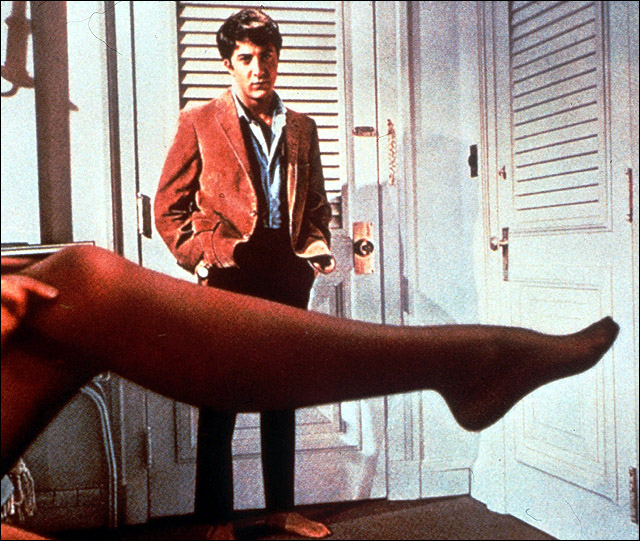
Dustin Hoffman looks at the stockinged leg of of body double Linda Gray representing actress Anne Bancroft, his seductress in this scene from the 1967 film The
In a 1984 interview she said she told her psychiatrist the next day: “Let’s speed this process up – I’ve met the right man. See, I’d never had so much pleasure being with another human being. I wanted him to enjoy me too. It was that simple.” A son, Maximilian, was born in 1972.
Bancroft appeared in three of Brooks’ comedies: “Silent Movie,” a remake of “To Be or Not to Be” and “Dracula: Dead and Loving It.”
She also was the one who suggested that he make a stage musical of his movie “The Producers.” She explained that when he was afraid of writing a full-blown musical, including the music, “I sent him to an analyst.”
When Bancroft watched Nathan Lane and Matthew Broderick rehearse “The Producers,” she realized how much she had missed the theater. In 2002 she returned to Broadway for the first time since 1981, appearing in Edward Albee’s “Occupant.”
Despite all her memorable performances, Bancroft was remembered most for Mrs. Robinson. In 2003 she admitted that nearly everyone discouraged her from undertaking the role “because it was all about sex with a younger man.” She viewed the character as having unfulfilled dreams and having been relegated to a conventional life with a conventional husband.
She added: “Film critics said I gave a voice to the fear we all have: that we’ll reach a certain point in our lives, look around and realize that all the things we said we’d do and become will never come to be – and that we’re ordinary.”
Arts and Entertainment
Photos: Lawrence begins World Cup festivities with downtown block party

Watkins Museum to open special exhibit detailing how Douglas County celebrated America’s Bicentennial

Go, See, Do: Kaw River Roots Festival, markets and more

Soccer gear honoring Lawrence history’s all-star team is now on sale as part of city’s public art exhibition

Nominations, call for artists open for Lawrence’s 2026 Phoenix Awards