Withdrawal of U.S. troops from Iraq could begin in spring
Baghdad, Iraq ? Iraq’s prime minister said Wednesday he wants U.S. troops “on their way out” as soon as his government can protect its new democracy. The top American general in the country said he hoped to begin significant withdrawal by next spring.
At the same time, in an unannounced visit, Defense Secretary Donald Rumsfeld said Iraqi security forces should take on more tasks now performed by U.S. troops.
American military commanders have repeatedly expressed hopes in recent months that they could begin major troop reductions next year, depending on the intensity of the insurgency. Even so, Wednesday’s remarks seemed to signal a new willingness to discuss specific ways American troops might exit an increasingly unpopular war in which nearly 2,000 have died.
There was a subdued reaction in Congress. John Warner, R-Va., chairman of the Senate Armed Services Committee, said, “I remain concerned about establishing timetables and raising expectations. However, I have not seen the data that the general had before him.”
Sen. John McCain, of Arizona, the second-ranking Republican on the committee, said he agreed with Casey and al-Jaafari that withdrawal will be possible only when conditions permit.
“I’m sure that the security situation at the time will dictate what they need to do,” McCain said.
Iraqi Prime Minister Ibrahim al-Jaafari, speaking at a joint news conference with Rumsfeld, said, “The great desire of the Iraqi people is to see the coalition forces on their way out.”
However, comments by Gen. George Casey, the most senior commander of coalition forces in Iraq, drew the most notice. He told reporters that a “fairly substantial” withdrawal of U.S. troops could go ahead in the spring and summer of 2006 if the Iraqi political process is not derailed and the insurgency does not grow.
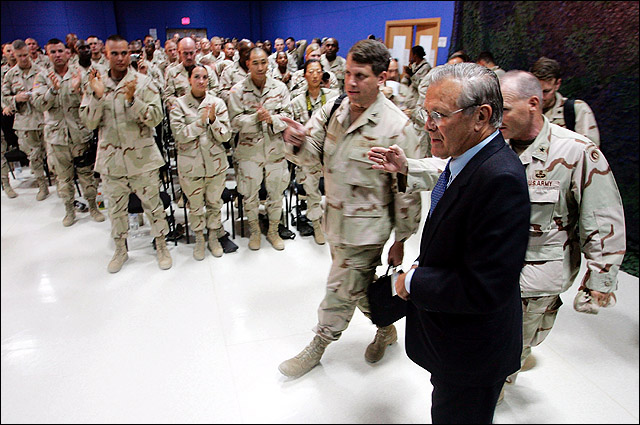
U.S. Secretary of Defense Donald Rumsfeld gets a standing ovation after he spoke to U.S. Army soldiers during a town meeting at the Balad airbase in Central Iraq. Rumsfeld, who arrived unannounced in Baghdad on Wednesday, talked with the Iraqi prime minister about withdrawing many U.S. troops within the next year.
Pentagon officials have provided little detail in discussing the possible withdrawal of forces from Iraq. The most specific estimate has come from Lt. Gen. John Vines, who runs day-to-day military operations in Iraq. He said in June that a reduction of “four or five brigades” – perhaps 20,000 troops out of the current 135,000 – was possible sometime next year.
More than 1,780 American troops have died since the U.S. invasion in March 2003. The Bush administration has refused to set deadlines for withdrawal, saying U.S. soldiers will remain as long as needed until Iraqi troops and police can defend the country on their own.
“The president wants to see our troops come home, but we’ve got an important mission that we need to complete,” White House spokesman Scott McClellan said Wednesday.
McClellan said Bush depended on his commanders to say how many troops they need, “And they make decisions based on the conditions and the progress that’s being made on the ground.”
Car bombings, roadside bomb attacks and other violence against U.S. forces and Iraqi civilians have increased in recent months, and al-Jaafari and his cabinet face constant threats. Rumsfeld’s visit to Iraq was not announced ahead of time for fear of attack.
Still, the United States points to successful elections in Iraq in January and formation of a democratic government as evidence both that the Iraqis are on the path to independence and that the U.S.-led toppling of Saddam Hussein was worthwhile.
Rumsfeld did not comment on al-Jaafari’s remarks, but later told reporters that the country’s political leaders needed to do more to relieve the burden on American forces. He said Iraqis needed to start taking responsibility for guarding the estimated 15,000 U.S.-held prisoners, and should meet the Aug. 15 deadline for completing a draft constitution.
More than half of Americans, 55 percent, who were polled in early July for The Associated Press by Ipsos, said they disapprove of the U.S. government’s handling of Iraq. Thirty-seven percent said in AP-Ipsos polling in June that they thought the United States should bring its troops home immediately.
The presence of U.S. troops is increasingly unpopular in Iraq as well. Forty-six percent of Iraqis polled in a survey conducted in March and April said the U.S.-led war had done more harm than good. At the same time, 61 percent said Saddam’s ouster was worth the price.
National
Lawyers for man accused of killing Charlie Kirk try to block death penalty
Trump’s name poised to come off Kennedy Center

Suspect in Texas shooting had fired at police days earlier, officials say
Man pleads guilty to killing a top Minnesota Democrat and her husband
New tornadoes outside Chicago as severe storms pummel the Midwest