Engineers cross fingers as countdown No. 2 begins
Cape Canavarel, Fla. ? NASA has fixed Discovery’s spotty grounding, scoured the spacecraft for electromagnetic interference, pored through innumerable pages of documents and done everything else it can think of to get the first shuttle flight in 2 1/2 years going.
With the countdown clocks ticking again Saturday and liftoff set for Tuesday, there’s nothing more to do, one manager says, but to keep fingers crossed.
Confidence isn’t nearly as high this time around because of the fact that despite all the exhaustive work, NASA still does not know exactly what caused a fuel gauge to malfunction and halt the first countdown 1 1/2 weeks ago.
Engineers have been unable to duplicate the problem or find any obvious sources of electromagnetic interference that could have exacerbated the faulty electrical grounding inside Discovery’s aft fuselage, right now considered the most likely cause of the fuel gauge failure.
“No doubt, there is some degree of finger crossing,” NASA test director Pete Nickolenko said Saturday morning, right before the start of countdown No. 2.
“But the other side of the coin is that we have really performed a very thorough troubleshooting analysis to a great degree, an excruciating degree of detail with all the shuttle program experts and the contractors that we can get.”
Nickolenko said he and others are confident the system will work the way it’s supposed to come Tuesday. But he hastily added, “We were confident that we were going to be in that case for the first launch attempt, too.” The problem first surfaced during a fueling test in April.
Discovery’s first countdown – the first since Columbia’s doomed flight in 2003 – ended just two hours before the scheduled liftoff July 13 after one of four hydrogen gauges in Discovery’s big external tank failed a routine test.
In the past few days, NASA has repaired three areas of ever so slightly flawed electrical grounding, sanding the connectors like someone might do with flashlight batteries that haven’t been used in a while.
Technicians also switched the wiring between the troublesome fuel gauge and another one, in an attempt to better understand the sensor problem if it recurs.
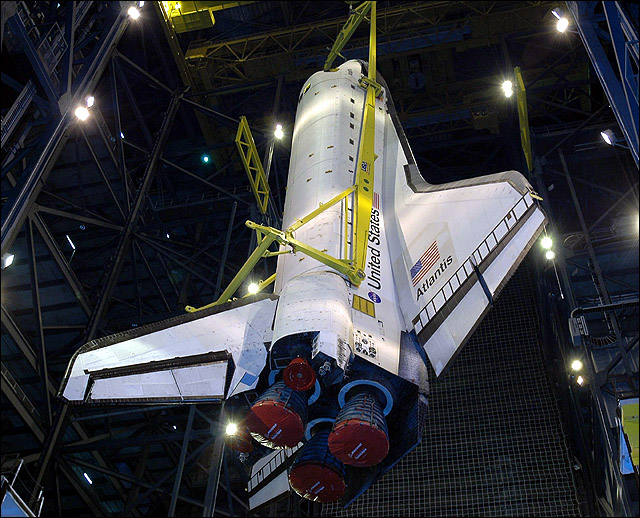
In this picture made available by NASA, Space Shuttle Atlantis is lifted in the Vehicle Assembly Building at the Kennedy Space Center Saturday in Cape Canaveral, Fla., where it will be hoisted over the cross-beam and mated with the solid rocket boosters and external tank. NASA is aiming for a Tuesday morning liftoff of Discovery on the first shuttle mission since Columbia's disastrous re-entry in 2003.
The 14 engineering teams that have been working nonstop on this problem have eliminated more than 300 possible causes, Nickolenko said. What remains in the so-called fault tree are faulty electrical grounding in the shuttle’s aft fuselage, which has been fixed, and possible electromagnetic interference, which may still be out there. The true test will come when the shuttle is fueled and all its systems are running right before liftoff.
Mission managers are considering launching Discovery and its crew of seven even if one of the fuel gauges malfunctions, as long as the problem is reminiscent of what happened two weeks earlier and is thought to be well understood.
NASA’s own launch rules require that all four fuel gauges be working, even though only two are needed to ensure that the main engines don’t shut down too soon or too late, both potentially deadly situations. Any rule change at the last minute, to allow less than four good gauges, would almost certainly raise eyebrows.
Technical issues aside, the weather could end up interfering.
Forecasters are putting the odds of acceptable launch conditions at 60 percent because of the threat of rain and clouds.
NASA has until the beginning of August to launch Discovery to the international space station, or it must wait until September to ensure good lighting throughout the ascent. The space agency is insisting on a daylight liftoff for good camera views in case the shuttle is hit by fuel-tank foam insulation, ice or other debris.
Columbia was brought down by a 1 1/2-pound chunk of foam that pierced the left wing. The gaping hole led to the shuttle’s destruction during re-entry on Feb. 1, 2003, and the deaths of all seven astronauts.
National
Unhealthy air quality in California city as huge warehouse fire burns for 3rd day
Judge orders Trump administration to restore National Park changes at sites that ‘disparaged’ US
Teens’ reading and math scores have stagnated, US test results show
WASHINGTON (AP) — Younger students have regained ground academically after the pandemic's disruptions while older ...

Lawyers for man accused of killing Charlie Kirk try to block death penalty

Trump’s name poised to come off Kennedy Center