Faulty fuel gauge scuttles shuttle mission
Cape Canavarel, Fla. ? NASA scrapped Wednesday’s launch of the first shuttle flight in 2 1/2 years because of a fuel gauge that mistakenly read full instead of empty, a frustrating setback to the agency’s bid to get back into space after the Columbia tragedy.
“All I can say is shucks,” deputy shuttle program manager Wayne Hale said at a news conference of grim-faced NASA managers.
The launch was delayed until at least Saturday, and the postponement could last much longer, depending on the repairs needed.
The disappointment came just a day after an embarrassing turn for NASA: A plastic cockpit window cover fell off the shuttle and damaged its fragile thermal tiles before the spacecraft had even taken off.
The seven astronauts had barely climbed aboard Discovery for their journey to the international space station when NASA halted the countdown with less than 2 1/2 hours to go. Up until then, the only threat to the mission was thunderstorms, which rained on the astronauts as they made their way to the launch pad.
From Cape Canaveral, where congressmen and astronaut families had come to witness the awe-inspiring sight of a rocket launch, to museums across the country where schoolchildren had gathered, the delay of the long-awaited return to space was disheartening.
“I wanted to see it really, really, really bad,” groaned 8-year-old Michael Schamtin of Sherwood, Ore., who had waited for liftoff at the Oregon Museum of Science and Industry.
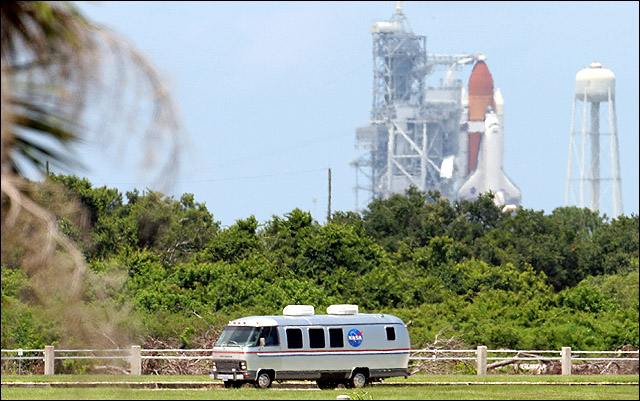
The crew of STS114 is driven away from Launch Pad 39B, where the space shuttle Discovery sits in background. Discovery's launch was scrubbed Wednesday at Cape Canaveral, Fla.
Similar fuel-gauge problems cropped up intermittently during a test of Discovery back in April. The external fuel tank, cables and other electronics were replaced, and even though NASA could not explain the failure, officials thought the problem was resolved and pressed ahead with launch.
Shuttle managers said it was unclear whether Discovery could be fixed at the pad or would need to be returned to the hangar for more extensive repairs. They expected to have a better idea today.
NASA has until the end of July to launch Discovery; otherwise it must wait until September. The launch windows are dictated by both the position of the space station and NASA’s desire to hold a daylight liftoff in order to photograph the spacecraft during its climb to orbit.
When the shuttle finally takes off, the astronauts will test new techniques for inspecting and repairing cracks and holes similar to the damage that doomed Columbia in 2003.
National
Unhealthy air quality in California city as huge warehouse fire burns for 3rd day

Judge orders Trump administration to restore National Park changes at sites that ‘disparaged’ US
Teens’ reading and math scores have stagnated, US test results show
WASHINGTON (AP) — Younger students have regained ground academically after the pandemic's disruptions while older ...

Lawyers for man accused of killing Charlie Kirk try to block death penalty

Trump’s name poised to come off Kennedy Center