

U.K. pop’s gone flat in America
The biggest pop band of all time took America by storm. Amid a whirlwind of speculation and media hype, it played show after show from the Hollywood Bowl to Madison Square Gardens. The musicians became superstars, then solo stars, then legends.
They were the Beatles, and they were British.
The Beatles’ split in April 1970 was seen by many as the end of pop and the beginning of a new era: a generation of punk. By the ’80s, however, pop music was exactly that again: popular. British bands like Simply Red and Genesis were topping charts on both sides of the Atlantic, while U.K. artists like Billy Idol and Steve Winwood were being nominated and winning Grammy awards.
But these artists had all but disappeared by the early ’90s, leaving the U.S. charts filled with boy bands and teen queens while Britain’s pop stars seemed confined to European success.
Robbie Williams, arguably the U.K.’s biggest pop star, is a prime example of the recent inability of British stars to break into the U.S. pop market. Williams’ first two albums, “Life Thru A Lens” and “I’ve Been Expecting You,” amassed a total of $4.8 million in record sales in his home country.
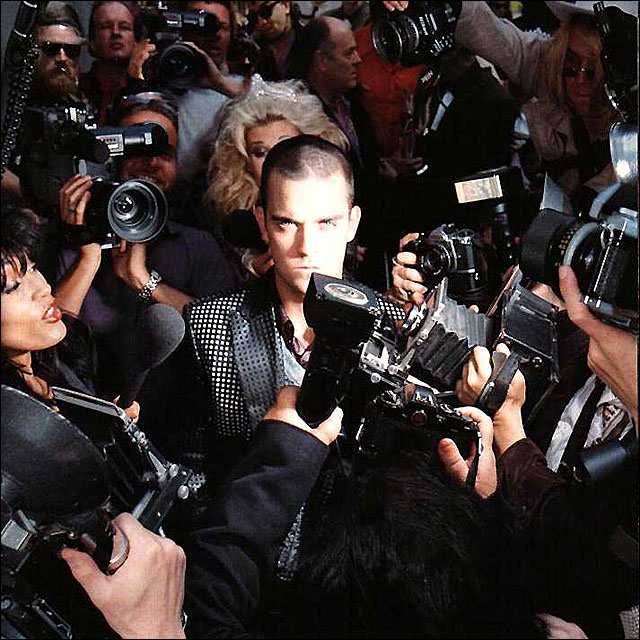
Robbie Williams, arguably Britain's biggest pop star, is a prime example of the recent inability of pop artists from across the pond to break into the U.S. market.
When his American label, Capitol, decided to create a compilation of the best tracks from each of the two albums, Williams was no doubt preparing for superstardom. The compilation, titled “The Ego Has Landed,” was released in 2000 and managed to sell a mere 564,000 copies.
The ego returned home with its tail between its legs.
Kristin Soper, an employee at Liberty Hall, believes British artists face problems because they are marketed differently.
“I think maybe the songs aren’t overplayed on the radio like most music is,” she said. “The stuff I listened to, I really enjoyed. But all I’ve heard is the singles.”
Williams hardly seems shattered by his dud entree in the American pop scene. In 2002, his British record label, EMI, signed him to a contract worth a reported $146 million – the most lucrative deal for any British artist. Since then he has released his fifth studio album, “Escapology,” and a live performance album. The latter, titled “Live at Knebworth,” became the U.K.’s fastest-selling album ever, unloading 117,863 copies in its first week alone, and “Escapology” sold more than 5 million outside the United States.
Williams’ U.S. label decided not to release the live LP, and 40,000 copies of the studio album sold in their first two weeks on American shelves.
Other nations don’t seem to be giving British pop stars the same cold shoulder.
In Australia, Williams’ greatest hits release was the only album in the 2004 top five chart that wasn’t by a native artist. The same album topped the charts in no less than 19 countries around the world.
Again, it was never released in the United States.
And Williams isn’t the only British pop star largely ignored by the U.S. music industry. While Simon Cowell helps “American Idol” winners like 2002’s Kelly Clarkson achieve success in Britain, the U.K.’s own 2002 “Pop Idol” competition winner, Will Young, remains an unknown on these shores, despite covering hits by The Doors and Crosby, Stills & Nash.
If only he had covered The Beatles.
Arts and Entertainment

Photos: Lawrence begins World Cup festivities with downtown block party

Watkins Museum to open special exhibit detailing how Douglas County celebrated America’s Bicentennial

Go, See, Do: Kaw River Roots Festival, markets and more
Soccer gear honoring Lawrence history’s all-star team is now on sale as part of city’s public art exhibition

Nominations, call for artists open for Lawrence’s 2026 Phoenix Awards