O’Connor came a long way from the family ranch
Retiring justice developed her work ethic in rural Arizona
Washington ? On a hot dusty morning at her family’s sprawling Arizona ranch, a teenage Sandra Day packed lunch at the house to deliver to her father and his crew who were rounding up cattle in a remote field hours away. On the way, literally in the middle of nowhere, the left rear tire on her Chevy pickup went flat.
“If the tire was to be changed,” she has recalled of that summer day in 1945, “I had to do it.” Struggling with all her strength, soaked with sweat and red-faced, she loosened the rusty lug nuts, jumping on the wrench, and changed the old tire, then somewhat triumphantly headed off again over the rocky canyon.
“You’re late,” her father greeted her, rejecting her explanation of the flat tire as the exhausted and dirty cowboys gathered for lunch. “You should have started earlier.”
“I realized only one thing was expected: an on-time lunch,” O’Connor recalled in her 2002 memoir. “No excuses accepted.”
Growing up in Arizona on the Lazy B Ranch – so remote that the nearest town was 35 miles away – O’Connor, independent, hardworking, self-reliant, long had been branding cattle and driving tractors and firing rifles, as she was, quite matter-of-factly, expected to do.
Those were her jobs. No excuses.
The traits she developed on that ranch would stay with her throughout her professional life, as she blazed trails as a student, lawyer, legislator and, ultimately, as the first woman to serve on the Supreme Court. She saw no obstacles, and, when presented with many throughout her life, she simply drove around them.
The 75-year-old O’Connor announced her retirement Friday after 24 years on the court. She was a pioneer on many levels, but one of her greatest achievements, as federal Judge Kimba Wood once put it, was to make the momentous seem commonplace.
She graduated from Stanford Law School near the top of her class in 1952, when the women law students made up about 1 percent – as opposed to today’s 50 percent – of the classes. A woman today would be aggressively recruited by some of the most prestigious and highest paying law firms in the country, but O’Connor got only one offer – as a legal secretary. She moved to Arizona with husband John, and eventually started her own firm.
Before it became commonplace, O’Connor balanced work with three children. Eventually, she sought public life, winning a seat in the state Senate and becoming the first female majority leader anywhere in the United States.
But when President Ronald Reagan called in 1981 to nominate her as the first female ever to serve on the Supreme Court, O’Connor was hardly eager.
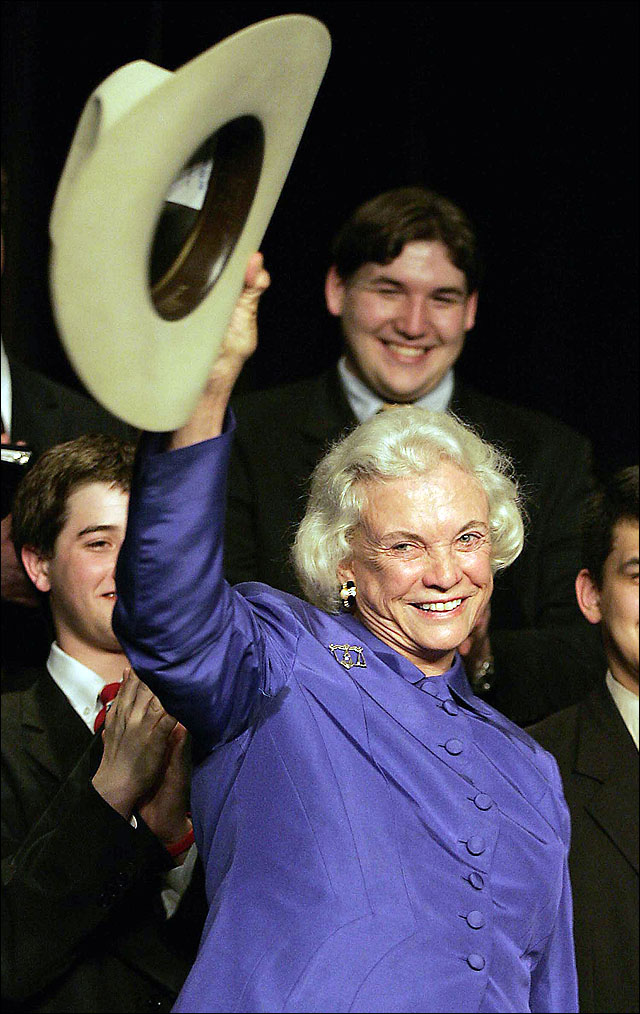
Supreme Court Justice Sandra Day O'Connor, the first woman on the Supreme Court and a swing vote on abortion as well as other contentious issues, announced her retirement Friday.
“I’ve always said it’s fine to be the first, but you don’t want to be the last,” she told the Chicago Tribune in a 2003 interview. “I was acutely aware of the negative consequences if I arrived here and did a poor job.”
And she did not disappoint. In her tenure on the court, O’Connor shaped the law in critical areas of race, religion, abortion and states’ rights. She came to define the court’s center, and her views often determined the direction the court would take, often a moderate course in the face of extreme positions. Her departure is momentous, not because of her gender, but because of her influence.
Justice Ruth Bader Ginsburg, who joined the court in 1993 as the second female justice, said in a statement that women worldwide “have been inspired by her example, encouraged by her words and deeds to be brave, to appreciate their own worth, to aspire, and to achieve.”
Ginsburg, a liberal Clinton appointee, has said O’Connor “provided grand aid to me” and “was like a big sister” during her first year on the bench. She recalled in a 1997 speech seeking O’Connor’s advice about her first opinion assignment, which was not the simple, unanimous case she had expected. Ginsburg said she was taken aback by the assignment, on an intricate issue involving federal employee benefits law on which the justices were sharply divided.
“Just do it,” O’Connor told Ginsburg, “and if you can, get your draft in circulation before the next set of assignments is made.”
“That is her approach to things,” Ginsburg recalled in the speech. “Waste no time on regret or resentment, just get the job done.”
National
Teens’ reading and math scores have stagnated, US test results show
WASHINGTON (AP) — Younger students have regained ground academically after the pandemic's disruptions while older ...

Lawyers for man accused of killing Charlie Kirk try to block death penalty

Trump’s name poised to come off Kennedy Center

Suspect in Texas shooting had fired at police days earlier, officials say
Man pleads guilty to killing a top Minnesota Democrat and her husband