

Imitators irk mariachi musicians
Mexico City ? At every hour of every day in Garibaldi Plaza, there is a song waiting to be sung for the right price.
Clusters of mariachis — elaborately dressed, traditional Mexican musicians — gather near bronze statues of past mariachi stars, hoping to be hired for a birthday party or romantic serenade. The tradition dates back nearly a century, but today there are sour notes amid the soaring sounds of brass and strings in this world-famous plaza.
“It’s an invasion! Too many people claiming to be mariachis!” complained Alfredo Ledesma Hernandez, a violinist who has worked in Garibaldi for 20 years. He said rising unemployment has led bricklayers, farmers and others with no musical training or talent to don mariachi costumes and pass themselves off as the real thing.
“These fake mariachis hurt our reputation,” said Ledesma, who was wearing his genuine mariachi outfit — tight bolero suit with silver trim, wide-brimmed hat and shiny boots. “They have holes in their suits. Their shoes are not clean. They don’t know the words to the songs.”
Mariachis have gathered since the 1920s in Garibaldi, one of the city’s most colorful and lively spots, where police look the other way when tequila is tippled in public. Visitors come from all over Mexico, and increasingly from abroad, to eat and drink in the plaza’s many cantinas while listening to sentimental classics that most Mexicans know by heart.
Others come to hire mariachis to mark the happy or sad milestones in their lives, from baptisms to funerals, while lovers young and old drive up and offer mariachis a handful of peso notes to sing to their sweethearts.
But purists worry that the cherished traditions of Garibaldi mariachis mean nothing to the impostors, who are merely trying to cash in on the growing popularity of a musical genre that is increasingly taught and played in the United States and other parts of the world.
Pedro Espinoza Hernandez, general secretary of the 2,000-strong mariachi union, said as many as 4,000 musicians, some of whom were little more than construction workers in fancy dress, now worked in the city block-sized plaza, which sits amid the crumbling slums and architectural gems of Mexico City’s historic center. On a busy weekend night, hundreds of musicians, including tone-deaf imitators, stroll the square, he said.
“There have never been so many,” he said. “It’s too much.”
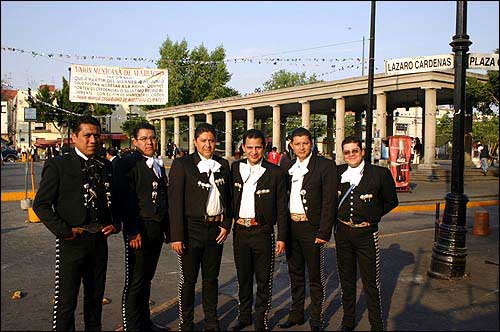
Alfredo Ledesma Hernandez, a violinst, second from right, and his band are among the growing number of musicians who compete for work at Garibaldi Plaza in Mexico City. There are too
According to the union, a true mariachi band must feature at least six musicians and a minimum of two violins, a trumpet, a guitar, a guitarron (a large bass-like instrument) and a vihuela, which resembles a guitar. The more elaborate bands have 15 or more members. Musicians from as far away as Japan have come here to copy the unique design of the tight jackets and trousers with silver spangles sewn down the outer leg seams.
Espinoza said the impostors attract business by charging about half the going rate, as little as $100 an hour for an eight-piece group to play at a party, or $6 for a tune on the spot. “They charge too little and play horribly,” he said, adding that the off-key pretenders are stealing work from professionals and damaging their reputation.
Arts and Entertainment
Photos: Lawrence begins World Cup festivities with downtown block party

Watkins Museum to open special exhibit detailing how Douglas County celebrated America’s Bicentennial

Go, See, Do: Kaw River Roots Festival, markets and more

Soccer gear honoring Lawrence history’s all-star team is now on sale as part of city’s public art exhibition

Nominations, call for artists open for Lawrence’s 2026 Phoenix Awards