Iraqi interest in election strong, officials say
Baghdad, Iraq ? The number of Iraqis making sure they are properly registered to vote has surged dramatically, officials said Saturday, calling the rise evidence of enthusiasm for the Jan. 30 elections despite continuing security concerns that have blocked the process in two provinces.
After a slow start to the six-week registration process that began Nov. 1, the number of voters making corrections to official voter lists more than doubled in the final week, according to a final tally quoted by election officials Saturday.
Officials said that more than 2.1 million people came to local election offices to assure that eligible members of their households could vote. About 1.2 million forms were submitted to add names to the voter lists, an involved process that requires providing proof of identification and residence.
“That’s a definite marker of voter interest,” said an election expert with the Independent Election Commission of Iraq who was not authorized to speak publicly.
Because Iraqis do not have to take any steps to register to vote — food rationing accounts serve as voter rolls — requests for corrections are essentially the only gauge of voter involvement in the registration process for the Jan. 30 election.
The nationwide tally of corrections leaves out two predominantly Sunni Muslim provinces where insurgents have prevented the interim government and U.S. military forces from establishing control. In Nineveh province, which includes Mosul, and Anbar province, where Fallujah and Ramadi are located, voters will be allowed to establish their credentials on the day of balloting, officials said.
Both provinces remain relative strongholds for insurgents, who mount daily attacks on U.S. and Iraqi government forces. The level of voter preparation there will remain unknown until officials break down the nationwide tally by province, which could take several more days. But in a poll for the International Republican Institute, more than 40 percent of residents surveyed in Sunni areas said they did not intend to vote.
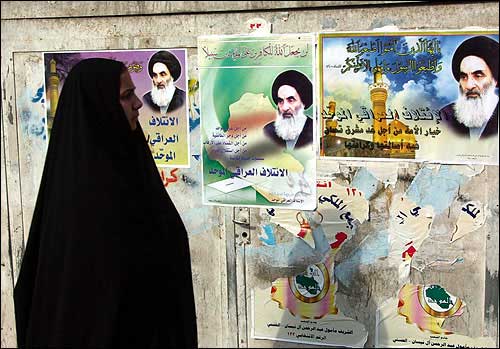
An Iraqi woman walks past posters in Baghdad advertising this month's elections in Iraq. The posters show Ayatollah Ali al-Sistani's fatwa, or religious ruling, calling Iraqi Shiites to vote.
In the poll, conducted in late October and early November, more than a quarter of Sunnis surveyed responded with the most adamant option: “Not intend at all.” Only 20 percent said they “strongly intend” to vote.
Among’s Iraq’s Shiite Muslim majority and ethnic Kurds, 90 percent and above strongly intended to vote, according to the survey. Most Kurds follow Islam’s Sunni branch but identify themselves by their ethnicity.
National
Lawyers for man accused of killing Charlie Kirk try to block death penalty
Trump’s name poised to come off Kennedy Center
Suspect in Texas shooting had fired at police days earlier, officials say
Man pleads guilty to killing a top Minnesota Democrat and her husband
New tornadoes outside Chicago as severe storms pummel the Midwest