Detectives testify about blood search in Murray case
Witness: Professor pointed finger at victim's father
Detectives on Friday described turning off the lights and using a glow-in-the dark chemical to search for traces of blood in the garage and car of a Kansas State University professor charged with murdering his ex-wife.
In professor Thomas E. Murray’s car, they saw a glowing reaction on areas including the steering wheel and the armrest on the driver’s-side door, one detective said. Another detective said he saw two small spots glowing on the floor of Murray’s Manhattan garage.
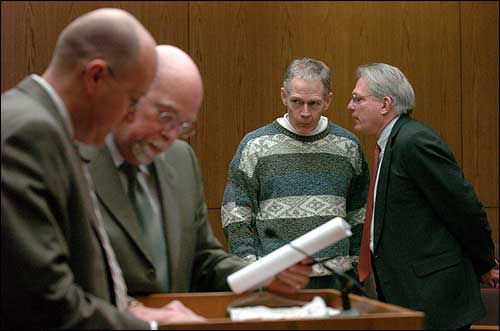
Prosecutor Tom Bath, from left, talks with defense attorney Pedro Irigonegaray, as defendant Thomas E. Murray and defense attorney Robert Eye have a discussion during a break in Murray's murder trial Friday afternoon in Douglas County District Court. Murray is standing trial in the slaying of his ex-wife, Carmin D. Ross.
But defense attorneys drove home the point that the chemical used in the tests, known as Luminol, also reacts with vegetation, cleaning products and other substances.
“You could also say that it was presumptive for horseradish, correct?” defense attorney Pedro Irigonegaray asked.
“I do not know if Luminol reacts with horseradish,” answered Lawrence Police Sgt. Dan Ward, who searched Murray’s garage.
Ward described Luminol only as an investigative tool that can help spot areas that should be swabbed and sent for further testing. No one testified Friday about the results of the lab tests of samples taken from the glowing areas, but Ward said one of the glowing spots in the garage also reacted to an on-the-scene swab test that reacts with blood.
Prosecutors showed jurors a photo taken by Ward of the glowing area in Murray’s garage. But Riley County Police Detective Alan Riniker said he used a digital camera instead of the recommended 35 mm camera to document the reactions in Murray’s car, and his photographs didn’t turn out.
Before the trial, defense attorneys had asked the judge not to allow prosecutors to present evidence collected by Manhattan police from Murray’s car, because the evidence had not been properly photographed.

 6News video: Detectives testify about use of Luminal (02-25-05)
 Photo Gallery: Murray Trial Day Six
 See complete trial coverage
Friday marked the end of the first full week of testimony in the first-degree murder trial of Murray, a 48-year-old English professor. He’s charged with stabbing and beating his ex-wife, Carmin D. Ross, in November 2003 at her home northwest of Lawrence shortly after she told him she planned to fight him for custody of the couple’s daughter and move to California.
Other witnesses Friday included Tamara Hawk of Manhattan, a member of Murray’s church. She testified that in the days after the death, Murray told her police should look at Ross’ father as a suspect.
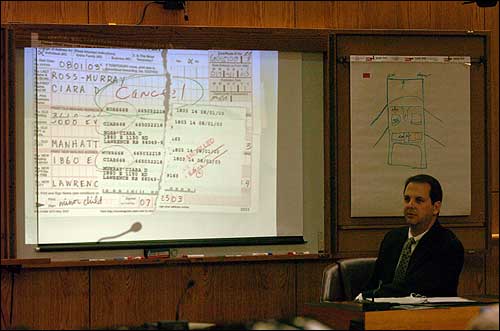
Lawrence Police Sgt. Dan Ward testified Friday in the trial of Thomas E. Murray, who is charged in the slaying of his ex-wife, Carmin D. Ross. Ward described some evidence found at Murray's home in Manhattan, including a canceled change of address form. He also described how detectives used a glow-in-the-dark substance to search for blood in Murray's car and garage.
Attorney Anne Miller, of Manhattan, testified that, two months before the death, she began giving Ross advice about how to prepare for getting primary custody of the couple’s daughter, Ciara. She said she told Ross to get Ciara involved in community activities in Lawrence to help establish it as her primary home.
Miller read from an e-mail, sent the day before Ross died, in which Ross wrote to her that a mediation session with Murray had gone poorly.
“He has absolutely no concept of his anger or blaming behavior,” the e-mail stated. It was clear, Ross wrote, that “there was no way we were going to come to any amicable agreement” unless she agreed to let Ciara keep living in Manhattan, as Murray wanted.
Testimony is expected to resume Monday.
City Government
Soccer gear honoring Lawrence history’s all-star team is now on sale as part of city’s public art exhibition
To honor public servants, Lawrence’s July 4 celebration will have a whole gallery of their photos on display; submissions open now
North Lawrence study consultants look at possibilities for a grocery store, food truck park, traffic calming and more
Algerian ambassador gives Lawrence a gift for supporting national team – a piece of art
Lawrence City Commission approves incentives for Alarm.com’s office project in downtown building