Police get tips on community relations
Neighborhood critics of the Lawrence Police Department on Wednesday welcomed a national consultant’s recommendations to reduce crime and nuisances across the city.
“I think it is an issue worth the city spending some money on, because there are some obvious problems,” said Kory Wilcoxson, a Brook Creek Neighborhood resident who says he believes police did not adequately investigate a burglary at his home.
“I think what the plan is talking about would be a welcome change in strategy,” said Laura Routh, who has been frustrated with how police have addressed a rash of burglaries in the Centennial Neighborhood.
The recommendations from John Campbell, a consultant with Oregon-based Campbell Delong Resources Inc., include goals of shortening police response times to nonemergency calls and reducing reports of chronic problems, such as frequent parties at the same house.
Campbell, who spoke to the Lawrence City Commission during a Wednesday study session, said the police force should work to solve problems rather than just responding to crimes.
“It is not just about showing up after something happens,” Campbell said. “We feel very strongly that moving to more problem-oriented policing can help a lot here. Our perception is there is a lot of running room for that here.”
The goals
Campbell said Lawrence police could set some achievable goals without spending too much extra money.
Under those objectives, police would commit to:
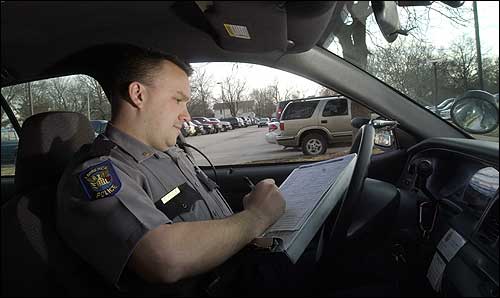
A consultant with Campbell DeLong Resources Inc. hired by the city said city leaders should work to create a police force that is more about solving problems rather than just responding to crimes. Lawrence police officer David Hogue works on some paperwork at the start of his shift Wednesday outside the Judicial & Law Enforcement Center.
- Reducing average response times to nonemergency calls to 90 minutes or sooner. Police Chief Ron Olin said he didn’t have a current average response time for nonemergency calls, but he said it was frequently longer than 90 minutes.
Campbell suggested that, without additional funding, the city could provide “limited additional resources” to reduce response times to an average of 45 minutes.
- Decreasing the number of residents reporting chronic problems, such as frequent parties, each of the next five years.
- Gathering more data on the times and places of the city’s most serious traffic accidents. Officers would also be assigned to saturation patrols aimed at finding drunken drivers.
- Staffing a “bar car” to make regular bar checks and reducing alcohol-related crimes.
- Hiring a crime prevention officer to work with neighborhood associations and other organizations to discuss the community’s role in crime prevention. This would require a budget increase for the police department.

 6News video: Study offers tips for police
 Police cracking down on noisy parties (01-20-05)
And Campbell offered one novel solution to dealing with chronic offenders.
“I’m a big proponent that if we have college students who are getting drunk on a regular basis and causing problems, why don’t we call their parents?” he said.
“People become aghast at the idea because they say the students are adults. But so what? If they have parents, call them. Why not use every human motivational factor we have to solve the problem?”
| City officials spent $57,890 for the police department resource study, which began in late 2003.John Campbell, president of Campbell DeLong Resources Inc., and Joseph Brann, chief executive of Joseph Brann & Associates, were the chief consultants on the study.Campbell has worked on studies for a variety of cities, including recently Columbia, Mo., in addition to national studies for the U.S. Department of Justice and the Washington, D.C.-based Community Policing Consortium. Brann is a retired police chief and served as the first director of the Justice Department’s Office of Community Oriented Policing Services. |
‘Right direction’
Officials said they would contemplate the recommendations — and the costs — during the spring when work begins on City Hall’s 2006 budget.
“This articulates a blueprint for the department to follow with no additional resources,” Olin said. “We’ll ask city commissioners and the city manager during budget time whether that is good enough or whether there are ways we can add to what we’re doing.”
But they added that police were already taking a “problem-solving” approach to community issues.
“Problem solving is part of what we do right now, but we probably need to see how we can enhance those measures,” said Debbie Van Saun, assistant city manager.
Campbell’s recommendations would probably lead to more police partnerships with social service agencies, landlords of troublesome properties and community anti-crime groups.
“I like the analogy of teaching people how to prevent crime just like we teach people how to prevent fires,” Hack said.
Routh said she still would like to see the department have an independent ombudsman to address complaints from residents, and the department should find other ways to measure success than by counting the number of tickets it writes.
“But I think the plan is heading in the right direction,” Routh said. “I felt better after I left there.”
And Wilcoxson said the department had been responsive to a recent rash of burglaries in his neighborhood.
“The police presence in this area over the last two months or so has really been unbelievable,” Wilcoxson said. “I think they’re starting to do a better job. Hopefully this study will help them continue that.”
City Government
A STAR Bond application raises questions for city leaders about Costco and housing west of the SLT

Soccer gear honoring Lawrence history’s all-star team is now on sale as part of city’s public art exhibition
To honor public servants, Lawrence’s July 4 celebration will have a whole gallery of their photos on display; submissions open now
North Lawrence study consultants look at possibilities for a grocery store, food truck park, traffic calming and more

Algerian ambassador gives Lawrence a gift for supporting national team – a piece of art