2005 drives comparable to 2000; shortcuts, improved flow play role
All congested? Everyone talks about Lawrence traffic getting worse, but evidence suggests driving times haven't changed much
Lawrence resident Meredith Beightel has a theory about how long it takes to drive from one point to another in the city.
“I think it increases daily,” said Beightel, who has lived here about 10 years.
A Journal-World stopwatch, though, doesn’t necessarily agree. An unscientific study of drive-times on major thoroughfares found that it doesn’t take much longer to navigate most streets than it did in 2000.
For example, a Journal-World reporter in 2000 found that a 5:30 p.m. weekday trip from the West Lawrence Turnpike terminal to the South Lawrence Trafficway overpass on Iowa Street took 10 minutes. This past week, the same trip at the same time took 10 minutes 12 seconds.
The much-maligned 23rd Street produced similar results. Last week, a weekday rush-hour drive from Iowa Street to the entrance of the former Farmland Industries plant took 8 minutes 28 seconds. In 2000, the time was essentially the same at 8 minutes 45 seconds.
Beightel is among those frustrated drivers who think the Journal-World ought to check its stopwatch.
“I really seem to notice it getting longer on any road that people take to get to Topeka or Kansas City,” Beightel said. “For me, 23rd Street is the worst, but Iowa is a close second. There’s some days on 23rd Street that it seems like it takes a half hour to get from Mass to Iowa Street.”
People’s opinions about Lawrence traffic seem to be as varied as the color of cars on 23rd Street. Scott Drummond has lived in town four years and said he really hadn’t noticed a change in drive times.
“This isn’t bad at all,” Drummond said of the city’s congestion.
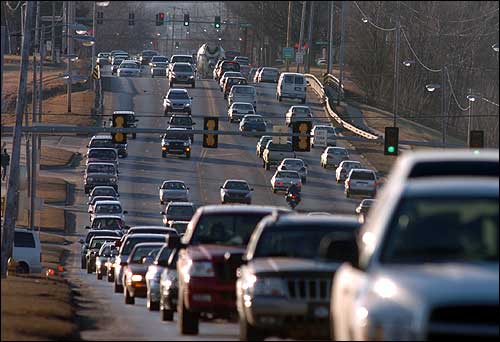
Evening Rush-hour traffic heads down 23rd Street near Haskell Indian Nations University. An unscientific study suggests that traffic congestion in Lawrence really hasn't grown in the last half decade, although some exasperated drivers beg to differ with that result.
But even Drummond admitted he steered clear of some busy byways, such as 23rd Street.
“I use 19th Street, but shhh, don’t tell anyone,” Drummond said. “That’s part of driving in Lawrence. If you know your way around, it is not bad at all.”
Avoiding the rush
Drummond’s secret likely is already out. Traffic counts by the Kansas Department of Transportation suggest more and more people are finding ways to avoid 23rd Street. For example, traffic counts in the summer of 2001 found 31,615 cars per day on 23rd Street near the Louisiana Street intersection. Despite the fact that Lawrence’s population has grown by about 2 percent per year, traffic counts in the summer of 2004 found 29,400 cars at the same location — a decline of 7 percent.
The numbers may mean KDOT officials picked a slow day to count, or it could be that there are a lot of people like Drummond who have found a shortcut to their destinations.


“You can talk to about anyone in Lawrence who has their own special route,” said Bill Ahrens, a transportation planner with the Lawrence-Douglas County Planning Department.
The problem is, many of those routes run through somebody’s neighborhood.
“You talk to the neighborhoods right now and they really think it is a problem,” Ahrens said.
Worries about the future
Some drivers aren’t worried so much about traffic congestion today, but are worried about the future. Kevin Kivela said he hadn’t noticed much change in drive times during the year he had lived in the city.
“It isn’t too bad right now, but there are a few problems, and I think they could get worse,” Kivela said.
Ahrens also subscribes to that school of thought. In particular, Ahrens spends some of his time worrying how to keep West Sixth Street from becoming the city’s next 23rd Street. West Sixth Street currently is being widened west of Wakarusa Drive. It won’t have the plethora of curb cuts that have plagued 23rd Street, but Ahrens said he was still concerned about future traffic volume.
“KDOT is really concerned about West Sixth Street,” Ahrens said. “They’re concerned there may be too much development for the road to handle.”
Because Sixth Street also is U.S. Highway 40, that may leave the city or state with the prospect of making major intersection improvements shortly after the road opens.
“We’ll probably need to do a study to look at that,” Ahrens said.
| Here are results from an unofficial Journal-World study of Lawrence drive times.Massachusetts Street/North Third Street:From 23rd Street to U.S. Highway 24-403 p.m. on a Tuesday2000: 12:102005: 10:12Iowa Street:From U.S. Interstate 70 to the South Lawrence Trafficway5:30 p.m. on a Thursday2000: 10:002005: 10:1223rd Street:From Iowa Street to O’Connell Road5:55 p.m. on a Thursday2000: 8:452005: 8:28Sixth Street:From Massachusetts Street to Wakarusa Drive3:20 p.m. on a Tuesday2000: 8:302005: 9:39Kasold Drive:From Sixth Street to Clinton Parkway3:30 p.m. on a Tuesday2000: 3:302005: 5:0431st Street:From Iowa Street to Haskell Avenue5:40 p.m. on a Tuesday2000: 3:002005: 2:59 |
According to the Journal-World’s “study,” Sixth Street did show one of the largest increases in driving times. A nonrush-hour, weekday drive from Massachusetts Street to Wakarusa Drive took 8 minutes 30 seconds in 2000. Last week it took 9 minutes 39 seconds.
By the minute
Other results from the Journal-World’s stopwatch:
- Massachusetts Street from 23rd Street through North Lawrence to U.S. Highway 24-40 took 10 minutes 12 seconds during a nonrush-hour weekday last week. In 2000, the same trip took 12 minutes 10 seconds.
- Iowa Street from 23rd Street to the South Lawrence Trafficway overpass about 1:30 p.m. on Saturday took 5 minutes 14 seconds. During rush hour on Thursday, the drive took 4 minutes and 8 seconds.
- Massachusetts from 11th Street to Sixth Street at 2:30 p.m. Saturday took 5 minutes and 48 seconds. About 3 p.m. on Tuesday it took 2 minutes and 15 seconds
- Kasold Drive from Sixth Street to Clinton Parkway at 3:30 p.m. Tuesday took 5 minutes 4 seconds last week. In 2000 it took 3 minutes 30 seconds.
- Driving 31st Street between Iowa and Haskell took 3 minutes to drive eastbound and 4 minutes to drive westbound about 5:30 p.m. Thursday. Those times were virtually unchanged from 2000. On Saturday last week about 1:45 p.m., drive times were 3 minutes and 50 seconds when heading eastbound and 3 minutes and 1 second when heading westbound.
Controlling flow
David Woosley, the city’s traffic engineer, said he wasn’t surprised by the Journal-World’s findings.
“I don’t think it takes significantly longer,” Woosley said. “Even if it takes you a minute or two more, you probably wouldn’t even notice that.”
Woosley said city officials tried to stay on top of the congestion issue. He said more computer technology on the city’s traffic signals had allowed officials to more easily adjust traffic lights to improve flows on major streets. But changing how long a traffic light stays green is good for some drivers and bad for others.
“It could mean that you’ll have to wait longer on a side street to turn onto a main street,” Woosley said.
Other strategies the city uses include adding more traffic signals. The city has plans to install a signal at Bob Billings Parkway and Wakarusa Drive by the end of this year. The city also is testing a policy that prohibits left hand turns on certain parts of 23rd Street from 4 p.m. to 6 p.m. on weekdays.
And, of course, there’s the much talked about roundabouts. Woosley said a recently installed roundabout at 19th Street and Barker Avenue had improved drive times on 19th Street.
“We used to have traffic backed up to Mass. Street during peak hours, and now it flows through there pretty well,” Woosley said.
Woosley said Lawrence always would have to be on guard against traffic congestion because the city is not only growing but also has some unique traffic issues.
“Congestion might be a little bit higher here than in other cities our size because we have KU in the middle of town, and we have the river,” Woosley said. “That means we don’t have many streets that go all the way across town. That is a bit unique.”
The city’s status as the home to many commuters also plays a role.
“What the commuter issue does is extend our peak time,” Woosley said. “People in Lawrence get off at five o’clock, and we have that rush hour. Then people who work in Kansas City start getting into town around six o’clock, and we have that rush hour. Basically, it doubles our peak time.”
City Government
Algerian ambassador gives Lawrence a gift for supporting national team – a piece of art
Lawrence City Commission approves incentives for Alarm.com’s office project in downtown building
Lawrence City Commission interested in a moratorium on data center development
Lawrence city leaders defer decision on selling downtown parking lot for senior housing project
Majed Al-Ghafry selected as Lawrence’s new city manager; he says he plans to ‘hit the ground running’