Transit ridership grows 22%
City buses fit travelers' needs to a T
Doni McCarten, and people like her, are a major reason that leaders with the Lawrence Transit System are smiling these days.
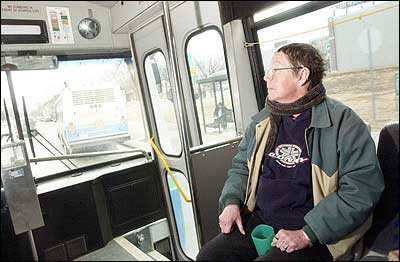
Doni MCcarten, who estimates that she rides the T five days a week, takes her seat on a bus Monday leaving for East Lawrence. Karin Rexroad, administrator for the Lawrence Transit System, said 2004 ridership numbers showed that more Lawrence residents were riding the T. The new figures show a record of 327,780 riders, up 22 percent from 2003.
McCarten estimates that she rides the bus five days per week. And here’s the kicker — she rides it because she wants to, not because she has to.
“I have a car,” McCarten said Monday while waiting for a bus downtown. “But I ride the bus because it is cheaper than gas.”
Karin Rexroad, administrator for the Lawrence Transit System, said 2004 ridership numbers showed that more Lawrence residents were adopting a similar attitude.
Ridership grew to a record 327,780 riders, up 22 percent from 2003 numbers. The growth rate also is well above the typical 5 percent growth rate for transit systems across the country.
“To just see in writing that things really are growing and that we’re keeping our costs reasonable is satisfying,” Rexroad said. “It just proves that more and more people are seeing the benefits of using the system.”
The system’s average daily ridership number grew to 1,061, up from 873 in 2003 and 507 in its first year of existence in 2001. Total fare revenue for the T increased to $105,732, up from $92,029 in 2003 and $54,967 in 2001.
Rexroad said a significant portion of the increase likely could be attributed to students. During the last year, the T started marketing to K-12 and Haskell Indian Nations University students by allowing them to ride for half the normal 50-cent fare. The system also started a program that allows Kansas University students to ride the bus for a flat $25 fee if they also subscribe to the KU on Wheels Bus System.

 6News video: Public transit administrator will resign
 Transit ridership grows 22%
But Rexroad said she thought the general population also was warming to the idea of public transportation.
“Perception is the biggest issue for us to overcome,” Rexroad said. “Until you get on a bus and try it, you don’t realize how much you can accomplish. I know one lady who is a teacher in town who has become a full-time rider because she can get all her papers graded before she gets home.”
Ken Meyer says he isn’t convinced enough people are seeing the benefits of the system. Meyer, a Lawrence resident who has been a frequent critic of the transit system, said the roughly $1.24 million in local tax dollars that the city spent on the system in 2004 was excessive.
The local tax dollars help cover the system’s operating expenses not covered by fares or approximately $1.2 million the city receives in federal funding. With total expenses of $1.8 million, the T required about $1.7 million in subsidies to break even.
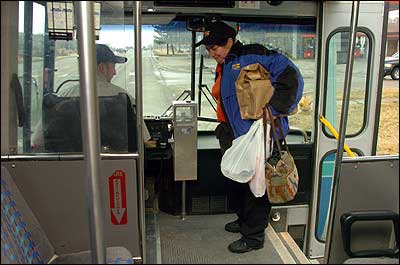
Shirley Phillips drops her money in to the fare machine on a city public transportations bus Monday as Phillips uses the bus daily to get back and forth from home to work a do many Lawrence residents.
“It seems like we’re spending an exorbitant amount of money to serve a small percentage of the population,” Meyer said. “My question has always been whether there is a better way. I don’t get the feeling that city commissioners have researched this enough to know that this is the best use of our tax dollars.”
In 2005, the city will levy 1.364 mills to provide property tax support to the system. A mill is $1 in tax for every $1,000 of assessed value. For the owner of a $150,000 home, that amounts to $23.52 per year.
City Commissioner Boog Highberger says that’s a good value for taxpayers, especially now that ridership on the T is growing “slowly but surely.”
“I would remind people that we subsidize every form of transportation,” Highberger said. “Plus, look at it this way: Every person who is on a bus is one person that isn’t taking up a parking space that you want to use.”
City Government
Soccer gear honoring Lawrence history’s all-star team is now on sale as part of city’s public art exhibition
To honor public servants, Lawrence’s July 4 celebration will have a whole gallery of their photos on display; submissions open now
North Lawrence study consultants look at possibilities for a grocery store, food truck park, traffic calming and more
Algerian ambassador gives Lawrence a gift for supporting national team – a piece of art
Lawrence City Commission approves incentives for Alarm.com’s office project in downtown building