Planes bomb alleged insurgent safehouses
Baghdad, Iraq ? U.S. warplanes bombed alleged safehouses being used by Abu Musab al-Zarqawi’s insurgent group near the Syrian border Tuesday during what one local leader called an unprecedented push by a Sunni Arab tribe to drive out al-Zarqawi’s foreign-led forces.
The bombings occurred in two towns along the Euphrates River that U.S. officials and Iraqis describe as haven and transit points for insurgents moving weapons, money and recruits into Iraq from Syria. Ali Rawi, an emergency-room director in the border city of Qaim, said at least 56 people – the majority of them apparently followers of al-Zarqawi – were killed in Tuesday’s air strikes and ground fighting. Al-Zarqawi’s group, al-Qaida in Iraq, said in a statement posted in local mosques that it had lost 17 men.
Neither U.S. nor Iraqi officials gave death tolls.
The clashes between Sunni Arab tribes and insurgents, coupled with growing vows by Iraq’s Sunni minority to turn out in force for national elections in the coming months, coincided with U.S. hopes for defusing the two-year-old insurgency. U.S. military leaders have repeatedly expressed optimism that public anger at insurgent violence would deprive insurgents of their base of support.
A tribal leader near the Syrian border, Sheik Muhammed Mahallawi, said his Albu Mahal tribe opened the latest fighting against al-Zarqawi’s insurgents after they kidnapped and killed 31 members of his tribe to punish them for joining the Iraqi security forces.
“We decided either we force them out of the city or we kill them,” with the support of U.S. bombing, Mahallawi said by telephone.
Sunni Arab tribes in the western province of Anbar have clashed sporadically with al-Zarqawi’s organization, al-Qaida in Iraq, at least since May, usually in revenge for killings of tribe members accused of collaborating with U.S. forces or the Iraqi government. This month in Ramadi, the capital of Anbar, tribes took up arms to block al-Zarqawi’s group from enforcing his ultimatum for all Shiite Muslim families to leave the city. Fighting there killed several fighters on both sides.
Local officials said Tuesday that Mahallawi’s tribe and the insurgents have been fighting near the border for at least three days. Rawi, the emergency-room director, said at least 61 people been killed since the fighting began. The majority of the dead Tuesday wore the Western-style clothes and athletic shoes often worn by al-Zarqawi’s fighters, Rawi said.
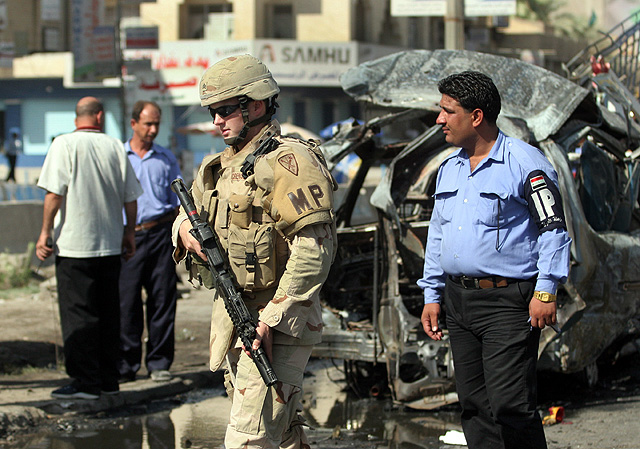
A U.S. soldier and an Iraqi police officer survey the scene after an explosion Tuesday in eastern Baghdad, Iraq. The minibus exploded when an unidentified person left a bag containing explosives that later detonated killing a driver and wounding two passengers. The attack came as U.S. planes targeted suspected insurgent safehouses.
The U.S. military confirmed six air strikes at dawn Tuesday on two residences in and around Husaybah believed to house insurgents. When survivors of those attacks drove three miles to another residence in Karabilah, the U.S. warplanes hit that house with two bombs, a U.S. military statement said.
The military said it believed the precision-guided bombs killed several insurgents.
Residents said one of the air strikes hit a weapons cache, setting off explosions in the house as the al-Zarqawi group’s munitions detonated. Another targeted building was a former clinic that had been taken over by al-Zarqawi, residents said.
There was no word from the U.S. military on whether the air strikes were coordinated with al-Zarqawi’s tribal opponents. On Friday, a U.S. military statement credited strikes by Marine F-18D fighters on an alleged al-Zarqawi safehouse in Husaybah to tips by telephone from local citizens. With al-Zarqawi and his allies trying to consolidate control of the border towns, “local leaders and sheikhs are resisting AQIZ’s murder and intimidation campaign,” a military statement said, using an acronym for al-Zarqawi.
Mahallawi said his tribe had asked local residents not to aid or house al-Zarqawi’s fighters. Some of the local people refused the request, he said.
National
Unhealthy air quality in California city as huge warehouse fire burns for 3rd day
Judge orders Trump administration to restore National Park changes at sites that ‘disparaged’ US
Teens’ reading and math scores have stagnated, US test results show
WASHINGTON (AP) — Younger students have regained ground academically after the pandemic's disruptions while older ...
Lawyers for man accused of killing Charlie Kirk try to block death penalty
Trump’s name poised to come off Kennedy Center