Task force doesn’t give bus merger recommendation
There’s a sight in town that drives City Commissioner Sue Hack crazy.
In downtown Lawrence it is not uncommon to see both a Lawrence Public Transit bus and a KU on Wheels bus leaving from the same location and heading in the same direction.
“That makes no sense to me,” Hack said. “It seems like there are so many reasons why a merger of those two systems would work.”
But prospects for such a merger may have dimmed Friday.
A Kansas University task force refused to endorse a recommendation to merge the two systems, instead leaving open the possibility of continuing with two systems.
KU’s Transit Task Force had prepared a report listing as its No. 1 recommendation the creation of a new transit authority that would include representatives from the city, KU administration and the KU student body that would run a single bus system serving the campus and the entire city.
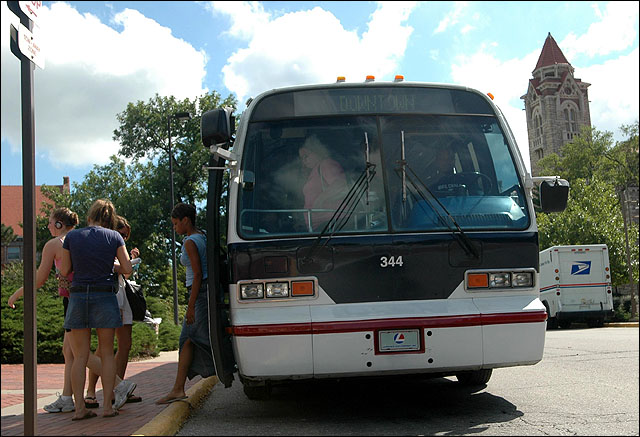
Kansas University students get on and off a KU on Wheels bus across from the Kansas Union on Friday. A KU task force on Friday failed to make an expected recommendation to merge bus system with Lawrence's T into a single service that would serve students and the general public
But when it came time to vote, key student leaders and administrators on the task force said they were leery of entering into a system where KU was not in complete control.
“The last thing I want to do is give up our control to determine our own destiny,” said Lindy Eakin, vice provost for administration and finance.
The task force does not have the final word, however. Its report will be delivered to Provost David Shulenburger for review and a decision on how to move forward.
Not married
City leaders have been interested in a merger since the city began its service, called the T, in 2001.
The 9,000 riders per day carried by KU on Wheels is significantly more than the 1,200 riders per day on the T. The increase in ridership would reduce the approximately $950,000 in property tax revenue the city uses to subsidize the T’s operations.

“If we can’t run a merged system cheaper than we can run two independent systems, we are doing something wrong,” City Commissioner David Schauner said. “Those buses at KU carry a lot of passengers.”
KU’s Eakin said Friday, however, that the two systems should continue operating independently – but do a better job of cooperating.
For instance, he said, the city and KU could share a maintenance facility for buses, or the Lawrence Transit System could take over some off-campus routes operated by KU on Wheels.
“But you don’t have to be married to someone to work together,” Eakin said.
Other task force members, though, said Eakin’s idea may be financially flawed.
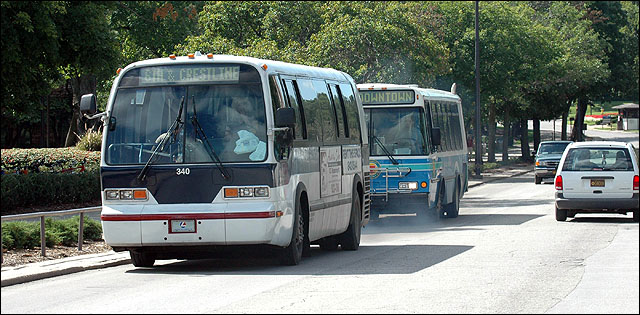
A KU on Wheels bus, left, and a Lawrence Transit bus both leave a stop in front of Budig Hall on Jayhawk Boulevard on the Kansas University campus. The city and KU are once again considering how the two bus services might work more closely together.
That’s because task force members believe several million dollars in federal transit money will be needed for KU on Wheels to upgrade its buses to be ADA compliant and meet new demands. The city’s transit service already receives federal transit dollars, and it’s unlikely the Federal Transit Authority would give significant funding to two transit authorities in a community the size of Lawrence.
Currently, KU on Wheels is entirely run by a student board of directors and is financed through a student fee and fares from its approximately 9,000 riders per day.
A report earlier this year, though, recommended that KU’s transit system needed to be expanded to meet new demands. Currently, KU on Wheels primarily serves students. Consultants said it likely would need to better accommodate faculty and staff members in an effort to address a campus parking deficit that is expected to grow to about 3,000 spaces in the future.
No timeline has been set for Shulenberger’s decision.
City Government

Developer seeks incentive from City of Lawrence to build 131 units of housing near Wakarusa and Queens

Lawrence city leaders will consider whether to keep Community Building open, make 2 other rec centers free to access
A STAR Bond application raises questions for city leaders about Costco and housing west of the SLT
Soccer gear honoring Lawrence history’s all-star team is now on sale as part of city’s public art exhibition
To honor public servants, Lawrence’s July 4 celebration will have a whole gallery of their photos on display; submissions open now