Iraq comes down to wire on constitution
Document's deadline is today
Baghdad, Iraq ? Iraq’s political heavyweights, struggling to overcome deep differences over oil and Islam, failed to agree on a draft constitution Sunday despite the expectations of U.S. and Iraqi officials.
The move surprised members of the 275-member National Assembly who had gathered to examine, discuss and vote on a proposed charter, which President Jalal Talabani had announced would be delivered by Sunday.
Instead, Talabani, a leader of Iraq’s Kurds, along with representatives of the majority Shiites, some Sunni Arab politicians, U.S. Ambassador Zalmay Khalilzad and U.N. envoy Ashraf Jehangir Qazi, met throughout the day and late into the night in an attempt to resolve several contentious issues, such as whether provinces will have the ability to impose Islamic law on citizens and how the country’s oil wealth will be distributed.
“Without solving these two points, we cannot say this draft is ready and there will not be a constitution,” said Rowsch Nouri Shaways, the country’s Kurdish deputy prime minister. “The negotiations were supposed to finish (Sunday or today), but it (could) take until the end of the month.”
Nevertheless, some Iraqi officials and Khalilzad said they were optimistic that a version of a constitution would be submitted to legislators for approval tonight at a meeting of the National Assembly.
Parliament scheduled a meeting for 6 p.m. (9 a.m. CDT) today to allow as much time as possible for negotiators to agree on a draft.
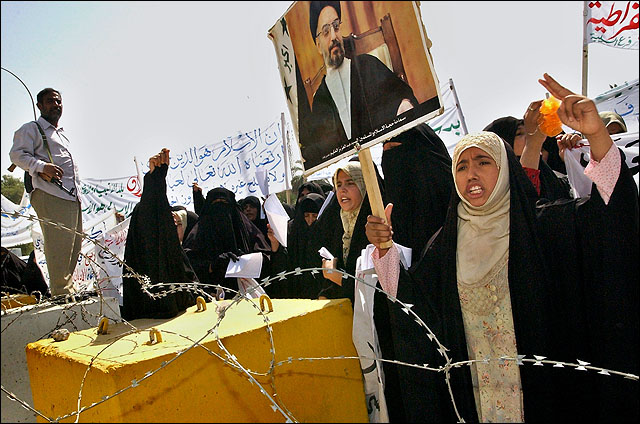
Holding a portrait of Iraqi Shiite leader Abdul-Aziz al-Hakim, local Iraqi women voice their demands to have Islamic law be the structure of Iraq's new constitution in front of the local government buildings Sunday in Basra, Iraq. Despite the many differences, Iraqi President Jalal Talabani predicted a constitutional draft would be ready by today's deadline. A finalized draft of the constitution will be put before the Iraqi people Oct. 15 for their approval.
“Iraqis tell me that they can finish it, and they will finish it (today),” Khalilzad said in an interview with ABC television.
Khalilzad has been publicly pressing the Iraqis to meet the Aug. 15 deadline spelled out in Iraq’s provisional constitution. But some say the strategy may have backfired.
“By insisting on the deadline, there wasn’t time to work out the differences,” said Peter Galbraith, a former U.S. ambassador and an Iraq expert now visiting the country. “And there was no opportunity for the public to participate.” Like Iraq’s current transitional charter, he said, “you have another constitution written in secret.”
Stark differences
Under Iraq’s transitional law, a draft of the constitution must be submitted and approved by today to allow for a nationwide Oct. 15 referendum on the charter. But Iraqi officials got off to a late start, taking three months to form a government after Jan. 30 elections and struggling for weeks to find a way to involve Sunni Arabs in the political process.
If the deadline is not met, the government could be disbanded and new elections called. But the National Assembly could also extend the deadline if three-fourths of its members approve.
In the last few days, members of the constitutional committee and other Iraqi leaders have finalized key constitutional issues, including the country’s formal name: the Republic of Iraq.
But stark differences between Iraq’s ethnic and religious groups remain.
Sunni Arabs, who make up the bulk of insurgents launching at least 60 attacks a day on U.S.-led forces, have been angered by the Shiite and Kurdish insistence on a federal Iraq, which would grant regions various degrees of political and economic autonomy.
“Federalism is one of the best ways to push the country into sectarian civil war,” said Sheik Abdul Rahman Naimi, a Sunni Arab member of the constitutional committee.
Sunni Arabs, who favor a strong central government in Baghdad, have proposed that the next National Assembly, to be elected by year’s end, address the issue of federalism. They also have threatened to walk out of discussions.
Leaders of the Shiite and Kurdish groups have threatened to let them.
“If the Sunnis want to withdraw, it’s their right,” said Saad Jawad Qindeel, a Shiite member of the 71-member constitutional panel.
Kurds also accuse Shiites of betraying agreements, some dating back to before the 2003 U.S.-led invasion, that granted Kurds control over oil revenues.
“The Shiites have changed their position,” said Mahmoud Othman, an independent Kurdish member of the constitutional committee. “It has created a bit of distrust and disappointment on the Kurdish side.”
Kurds and secular Iraqis reject a Shiite-initiated provision that would require all laws to be in accord with Islam. Many fear such language could open the way to an Iranian-style system where religious clerics are the final arbiters of all law.
“There are intractable differences on key issues,” said a source close to the negotiations, who spoke on condition of anonymity.
Down to the wire
Other Iraqi officials said they worried that a draft hastily put together under U.S. pressure and quickly approved by the National Assembly would get no public airing. “They want to pass it without any discussions,” said Yunadam Kanna, a Christian member of the constitutional panel. “If it goes like that, we have to go against the constitution.”
Throughout the day, confusion mounted at the Baghdad Convention Center, where the Iraqi parliamentarians meet. Instead of a draft constitution to peruse, the legislators were confronted by a noisy group of demonstrators demanding the inclusion of more men in their 20s in the political process.
Another group of demonstrators arrived and began lobbying for an end to tribal rules governing marriage. Nearby, a group of tribal leaders sat in a circle and insisted on a stronger role for tribal rules in the new constitution.
Outside the U.S.-protected Green Zone, violence continued. In Baqubah, gunmen assassinated a police detective. To the east along the Iranian border, three police officers were shot dead. In Kirkuk, gunmen killed a police captain. In the capital, a car bomb targeting a passing U.S. military convoy killed a civilian.
National
Unhealthy air quality in California city as huge warehouse fire burns for 3rd day
Judge orders Trump administration to restore National Park changes at sites that ‘disparaged’ US
Teens’ reading and math scores have stagnated, US test results show
WASHINGTON (AP) — Younger students have regained ground academically after the pandemic's disruptions while older ...
Lawyers for man accused of killing Charlie Kirk try to block death penalty
Trump’s name poised to come off Kennedy Center