NASA set to launch $450 million Mars orbiter
Cape Canaveral, Fla. ? A $450 million NASA probe that will search for signs of water and future landing sites on Mars is set to launch today from Cape Canaveral Air Force Station.
Liftoff aboard an Atlas 5 rocket is scheduled between 6:50 a.m. and 8:35 a.m. CDT. Forecasters are predicting an 80 percent chance of favorable weather.
The Mars Reconnaissance Orbiter is the latest in an armada of robot trailblazers dispatched in recent years to the Red Planet. It will join three other spacecraft, two American and one European, that currently are orbiting Mars and surveying its features from above.
The 2.4-ton probe will study Earth’s smaller neighbor in unprecedented detail from the top of the Martian atmosphere to more than a half-mile beneath its reddish-hued surface.
“Mars Reconnaissance Orbiter is a weather satellite, a geological explorer, a communications satellite and an exploration pathfinder hunting for landing sites of the future,” said Doug McCuistion, NASA’s Mars exploration program director. “It has got a critical strategic role.”
After launch, the versatile spacecraft will begin a looping, 310-million-mile, seven-month journey. The probe will arrive at Mars in mid-March and spend another seven months refining its orbit around the planet’s poles before starting the primary science mission in November 2006.
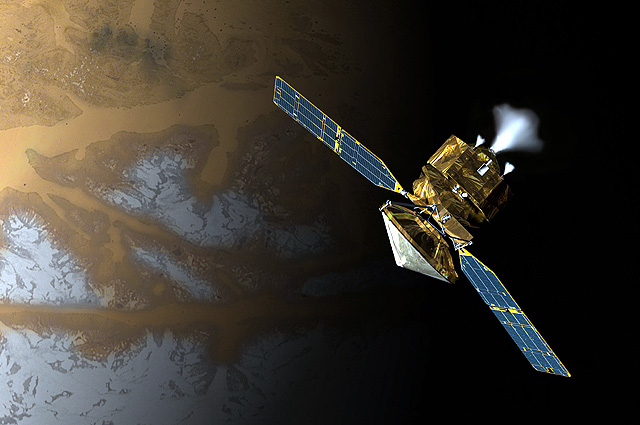
This artist's concept of the Mars Reconnaissance Orbiter, provided by NASA, drifts near the Red Planet during its critical Mars Orbit Insertion process. In order to be captured into orbit around Mars, the spacecraft must conduct a 25-minute rocket burn when it is just shy of reaching the planet. As pictured, it will pass under Mars' southern hemisphere as it begins the insertion.
As on previous Mars expeditions, the main goal is to find evidence of past or present liquid water that carved the planet’s terrain and could have provided conditions favorable for life. The satellite is equipped with six science instruments that will examine Mars from a celestial vantage point that periodically dips within 158 miles of the frigid, rocky surface.
Scientists will use the information to look for interesting places that deserve further exploration by future robot rovers and possibly human missions.
“We’ll be able to identify things on such a small scale that we can now know more intelligently where to send the next landers,” said Michael Meyer, chief program scientist for NASA’s Mars Exploration Program.
One of the six instruments is a telescopic camera that can take images of objects the width of an office desk. Another camera will do high-resolution photo surveys of surface areas as small as a tennis court, eventually covering about 15 percent of the planet. A third camera that can observe in the ultraviolet wavelength will produce daily weather maps of the entire Martian globe.
A ground-penetrating radar will look for layers of rock, ice and water beneath Mars’ surface. A spectrometer will identify minerals that could indicate the presence of water. And a climate instrument will record temperatures, water vapor and dust in the atmosphere.
The probe’s 25-month primary research mission is expected to last until December 2008. After that, the spacecraft will spend the next two years serving as a high-speed communications relay for future NASA landers on Mars.
If successful, the orbiter is expected over its lifetime to send back more information back than all the previous missions to Mars combined.
National

Lawyers for man accused of killing Charlie Kirk try to block death penalty

Trump’s name poised to come off Kennedy Center

Suspect in Texas shooting had fired at police days earlier, officials say

Man pleads guilty to killing a top Minnesota Democrat and her husband

New tornadoes outside Chicago as severe storms pummel the Midwest