Soldier convicted of murder
Army sergeant could get death penalty for attack on comrades
Fort Bragg, N.C. ? An Army sergeant was convicted Thursday by a military jury of premeditated murder and attempted murder in a grenade and rifle attack that killed two of his comrades and wounded 14 others in Kuwait during the opening days of the Iraq war.
Hasan Akbar, 34, now faces a possible death penalty, which the same 15-member jury will consider at a hearing that begins Monday.
Prosecutors say Akbar told investigators he launched the attack because he was concerned U.S. troops would kill fellow Muslims in Iraq. They said he coolly carried out the attack to achieve “maximum carnage” on his comrades in the 101st Airborne Division.
The verdict came after only 2 1/2 hours of deliberations following seven days of testimony in the court-martial — the first time since the Vietnam era that an American has been prosecuted on charges of murdering a fellow soldier during wartime.
Akbar stood at attention as the verdict was read by the colonel who headed the jury panel, biting his lip but giving no other outward sign of emotion. Defense attorneys acknowledged Akbar carried out the attack, but argued he was too mentally ill to have premeditated it and was fueled by emotion.
Killed in the middle-of-the-night attack were Army Capt. Christopher Seifert, 27, who was shot in the back, and Air Force Maj. Gregory Stone, 40, who suffered 83 shrapnel wounds. The 101st was preparing to move into Iraq in support of the U.S. invasion when the attack occurred March 22, 2003.
“Sgt. Akbar executed that attack with a cool mind,” prosecutor Capt. Robert McGovern said during closing arguments, cocking Akbar’s unloaded M-4 rifle and pulling the trigger twice for emphasis. “He sought maximum carnage.”
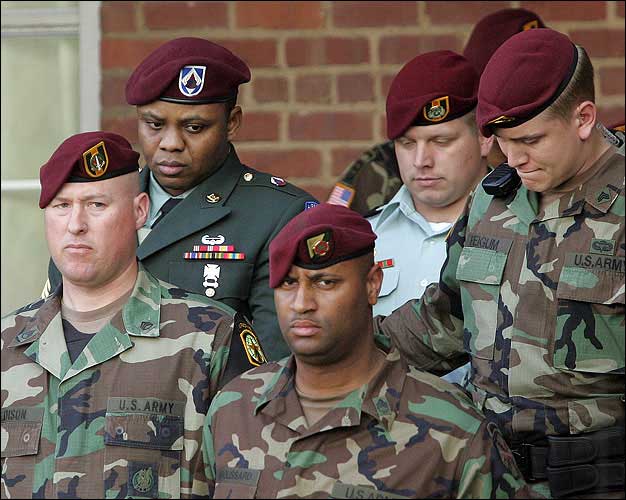
Sgt. Hasan Akbar, upper left, is led from the Staff Judge Advocate Building at Fort Bragg, N.C. Akbar, a soldier with the 101st Airborne Division, was convicted Thursday of premeditated murder and attempted murder and faces the death penalty for a grenade attack that killed two U.S. officers and wounded 14 other soldiers March 22, 2003, in Kuwait.
Defense attorney Maj. Dan Brookhart countered that Akbar was concerned the invasion of Iraq would result in the deaths of Muslims and that U.S. soldiers would rape Iraqi women. Akbar’s father issued a statement this week saying his son was the source of harassment by fellow soldiers because he is a Muslim.
National
Lawyers for man accused of killing Charlie Kirk try to block death penalty

Trump’s name poised to come off Kennedy Center

Suspect in Texas shooting had fired at police days earlier, officials say

Man pleads guilty to killing a top Minnesota Democrat and her husband

New tornadoes outside Chicago as severe storms pummel the Midwest