A decade later, impact lingers
For all Americans, Murrah building tragedy hit close to home
Why Oklahoma City? Why us?
That was the question on every Oklahoman’s mind after a terrorist’s bomb killed 168 people at the Alfred P. Murrah Federal Building at 9:02 a.m. April 19, 1995.
Ten years later, we still struggle to understand.
In May 2001, I was driving from Oklahoma to the East Coast for an internship. The radio, tuned to National Public Radio, had been talking about Timothy McVeigh, the convicted bomber, all day. His execution was scheduled to take place in a few days, at the federal prison in Terre Haute, Ind. Then I saw that Interstate 70 would take me right through there.
Why did I feel the need to stop? I didn’t know any of the victims. I’m from Oklahoma City, but at the time of the bombing I was a little more than an hour north in Stillwater, Okla., doing computer support over the phone. I found out about the blast from a caller who wanted me to help him fix his CD-ROM drive.
I guess all I can say is I’m an Oklahoman. How could I not stop?
I don’t know what I was expecting to see. Groups of victims demanding to see justice? Protesters against the death penalty?
What I got were a few broadcast news trucks parked in a field in front of the prison and one guy holding a large sign for those driving by to see. He wasn’t out for blood, nor was he protesting an execution. His sign said simply: “Pray for Tim McVeigh.”
I again found myself asking why. Why would he come out here, away from his job, his family, to stand alone on a two-lane road in Indiana?
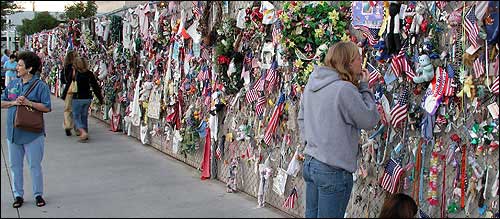
Tucked behind the Oklahoma City National Memorial is a chain-link fence filled with personal messages and memorabilia directed at those killed in the 1995 blast. The fence is covered with flowers, teddy bears, American flags and notes put there by the memorial's many visitors.
He said because he was a father, and no matter what he’d done, McVeigh was still someone’s son. He asked me to pray for the Oklahoma City bomber.
I left Terre Haute with an uneasy feeling. I still can’t really explain why I had to stop, and I didn’t really take anything away from the visit. Except that I never did pray for Tim McVeigh, and in a strange way I’m slightly ashamed I didn’t.
There will never be any satisfactory answers. Today, the Oklahoma City National Memorial and Museum will hold “A Day of Remembrance.”
I would urge everyone who hasn’t made it to the memorial to go. It is the most sacred place in my home state. It’s very beautiful, a fitting way to honor the 168 men, women and children who died in the attack.
But the real memorial is just to the side. It’s not beautiful like the National Memorial, which belies the ugly nature of the tragedy. After the Murrah building was reduced to rubble, a chain-link fence was erected around the site. That’s where you’ll find birthday cards left for those who’ll never celebrate another birthday, pictures of growing kids left for parents robbed of the chance to see them grow up, and toys left for the children whom McVeigh referred to as “collateral damage.”
Seeing that, it no longer matters whether you’re from Oklahoma or that you may not have known any of the victims. You’ll find that you’re missing them just the same.
The Oklahoma City bombing, the 9-11 attacks — we vow to never forget them. They show how we as a country respond to tragedy. No matter how divided we are by issues such as gay marriage, abortion or Terri Schiavo, Americans can put it all aside to come together. Oklahoma City helped remind us that in times of need, united we stand.

 A decade later, impact lingers
City Government
Report recommends routing Lawrence Loop down Seventh and New Hampshire; city told consultants not to consider going through Riverfront
Opinion: Lawrence’s data center moratorium is wrong in one way, but right in the most important
Current and former elected officials celebrate Lawrence’s new Municipal Services and Operations campus
‘We have to move forward’: On 3-2 vote, Lawrence City Commission approves budget with 1.4-mill hike
Manufacturer opens new production facility, adds 30 jobs in Lawrence industrial park