Leader of Iraq thanks U.S.
Despite violence, Allawi sees democracy emerging in nation
Washington ? Iraqi interim Prime Minister Iyad Allawi on Thursday thanked Americans for their sacrifices in Iraq and promised that violence would not stop planned elections in January.
In an emotional speech to a joint session of Congress, Allawi sketched out an optimistic future for a country beset by terrorism, ethnic tensions and economic difficulties. He acknowledged the problems but insisted that Iraq was well on its way to becoming a stable democracy and a U.S. ally.
“Thank you, America,” Allawi said to members of Congress. “We the people of the new Iraq will remember those who have stood by us. And as generous as you have been, we will stand with you, too.”
At a later news conference with President Bush, the Iraqi leader urged other nations to help Iraq emerge from the “dark ages of tyranny, aggression and corruption.”
Allawi, who acknowledged that he lives under the constant threat of assassination, pledged to stick with the election timetable, despite expectations of more violence before the elections. He said that 15 of the 18 Iraqi provinces already were secure enough to hold elections.
“The Iraqi elections may not be perfect. They may not be the best elections Iraq will ever hold. They will undoubtedly be an excuse for violence from those who disparage and despise liberty,” Allawi said. “But they will take place.”
Shortly after Allawi’s visit to the Capitol, Defense Secretary Donald Rumsfeld suggested that as much as one-fourth of Iraq could be too dangerous to participate in the elections.
“Let’s say you tried to have an election, and you could have it in three-quarters or four-fifths of the country, but some places, you couldn’t because the violence was too great. Well, so be it,” Rumsfeld told the Senate Armed Services Committee. “So you have an election that’s not quite perfect.”
Questionable assessment
But other aspects of Allawi’s upbeat assessment also were called into question. Although Bush and Allawi cited progress in training Iraqi security forces, State Department figures indicate that fewer than half of the 85,000 Iraqi police and fewer than 40 percent of the 12,700-member Iraqi army have received training.
And even with the untrained recruits, the security force is still far short of the goal of 213,000 police officers and 23,600 soldiers.
Meanwhile, Iraq’s insurgency has grown larger and more violent and expanded the territory under its control.
“The situation in Iraq needs a great deal more than a visit from Prime Minister Allawi and more election-oriented reassurances,” said security expert Anthony Cordesman at a Wednesday forum on Iraq at the Center for Strategic and International Studies. “There is a clear need to explain U.S. goals in Iraq, explain how the United States is reacting to the rising insurgency and set forth a clear U.S. plan to support the elections in Iraq, create effective Iraqi security forces and implement an effective aid program.”
Kerry doubtful
Democratic presidential candidate John Kerry questioned whether Iraq would be ready for national elections in January.
“I want democracy to take hold. But at the moment, I think most people would tell you that the United States and the Iraqis have retreated from whole areas of Iraq,” Kerry said during a visit to a fire station in Columbus, Ohio. “You can’t hold an election in a no-go zone.”
White House officials used Allawi’s visit to try to shore up support for the Iraq war at a time when American resolve is being tested by the mounting death toll and signs of spreading chaos. But Allawi said he didn’t come to Washington to get involved in U.S. politics.
“I am a tool of nobody,” he said Thursday evening at a meeting of the Council on Foreign Relations.
Bush and Allawi seemed to hit it off as they stood in front of U.S. and Iraqi flags at a joint news conference earlier Thursday in the White House Rose Garden.
Allawi, a former neurologist who survived a 1978 ax attack by agents of former Iraqi leader Saddam Hussein, nodded along as Bush stressed his determination to complete Iraq’s transition from dictatorship to democracy.
“We’re sickened by the atrocities, but we’ll never be intimidated,” Bush said, referring to the recent spate of suicide bombings and the beheading of two American hostages.
National
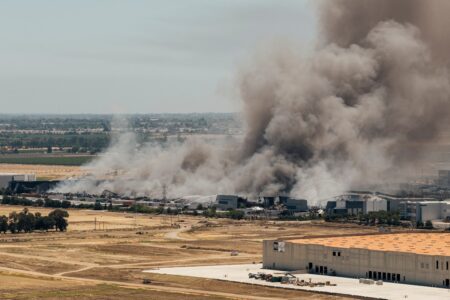
Unhealthy air quality in California city as huge warehouse fire burns for 3rd day
Judge orders Trump administration to restore National Park changes at sites that ‘disparaged’ US
Teens’ reading and math scores have stagnated, US test results show
WASHINGTON (AP) — Younger students have regained ground academically after the pandemic's disruptions while older ...
Lawyers for man accused of killing Charlie Kirk try to block death penalty
Trump’s name poised to come off Kennedy Center