

Guard has faced challenges in 150 years
Topeka ? War. Trouble on the home front. Citizens asked to leave their families to take up arms. That was the report from the state’s adjutant general in 1865.
It also was the report Friday from the man currently holding that job as the Kansas National Guard kicked off a yearlong celebration of the 150th anniversary of its founding in 1855. Several hundred people participated in a ceremony at the Statehouse’s south steps.
Like their early predecessors, Maj. Gen. Tod Bunting said, today’s soldiers are being pressed into service amid growing anxiety about whether the Guard can meet demands placed on it.
“No one knows what the future will bring out,” Bunting said.
He said about 1,800 soldiers were mobilized or deployed to Iraq, Afghanistan or Kosovo, representing about 40 percent of the Kansas Army National Guard’s strength.
Bunting said the deployments — affecting 74 Kansas counties and more than 270 cities — had increased steadily for the Guard over the past decade. Even before the 2001 terrorist attacks, guardsmen were deployed on active duty more than they were during the 1991 Gulf War, he said.
Richard Stark, military analyst with the Center for Strategic and International Studies in Washington, said the Guard’s role changed when the Cold War ended. It moved from being a strategic reserve to taking on more front-line duties.
For example, in 1986 the Guard provided 1 million days of service, compared with 60 million days during the war in Iraq.
“The men and women clearly want to do a good job,” Stark said. “But it is a demanding set of circumstances.”
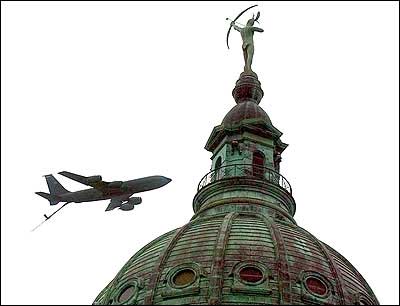
A KC-135 Stratotanker flown by members of the Kansas Air National Guard flies over the Statehouse in Topeka at the conclusion of the Guard's 150th anniversary celebration. During the last decade, Guard deployments have increased steadily.
And even as units prepare to deploy, the military is trying to transform its reserves from being heavy on armor and artillery to being lighter and more mobile, Stark said.
He said finding the right mix of units for deployments — and having enough of them — also created new pressures.
“Every time governors get together, this is an issue on the table,” Gov. Kathleen Sebelius said.
States want to know what the plans are for Guard deployments, whether families will be fully supported and whether soldiers are getting adequate equipment and training, she said.
Sebelius said the Pentagon had done little to reassure governors.
“Frankly, there are no very clear answers in sight,” she said. “I think it’s a very constant worry, not only about what’s happening overseas, but certainly that guardsmen are available to do the duties here. We live in a disaster-prone state, and we rely on the Guard as that safety net on a very regular basis.”
Retired Brig. Gen. Ronald Tinscher, who served 42 years with the Kansas National Guard, said soldiers still felt good about serving but added that frequent deployments eventually would take a toll.
“I don’t think there is an answer,” Tinscher said.
State Government
State legislators push back against federal energy regulators ending competitive bids
TOPEKA — Two Kansas legislators asked federal energy regulators to ensure competitive bidding occurs on ...
Senate confirms 1st of 3 Kansas nominees to U.S. District Court
Corporate income tax collections falling sharply in Kansas; Republican, Democratic leaders disagree on what it means
TOPEKA — Corporate income tax collections in Kansas have almost halved since last year, while other sources trend ...
Candidate’s campaign manager created website with documents used to attack rival
TOPEKA — Kansas U.S. Senate candidate Patrick Schmidt’s campaign manager left his digital footprint on ...
GOP secretary of state files to run for governor
