

Plan would limit wind energy farms
Sebelius seeks Flint Hills protections
Topeka ? Gov. Kathleen Sebelius on Monday put a prime area of potential wind energy off-limits to near-term development, citing a need to protect the scenic Flint Hills.
Wind energy supporters said Sebelius’ move could kill environmentally sound projects and have a devastating effect on struggling rural areas that have been banking on potential leasing dollars from the wind farms.
“We are shocked and disappointed,” said Jennifer States, managing director for Lawrence-based JW Prairie Windpower.
The company has been planning for three years to build about 80 wind towers producing 120 megawatts of power in Morris County.
But Monday, the project and others like it were essentially put on hold, States said, when Sebelius declared support of a plan to restrain wind energy development in an area that includes much of the best wind in the region.
Some landowners, however, praised Sebelius. They said the generating towers, usually about 400 feet tall, would mar views of the Flint Hills, endanger migrating birds and generally disturb the environment.
“I think the governor has recognized, and it is clear to most people, that there really is something special about the tallgrass prairie,” said Patrick Hughes, of Leon, a member of a group of ranchers that has opposed wind farm proposals.
Flint Hills wind
The Flint Hills is among the top areas in the nation for potential wind-generated electricity, but also is home to the fast-disappearing tallgrass prairie ecosystem.
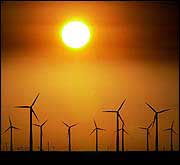
A group of wind turbines is silhouetted by the setting sun at the Gray County Wind Energy farm near Montezuma. A state committee has proposed creation of a Heart
At one time, the tallgrass prairie stretched across 170 million acres, from Manitoba, Canada, to Texas. But during a short span in the 1800s, most of the land was settled and partitioned.
Only 4 percent of the original tallgrass prairie remains, and two-thirds of that is in the Flint Hills of Kansas, a swath running from north of Manhattan to Cowley County and into Oklahoma, where the prairie is called the Osage Hills.
Sebelius said she was trying to strike a balance by establishing a “Heart of the Flint Hills Area” where placement of wind towers would be delayed if and until local officials could put guidelines in place and the state could assess economic strategies for the region.
The restricted area is bounded by U.S. Highway 24 to the north, Kansas Highway 77 to the west, U.S. Highway 400 to the south and Kansas highways 99 and 4 to the east.
Impossible deadline
But outside that area, Sebelius said wind energy developers should go full speed ahead.

 Wind and Prairie Task Force report (.pdf)
“Developers pursuing projects outside of the designated area who have been waiting for a signal from the administration now have it and should proceed accordingly so they can benefit from federal tax credits,” said Lee Allison, Sebelius’ energy adviser.
Conversely, Sebelius’ go-slow approach in the center of the Flint Hills could kill potential projects because to take advantage of the federal tax break, wind projects must be in operation by the end of 2005. That would be an impossible deadline because some of those counties have not yet developed ordinances to regulate wind towers, officials said.
States, with JW Prairie Windpower, criticized Sebelius’ policy because many areas inside the wind-free zone have been tilled for farming and ranching and can no longer be considered tallgrass prairie.
“This delineation is based on highways, not prairie,” States said.
Her company’s project was proposed to be built over plowed ground and had been developed in a way to leave undisturbed wetlands, bird flight paths and even the area’s cultural heritage, she said.
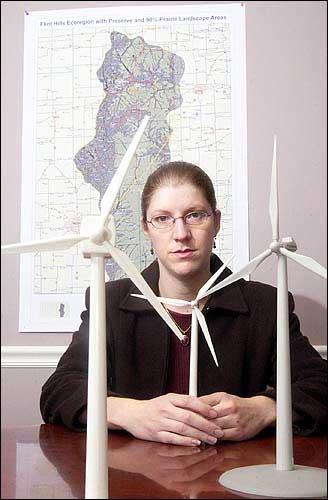
Jennifer States, managing director of Lawrence-based JW Prairie Windpower, says the company's planned wind tower project in Morris County is jeopardized by proposed protections for the Flint Hills.
Mapping ignored
Donna Johnson, owner of Lawrence’s Pinnacle Technology and a member of the advisory Kansas Energy Council, said she was surprised by Sebelius’ statement, especially because the council is scheduled to meet today to approve recommendations on wind energy for the governor.
“We’ve been working with so many developers to locate their projects out of the tallgrass prairie. Now they are getting included in this ‘Heart of the Flint Hills Area’ because of the roads as opposed to where the actual native prairie is,” she said.
The Kansas Energy Council produced detailed maps that show where the tallgrass prairie still exists and what areas have been plowed, Johnson said.
“There has been a lot of mapping efforts done this year that did not appear to be taken into account,” she said.
Sebelius said her position was based on a recommendation by a Cabinet-level team chaired by Mike Hayden, secretary of the Kansas Department of Wildlife and Parks.
But Hughes said looking at whether the ground had been plowed missed the point. The wind towers still would disrupt the view, he said.
“It’s not just the footprint; it’s what you are doing to the landscape,” he said.
State Government
State legislators push back against federal energy regulators ending competitive bids
TOPEKA — Two Kansas legislators asked federal energy regulators to ensure competitive bidding occurs on ...
Senate confirms 1st of 3 Kansas nominees to U.S. District Court
Corporate income tax collections falling sharply in Kansas; Republican, Democratic leaders disagree on what it means
TOPEKA — Corporate income tax collections in Kansas have almost halved since last year, while other sources trend ...
Candidate’s campaign manager created website with documents used to attack rival
TOPEKA — Kansas U.S. Senate candidate Patrick Schmidt’s campaign manager left his digital footprint on ...
GOP secretary of state files to run for governor
