Anti-Bush protest turns violent
Santiago, Chile ? The largest protest march since Chile’s police state ended 14 years ago turned violent Friday when demonstrators waged pitched street battles with riot police before President Bush arrived for a summit of Asia-Pacific leaders.
Most of the anger in Friday’s march was directed at the United States for the war in Iraq. Chile was among the nonpermanent members of the U.N. Security Council who did not approve of the United States going to war without U.N. authorization.
The protest was part of an alternative forum to the annual summit of the Asia-Pacific Economic Cooperation, a 21-member group of nations on both sides of the Pacific Ocean.
The heads of state will discuss trade and economic development. Bush also plans to meet with leaders on the sidelines of the summit, starting Saturday morning with Chinese President Hu Jintao. Bush hopes to use the APEC summit to rally support for his effort to shut down North Korea’s nuclear weapons program
He also will talk with leaders from Japan, South Korea, Indonesia, Canada, Russia and Mexico before stopping in Colombia on Monday on his way back to Texas.
The protest, estimated by Chilean news media at more than 30,000 demonstrators, was mostly peaceful until a relatively small number of radicals began looting in the center of the city.
Rioters attacked a McDonald’s and offices of the Spanish phone operator Telefonica. They ransacked the lobby of the four-star Prince of Asturias Hotel, breaking windows and dragging furniture into the street. The attack surprised members of a large Russian delegation to APEC staying at the hotel, who were having lunch at the time.
“It’s now safe to move about. There is nothing left to destroy,” one member of the Russian delegation quipped later.
Water cannons and tear gas ended the demonstration abruptly. Police arrested dozens, and many people were injured when radical youths rained stones and bricks on police officers and journalists.
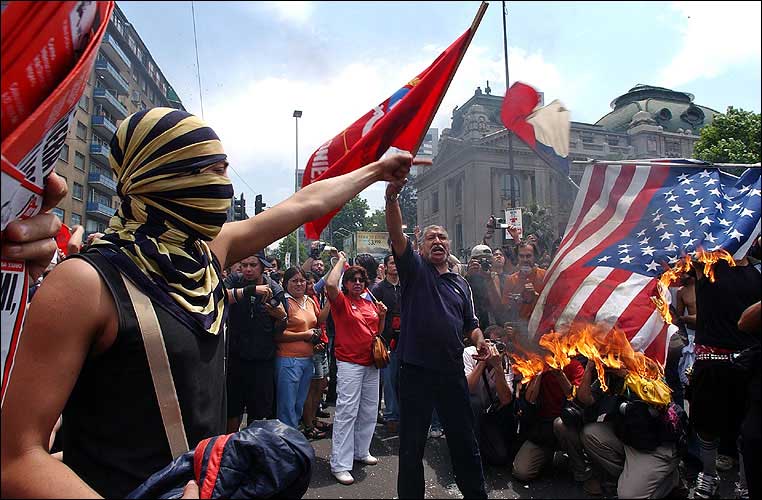
Demonstrators set fire to a U.S. flag as they protest in Santiago, Chile. The demonstrators gathered Friday before this weekend's summit of the Asia-Pacific Economic Cooperation.
Many of the protesters oppose globalization — the breakdown of barriers to world trade, investment and communications — because they fear damage to local practices and cultures. They also argued free trade benefits wealthy corporations and corrupt politicians but never reaches the poor and needy.
“We believe globalization has to be for everyone. We are talking about a globalization that today has 75 percent of the people outside of it,” said Patricio Quiroga, a middle-aged university professor who was marching Friday.
Some protesters carried old Soviet flags or Cuban flags, even though protests in Havana today can result in long jail terms.
Chile itself was a battleground during the Cold War. A U.S.-backed coup in 1973 topped elected socialist President Salvador Allende, who was aligned with Cuban strongman Fidel Castro. Right-wing leader Gen. Augusto Pinochet then ruled with a bloody fist until 1990. Today, socialist President Ricardo Lagos, Allende’s former nominee to be Chile’s ambassador to the old Soviet Union, runs the nation as part of a centrist coalition that has made his country one of the world’s most vocal proponents of open markets and free trade.
National
Lawyers for man accused of killing Charlie Kirk try to block death penalty
Trump’s name poised to come off Kennedy Center

Suspect in Texas shooting had fired at police days earlier, officials say
Man pleads guilty to killing a top Minnesota Democrat and her husband

New tornadoes outside Chicago as severe storms pummel the Midwest