Hereford House on brink of closing
Smoking ban blamed
The state’s biggest restaurant may be about to close, its owner says.
And he’s counting on Lawrence voters to help breathe new life into the place by repealing the city’s smoking ban, which he says is draining $10,000 a week from his Hereford House restaurant at Sixth Street and Wakarusa Drive.
“We’re going to hang on tight … and I’m going to stick with it until it makes absolutely no business sense to do so,” said Rod Anderson, president of Anderson Restaurant Group, based in Kansas City, Mo. “I’m at that point right now.”
Anderson said he had no immediate plans to close the 16,000-square-foot restaurant, despite rumors buzzing around that suggest the place could close as early as February. But he’s hoping a petition drive to get a bring-back-smoking question on an election ballot in March proves successful.
“I could probably sell off some of the assets and lick my wounds and go away,” he said, describing what he might do if the ban isn’t lifted this spring. “It’s not my desired intention to do that, but those are my options.”
Anti-smoking advocates don’t buy it.
Dave Kingsley, who was chairman of the Mayor’s Task Force on Smoking, said Anderson’s comments represented little more than the latest salvo in a push for public opinion — a firing line that got reinforcements this month with the closing of The Meat Market and will be certain to get stronger in the weeks and months ahead.
“The campaign has started,” Kingsley said. “These guys, they need to prove to the world that their business is down because of the smoking ordinance. They’re trying to create this image that we’re putting all these businesses out of business.
“We have to get the message back to where it needs to be: What was the purpose of passing it? To protect employees. This is the only industry in America — the only industry — that is allowed to expose its employees to a toxic substance where it’s preventable.”
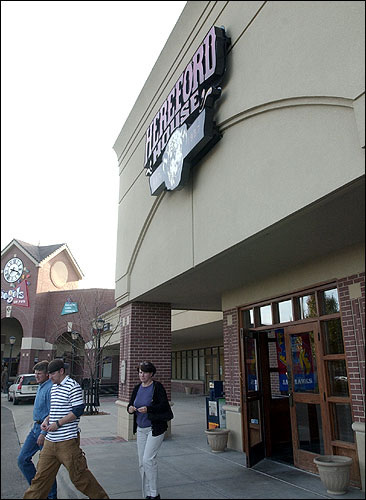
The owner of Hereford House, 4931 W. Sixth St., is considering closing the restaurant if business conditions don't improve. Rod Anderson, president of Anderson Restaurant Group, said sales were down 0,000 a week from a year ago.
Kingsley said he had studied the effects of smoking bans on more than 20 communities across the country. In each case, he said, a handful of businesses closed but overall restaurant and bar business increased.
“In every other community that has passed one of these and has a steak house, it didn’t lose business,” Kingsley said. “I’m not buying this. I’m just not buying it.”
But Anderson says the numbers don’t lie.
Since July, when Lawrence’s ban on smoking in buildings open to the public took effect, Anderson said he watched receipts from out-of-towners drop by 40 percent.
Overall sales are off $10,000 a week, he said. The restaurant’s one-time burgeoning bar business is down $1,000 or $1,500 a day.
“Happy hour, Friday nights, the place was packed,” Anderson said of the restaurant’s bar up front. “Now there’s five people there. It’s crazy.”

 Smoking ban’s opponents kick off drive to force vote (06-09-04)
Anderson also is fighting efforts to establish smoking bans in metropolitan Kansas City, where he has four other restaurants and a fifth is scheduled to open in two weeks.
He acknowledged the Lawrence market hadn’t lived up to all of his expectations. Since opening the restaurant four years ago, plans for a complex of national retailers across Sixth Street have become mired in court battles, and state budget cuts have cut into wages and spending from Kansas University employees.
It’s not exactly a recipe for success in a restaurant boasting an investment of $2 million.
“It’s too big for the business that it’s doing right now,” Anderson said. “For the first year, it was perfect. But now — Lawrence has been written up all over the country as a great place to do business, but I’m certain that’s not as true lately as one tends to believe.”
Anderson, a nonsmoker, figures the smoking ban will end up costing his Lawrence restaurant — said to be the biggest in Kansas by square footage — about $400,000 a year. He’s already cut staff to 74 from 90 employees, and made other moves to bring revenues more in line with expenses.
“My initial reaction when the smoking ban happened was, ‘Let’s suck it up and deal with it,'” Anderson said. “But now I’ve had a reality check.”
City Government

Soccer gear honoring Lawrence history’s all-star team is now on sale as part of city’s public art exhibition
To honor public servants, Lawrence’s July 4 celebration will have a whole gallery of their photos on display; submissions open now

North Lawrence study consultants look at possibilities for a grocery store, food truck park, traffic calming and more

Algerian ambassador gives Lawrence a gift for supporting national team – a piece of art

Lawrence City Commission approves incentives for Alarm.com’s office project in downtown building