Sebelius plan would pack on costs for smokers
KANSAS CITY, KAN. ? Gov. Kathleen Sebelius on Tuesday unveiled a $50 million initiative aimed at extending health care benefits to more than 70,000 uninsured Kansans.
To pay for the plan, Sebelius proposed raising the state tax on cigarettes by 50 cents a pack.
“Raising taxes is always difficult,” she said. “I think Kansans need to know how we’re going to pay for it. You get nothing for free.”
Sebelius, a Democrat, and Insurance Commissioner Sandy Praeger, a Republican, announced the plan at a morning news conference at Kansas University Medical Center. They later addressed the Kansas Hospital Assn.’s annual convention in Topeka.
Both the hospital association and the Kansas Medical Society have endorsed the “HealthyKansas” plan.
In Kansas, according to the administration, more than 300,000 adults and children are uninsured. All but 5 percent live in households where at least one adult is working.
Under Sebelius’ plan, the state’s health insurance programs for employees and retirees would be combined with most of the state’s Medicaid programs. Together, the two programs account for $1.6 billion in health care spending.
The newly created Kansas Health Care Authority would fall under the Department of Administration.
The authority would be the state’s largest purchaser of health care services and, according to Sebelius, have a better shot at controlling costs.
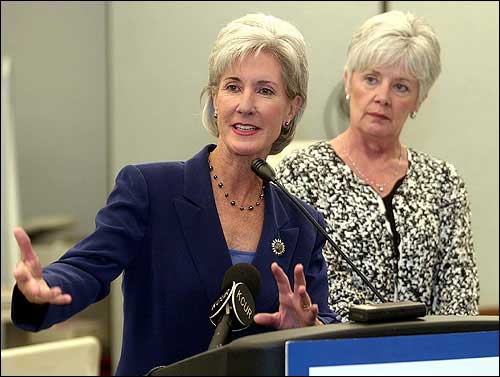
Kansas Gov. Kathleen Sebelius discusses HealthyKansas, an initiative to cut health care costs, Tuesday at Kansas University Medical Center in Kansas City, Kan. Insurance Commissioner Sandy Praeger is shown at right. The measure would raise the price of cigarettes by 50 cents a pack.
Other elements of the initiative:
- An aggressive campaign aimed at adding 40,000 children to HealthWave, the state’s health insurance program for children in low-income, working families.
- An expansion of the HealthWave coverage for “care-giving parents.” Currently, parents whose incomes are less than 37 percent of the federal poverty guideline are eligible.
Sebelius has proposed adding 30,000 adults to the program by raising eligibility to 100 percent of the guideline, almost $19,000 a year for a family of four.
- Creation of a Web site to help Kansans stay informed of discounts on prescription drugs.
| ¢ Tobacco taxes: The state’s cigarette tax would increase by 50 cents a pack, to $1.29, and the tax on tobacco products would rise to 15 percent from 10 percent, to provide $50 million annually for health care initiatives.¢ More children covered: The state would be more aggressive in seeing that children who are eligible for state health insurance coverage actually get covered. The goal is enrolling an additional 40,000 children.¢ More adults covered: Eligibility requirements for state health coverage would become less strict for low-income adults, allowing an additional 30,000 to qualify.¢ Subsidizing private insurance: Working through an existing nonprofit group established under a 2000 law, the state would subsidize private health insurance plans for low-wage employees of small businesses.¢ Attacking inefficiencies: A new Health Care Containment Commission, led by Lt. Gov. John Moore, would examine ways to make the health care system more efficient and reduce administrative costs.¢ Reorganizing health programs: State health insurance programs for poor Kansans would be combined with the program for government workers under a Kansas Health Care Authority. The goal is using the state’s clout as the buyer of $1.6 billion worth of health care to force efficiencies.¢ Prescription drugs: The state would work with pharmacies to provide low-cost generic drugs to low-income Kansans and establish an Internet drug information center. Also, Sebelius said her administration was examining an Illinois program that works through a Canadian clearinghouse to connect residents to 45 foreign pharmacies and wholesalers offering lower-cost drugs.¢ Health education: The state Department of Health and Environment would establish a program to educate Kansans about improving their health to combat obesity and other chronic problems.— The Associated Press |
‘A basic right’
Praeger’s office would oversee several projects aimed at using tax-funded subsidies to help small businesses insure low-wage workers.
“I believe we have a moral responsibility to find a way to provide coverage that’s affordable and accessible to all,” Praeger said. “Access to health care should be a basic right.”
Asked how much each program would cost, Sebelius said about one-third of the $50 million would be set aside for the subsidies. The remaining two-thirds, she said, would finance increased access to HealthWave.
Under the plan, revenues from the proposed tax would be kept in a separate fund and could not be used to offset other demands within the budget.
Medicaid programs now administered by the Department of Social and Rehabilitation Services — payments to doctors and hospitals, mostly — would move to the Kansas Health Care Authority. Programs aimed at helping the disabled avoid institutional care would remain at SRS.
Asked if that meant doctors and hospitals would fare better than the disabled, Sebelius replied: “This is in no way a two-tiered system.”
The intent, she said, is to separate the “insurance pieces, so they can be run like a business” without interfering with services for the disabled.
Tobacco tax
If approved, the state tax on cigarettes would increase to $1.29 a pack from 79 cents a pack.
Sebelius also proposed raising the tax on tobacco products — cigars and chewing tobacco, for example — to 15 percent from 10 percent.
In the state fiscal year that ended June 30, taxes on cigarettes and tobacco products netted the state almost $120 million. The year before, the taxes generated $133.8 million.
“The tax went to 79 cents a pack on Jan. 1, 2003. That’s why it went up like that,” said Department of Revenue Secretary Joan Wagnon. “Since then it’s come down — but that’s what (cigarette taxes) do, they spike, they come down, and then they plateau.”
At 79 cents a pack, the current tax is projected to raise $118 million this year.

 Sin tax may fund new health plan (10-30-04)