TV networks swear off early predictions tonight
Orlando, Fla. ? From eye-popping backdrops to overhauled procedures, television will unfurl many changes tonight in its coverage of the 2004 presidential election. But news executives agree on the biggest: They cannot repeat the debacle of 2000.
“Nobody wants to go to Congress and explain why we got it wrong twice,” said David Bohrman, CNN’s Washington bureau chief.
Four years ago, the networks projected Al Gore as the winner in Florida shortly before 8 p.m. Two hours later, they decided the state was too close to call.
At roughly 2:15 a.m., they gave George W. Bush the Florida victory and the election. At about 4 a.m., the close Florida count threw the election into a 36-day deadlock until the U.S. Supreme Court handed Bush the presidency.
“We got sobered up last time,” said Linda Mason, CBS vice president of public affairs. “A system that worked 30 years fell apart. It was a pretty messed-up election, and our system failed as well.”
Caution will be the approach this year, TV executives say. They will strive to be more transparent in relaying the results.
“All the networks’ emphasis is on clarity and being right, not first,” Mason said. “It’s a real contrast to last time.”
The networks point to their resolve in revamping their methods. Gone is the Voter News Service, an exit-polling staff hired and managed by a consortium of ABC, CBS, CNN, Fox News Channel, NBC and The Associated Press.
The networks ended the Voter News Service after it suffered a technological meltdown two years ago and did not offer exit-poll information on election night.
This time, the networks, working as a consortium called National Election Pool, have hired others to do the polling. The Associated Press will collect the tabulated vote with a modernized system.
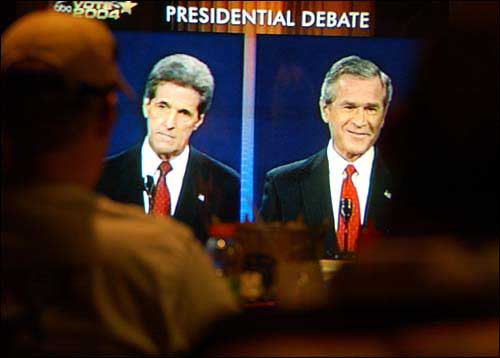
Students surround a big-screen television in a campus lounge of the University of Denver as Democratic presidential candidate John Kerry and President Bush meet in their third debate Oct. 13 in Tempe, Ariz. Television networks have vowed not to make early predictions of who will win the close race; in 2000, the assertions proved futile -- and incorrect -- as the Bush-Al Gore matchup proved too close to call.
Polls on absentee ballots will be conducted in 13 states, an increase from three in 2000.
“More people than ever are doing early voting or absentee voting,” said Marty Ryan, executive producer of political coverage for Fox News. “It’s a crucial part of the electorate. If you misrepresent that, you could get it totally wrong.”
Once the networks receive the data, they make their own projections. But they will wait until the scheduled closing of every poll before projecting a state’s outcome. That’s a reaction, in part, to the early call on Florida for Gore while some polls remained open.
“The guiding principle of the projections is be accurate,” said Dan Merkle, ABC’s decision desk director. “If we’re not fully confident, we’ll wait for more data. If the race is too close, we won’t project. A new rule in place is that ABC News will not project a race if there’s less than 1 percentage margin between the candidates.”
The networks will strive to be more precise with language. CBS will put the word “estimate” on graphics. The network will draw the distinction between “too close to call” and “not enough votes” in explaining results.
At CNN, about 30 people are working on the projections.
“I think everyone rightfully learned a lot of lessons four years ago,” CNN’s Borhman said.
National
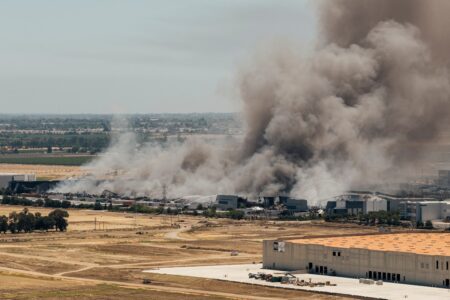
Unhealthy air quality in California city as huge warehouse fire burns for 3rd day
Judge orders Trump administration to restore National Park changes at sites that ‘disparaged’ US
Teens’ reading and math scores have stagnated, US test results show
WASHINGTON (AP) — Younger students have regained ground academically after the pandemic's disruptions while older ...
Lawyers for man accused of killing Charlie Kirk try to block death penalty
Trump’s name poised to come off Kennedy Center