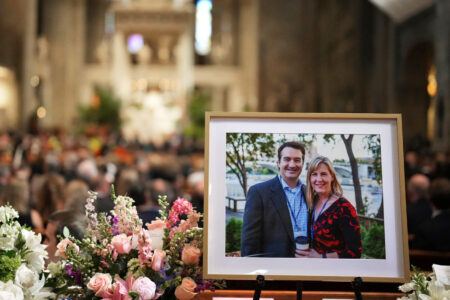
Once race ends, when will we know the winner?
Dallas ? Finally.
Maybe.
The most expensive — and one of the most contentious — presidential election in history has at last arrived, though no one is sure if a president will actually be identified tonight.
The down-to-the-wire nature of the race between President Bush and John Kerry means it could be at least Wednesday before we know who wins. And any number of recounts or lawsuits, in any of a dozen or so closely contested states, could delay the result and set up a virtual repeat of the overtime 2000 election, said campaign aides and analysts.
As each side claws toward the necessary 270 electoral votes, some analysts said resolution could boil down to the very last state to report: Hawaii, where polls don’t close until 10 p.m.
Among the factors driving the uncertainty: polls showing a virtually tied race, the prospect for extraordinarily high voter turnout, and problems with the voting process that range from partisan registration challenges to “provisional ballots” that must be evaluated after the polls close.
And there’s one overriding fear — a terrorist attack designed to disrupt the vote. In the first presidential election of the post-Sept. 11 era, security forces will be on high alert throughout the day.
With polls showing the race about as evenly divided as possible, both candidates predicted victory — and hoped for a quick and clear one.
“Americans are determined not to have a repeat of the year 2000,” Kerry said on ABC News.
Bush said in Pittsburgh: “I just want to assure you I’ve got the energy, the optimism and the enthusiasm to cross the line.”
Their aides and supporters, though, geared up for another epic politico-legal battle.
Republican Party chairman Ed Gillespie noted the Kerry team had thousands of lawyers at the ready.
“It is clear that their intention is that even when he loses, they’re going to drag our electoral process into courtrooms across the country,” he told CBS.
Democrats said their lawyers already had worked to stop Republican suppression of Democratic votes in Michigan, Nevada and Florida.
“We have 10,000 lawyers that we have enlisted over the last months all across the country to guarantee … the right to vote is protected,” Kerry told ABC News.
He added: “I’ll do what’s necessary to protect the constitutional right of Americans to vote.”
The closer the vote in the Electoral College, the larger such disputes will become. The result could turn on a single state, and even tiny ones like New Hampshire and New Mexico could turn into this year’s Florida.
Old animosities are also likely to resurface if the race is excruciatingly close.
The GOP has set up a “voter fraud watch,” urging Republicans to be on the lookout for would-be voters who may not be properly registered or even be U.S. citizens.
The Democrats have hot lines to report GOP attempts at “voter intimidation,” particularly involving minorities in the key states of Florida, Ohio and New Mexico.
Already heading to court, some Democratic lawyers are citing a fairly recent case: Bush v. Gore, the Supreme Court decision that ended the still-disputed Florida recount four years ago. Some said such intimidation four years ago cost Gore the state, and the election.
The rancor remaining from the battle of Florida has made this campaign a particularly harsh one, and that has been amplified by economic anxiety, the bloody and controversial occupation of Iraq, and the chilling shadow of another potential attack.
For all the visions of doom and gloom, however, some analysts are optimistic, describing the 2000 photo finish as a once-a-century fluke.
“It could even be an early evening,” said Karlyn Bowman, who studies polls for the American Enterprise Institute. “Some of the big, hotly contested states come in early.”
National
Lawyers for man accused of killing Charlie Kirk try to block death penalty
Trump’s name poised to come off Kennedy Center
Suspect in Texas shooting had fired at police days earlier, officials say
Man pleads guilty to killing a top Minnesota Democrat and her husband
New tornadoes outside Chicago as severe storms pummel the Midwest