Lawmakers say Pentagon hedging on cost of war
Washington ? Pressed to estimate the cost of future operations in Iraq, the Pentagon has repeatedly said it’s just too hard to do.
Now the ranks of disbelievers are growing, in Congress and among private defense analysts. Some say the Bush administration’s refusal to estimate costs could erode American support for the Iraq campaign, as well as the credibility of the White House and lawmakers.
“It is crucial that we have every bit of information so we can level with the taxpayer,” Democratic Rep. David Obey of Wisconsin fumed recently at Defense Secretary Donald Rumsfeld. “We don’t have that information now.”
“The White House plays hide-and-seek with the costs of the war,” said Sen. Robert Byrd, D-W.Va.
The object of their ire is President Bush’s proposed defense spending for the budget year beginning Oct. 1, a $402 billion request that didn’t include money for the major military operations in Iraq and Afghanistan.
And it’s not just Democrats who disagree with the administration’s approach.
Republican chairmen of the House and Senate budget committees penciled in tens of billions of dollars for the two military campaigns in spending plans they began pushing through Congress this week.
Asked at a recent congressional hearing why costs for Iraq were not included in the Bush administration’s budget, Pentagon comptroller Dov Zakheim replied: “Because we simply cannot predict them.”
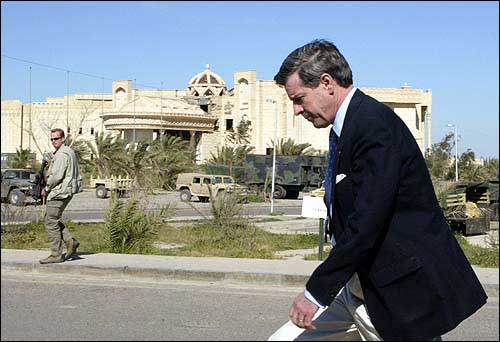
The U.S. civilian administrator for Iraq, Paul Bremer, walks past one of ousted President Saddam Hussein's palaces, now a U.S. army base, during his visit to the Task Force Iron Horse headquarters in Tikrit, about 110 miles northwest of Baghdad. While lawmakers are pressing for estimates on what the U.S. occupation in Iraq will cost, the Pentagon says it's too hard to offer an approximation.
Yet many contend the administration at least knows that roughly 100,000 soldiers will remain in Iraq for another year and could have budgeted an estimate or a placeholder request for that.
The Congressional Budget Office a few months ago estimated the cost to occupy Iraq through 2013 at up to $200 billion, depending on troops levels.
White House budget chief Joshua Bolten acknowledged in a briefing with reporters last month that the military would need money over and above the defense request — up to $50 billion the administration will seek in a so-called emergency supplemental budget for Iraq and Afghanistan. It used a similar supplemental last fall to ask for $87 billion for Afghanistan and Iraq.
But administration officials don’t plan to ask for that supplement, or specify what it might include, until sometime after Jan. 1, 2005 — about two months after November’s presidential election.
National
Teens’ reading and math scores have stagnated, US test results show
WASHINGTON (AP) — Younger students have regained ground academically after the pandemic's disruptions while older ...

Lawyers for man accused of killing Charlie Kirk try to block death penalty
Trump’s name poised to come off Kennedy Center

Suspect in Texas shooting had fired at police days earlier, officials say

Man pleads guilty to killing a top Minnesota Democrat and her husband