Visitors Bureau reports uptick in city tourism
Lawrence hotel operators ponder gasoline prices' effects on recovery
A turnaround has begun in the Lawrence lodging and tourism industry after two wretched years.
But hotel operators and tourism officials say the industry hasn’t returned to its heydays of the late 1990s.
“It feels like a turnaround has begun, but we’re not even halfway into it,” said Kate Kelly, general manager of the city’s Days Inn. “But at least it has begun.”
Whether the uptick will continue is the big question. Worries are mounting that rising gasoline costs may force people to stay at home and find other forms of entertainment.
“Gas prices are a pretty big question mark,” Kelly said. “I’m not sure people are going to get in their car and spend $400 to drive across Kansas.”
Others, though, are hoping high gasoline prices may help the Lawrence tourism industry. That’s because it may fuel a trend of travelers who stay closer to home. Cities like Lawrence, which don’t rely on large attractions to lure visitors, may benefit.
“Gasoline prices are definitely something that are going to impact us,” said Rob Phillips, general manager of the Eldridge Hotel, which is under bankruptcy protection and is in the process of being sold to a new investment group. “It is just a matter of whether they are going to hurt us or help us.”
Spending surge
What’s not up for debate is that 2003 was the best year for the Lawrence lodging industry in at least three years.
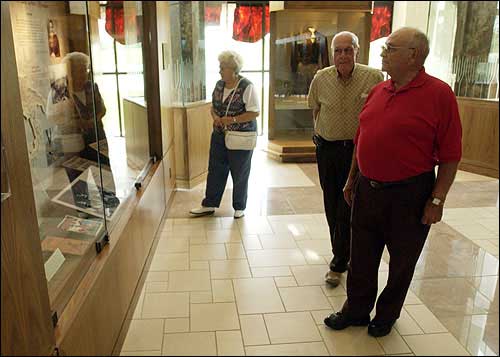
Faye Young, left, and her husband, Lyle Young, visit the Dole Institute of Politics with Faye's brother James McKain, of Raynham, Mass. They toured the center on Wednesday. Several hotel operators said the institute had helped attract more bus tours to the city. But, they said, more efforts were needed to convince the tour operators to stay overnight.
According to figures compiled by the Lawrence Convention and Visitors Bureau, visitors spent $41.7 million in the city during 2003. That’s up 18 percent from the $35.4 million spent in 2002. It’s also up from $35.3 million spent in 2001.
“Generally speaking, over the last 12 months or so, we have been doing pretty well,” said Judy Billings, director of the Lawrence Convention and Visitors Bureau.
Ron Desch, area manager for Lawrence’s Holiday Inn Express Hotel & Suites, said he had seen about a 20 percent improvement in his business.
“2002 was miserable, it was awful,” Desch said. “But I would say that a turnaround absolutely has begun.”
The bureau’s spending estimates are based on a formula that looks at how much the city collects in transient guest tax revenue, which is a sales tax charged on every hotel room in the city. In 2003, guest tax revenues reached a new high of $560,410, surpassing the 1999 mark of $535,436.
| Here’s a look at Lawrence tourism statistics for 2003, according to a new report from the Lawrence Convention and Visitors Bureau.¢ Total visitors. It is estimated that there were 712,318 visitors. There were 398,898 overnight guests and 313,420 day-trip visitors.¢ Total conventions. Nearly 25,000 people attended 116 conventions.¢ Visitor center attendance. There were 13,772 signatures in the registration book. Forty-three percent were from out-of-state.¢ Web site users. There were 125,101 visits to visitlawrence.com. |
But those numbers don’t tell the whole story, Billings said. The 2003 totals are inflated because they include some delinquent tax payments — another sign of how bad the industry had gotten — that represent sales made in previous years.
“We’re still not up to where we were in the mid-to-late 1990s,” Billings said. “But the good news is we’re approaching it. Hopefully this year, we’ll pass it.”
Spreading the word
An increase in the tax rate charged to Lawrence hotel guests has created new optimism.
In January, city commissioners implemented a 1 percent increase in the city’s transient guest tax, raising it from 4 percent to 5 percent. The tax increase is expected to add at least $70,000 to the Convention and Visitors Bureau’s budget.
Billings said much of the new revenue had been devoted to advertising. The bureau’s advertising budget has grown from $40,000 in 2003 to $90,000 in 2004.
The money has allowed the bureau to begin its first in-state advertising campaign. The bureau, beginning this month, is advertising in more than a dozen daily and weekly Kansas newspapers that are at least 100 miles from Lawrence.
The advertisements are promoting Lawrence’s role in the state’s travel campaign called the Kansas Mega Gigantic Get Away Giveaway. The program encourages people to travel at least 100 miles from their home, take a picture at a Kansas tourist attraction and send it in to the Kansas Department of Commerce for a drawing to win a 2004 Chevy Malibu.
The Lawrence promotion encourages visitors to come to Lawrence and have their picture taken at the Lawrence Visitor Center. Staff members of the center will take the picture and fill out the necessary paperwork to enter visitors in the drawing.
Billings said she thought it was the right time for the city to increase its advertising to other Kansans.
“We think the trend may be for people to stay closer to home,” Billings said. “They may not have enough money to take the family on a long trip to Disney World, but they may decide to take a quick trip to Lawrence.”
The extra tax revenue also has allowed the bureau to restart an advertising program targeting residents in four Midwest metropolitan areas — Des Moines, Iowa; Omaha, Neb.; Kansas City and Wichita.
Billings said the advertisements generally tout one of four themes — Lawrence’s music and arts culture, the city and university’s museums, the area’s golfing options, or Lawrence as a gathering spot for a nostalgic reunion with friends and family.
More events
The city’s hotel operators said they haven’t received any complaints from customers about the increase in the guest tax.
“It seems like a good strategy to me,” said Desch, who is on the bureau’s advisory board. “The CVB does need to advertise a little bit more and send its staff to more meetings and events to attract new business here. We have a nice package in Lawrence. We just need to let folks know about it.”
The strategy does have its critics. Phillips said he wasn’t opposed to the tax increase but doesn’t think the money is being spent in the right way. He said the city should have used some of the money to begin planning for a convention center or developing new events and festivals to attract visitors during slow periods of the year.
“Instead of increasing our advertising budget, I wish they would have given the $50,000 to the arts community and told them we want to put on a weeklong arts festival that will blow the state of Kansas and the Midwest apart,” Phillips said. “We could have given them $50,000 in seed money, and let me tell you, we would have had some people motivated to bring visitors to Lawrence.”
Desch said the lodging industry would like to see more events in the community but said using tax dollars to fund them could become difficult. Instead, the bureau offers help in staffing events and promoting them.
“In theory it is a great idea to start more events, but in reality it becomes tough to make the judgment calls of who should receive money,” Desch said.
Billings said the bureau was working on new attractions to bring visitors. She said work was continuing on having Douglas County and part of Eastern Kansas designated as a National Heritage area for its role in the Civil War and the abolitionist movement. A bill is awaiting debate before Congress that would establish the area as the 25th National Heritage area in the country. The listing, which is part of a National Park Service Program, would give the area more visibility on national Web sites and could increase the amount of federal tourism funds the area would be eligible to receive.
As part of the plan, the bureau is part of a group looking to highlight the history of the Blackjack Battlefield near Baldwin. A committee is trying to raise $250,000 to build a visitors center at the site and promote the area as the birthplace of the Civil War.
“I think it has tremendous potential,” Billings said. “To have a center where people could go and stand on the ground and understand how the events there shaped our nation, I think that would be a tremendous draw for the area.”
Some tourism officials also think that site and the National Heritage area eventually may be the major boost the industry has been waiting for.
“I think that is the type of thing that could bring bus loads of visitors to Douglas County,” Desch said.
City Government
Soccer gear honoring Lawrence history’s all-star team is now on sale as part of city’s public art exhibition
To honor public servants, Lawrence’s July 4 celebration will have a whole gallery of their photos on display; submissions open now
North Lawrence study consultants look at possibilities for a grocery store, food truck park, traffic calming and more
Algerian ambassador gives Lawrence a gift for supporting national team – a piece of art
Lawrence City Commission approves incentives for Alarm.com’s office project in downtown building