Dropped on D-Day: Former paratrooper still recalls events of 60 years ago
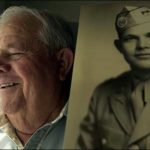
Roy Creek parachuted into Normandy France on D-Day with the 82nd Airborne division. Creek, now 86 and retired in Lawrence, remained in the Army until 1967. He's shown next to a photo of himself from the war years.
Roy Creek arrived 60 years ago in France half-drowned, gasping for air and missing his gun.
“I was full of water, out of breath, afraid I would attract some German,” said Creek, who had parachuted on D-Day, June 6, 1944, into a French field that had been flooded by Nazi forces. He had to cut himself loose from his equipment to avoid drowning.
Once he found dry land, though, Creek realized he had a new problem: His Thompson submachine gun and ammunition was left behind, under the water.
“I realized, here I was in a war, and I didn’t have a gun,” Creek said. “That’d be kind of embarrassing. Don’t you think?”
Things would get better that day for Creek, a captain in the 82nd Airborne. He joined up with other paratroopers, then helped lead an attack to take and hold a bridge key to the Allies’ plans for the invasion of Europe.
Sixty years later, Creek, now an 86-year-old resident of Lawrence, is one of the few remaining participants from the largest invasion in human history. His memory of World War II burns clearly, but he finds himself mildly perplexed at the attention D-Day still receives.
“We had war going on all over the globe, people in the Pacific who maybe had it harder as far as the enemy goes,” Creek said recently. “But now this one day gets celebrated, even more than the surrender.”
It was a quirk of timing that kept Creek out of the fight against the Japanese in the Pacific. On Dec. 7, 1941, the active-duty lieutenant in the Army reserves was preparing to go to San Francisco to join forces in the Philippines. The Japanese bombed Pearl Harbor, the Philippines soon fell, and Creek found his orders changed before he sailed.
He returned to Fort Huachuca, Ariz., where he spent the first year of the war training new soldiers for the suddenly overflowing Army.
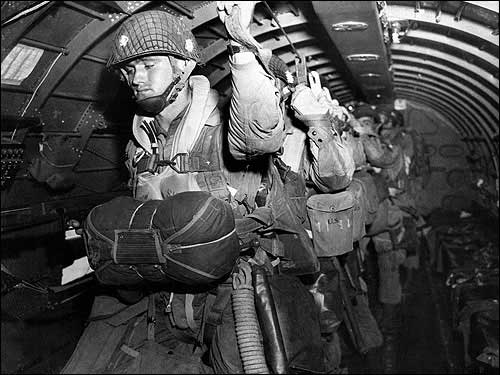
U.S. paratroopers fix their static lines for a jump before dawn
over Normandy France on D-Day, in this June 6, 1944, file photo.
The pivotal battle of World War II began 60 years ago today.
“Recruits were coming in by the trainload,” Creek said. “We were working 15 hours a day at training new recruits; the Army was growing by leaps and bounds.”
But as war raged across Africa, Europe and Asia during 1942, he became impatient with his assignment. He volunteered for the “parachute troops.”
“I was motivated to go out and win the war by myself. Everybody was,” Creek recalled.
He was sent to Camp Toccoa, Ga., without any training.
“I reported to the commander,” Creek said. “He said, ‘How many jumps have you made?’ I said none. He said, ‘What the hell are you doing here?'”
The Army sent Creek to Fort Benning, Ga., for training. He then went to Nebraska to command a company in the 507th Parachute Infantry Regiment.
“We had lots of room out there to jump without worrying about landing in water or trees,” Creek said.
But he used trees as incentive for his company during practice jumps — promising a three-day pass to any soldier who could land in a tree during training jumps.
“We were always the first company assembled after the jump,” he said, “because everybody was slipping toward the tree.”
In December 1943, Creek and his company sailed for England.
‘Mass confusion’
The night of June 5, 1944, Creek couldn’t sleep. The invasion was just hours away; some paratroopers fell asleep on the C-47 Dakota as it flew over the English Channel on the way to France, but he couldn’t relax that much.
“We were up all night,” Creek said. “I didn’t sleep from reveille June 5, till about 10 o’clock June 7.”
At 2:30 a.m. June 6, he jumped.
“We were supposed to jump from 600 feet,” he said. “My estimate is we jumped at 300, based on how long it took to descend.”
His radio operator followed Creek out of the plane, and landed in the same flooded field.
“It ruined his radio,” Creek said. “It almost ruined me; the water was over my head.”
After catching his breath on dry land, he decided he couldn’t wage war without a weapon.
“I went back into the water,” Creek said. “I got my gun and ammo clips.”
But he and his radio operator soon realized they were alone.
“The drops were very poorly done,” Creek said. “People were scattered everywhere. … You had mass confusion in the early hours of D-Day.”
As the two men tried to get their bearings in the predawn hours, they heard a sound nearby. Creek called a code-word challenge: “Flash!” The response was supposed to be, “Thunder!”
“I got my wet machine gun ready and shouted, ‘Flash!'” I heard, ‘Flash, hell, this is Colonel Maloney!'”
The three men started walking together, picking up additional lost paratroopers along the way, including Gen. James Gavin, second in command of the 82nd.
“We were certainly meeting the right people,” Creek said. “We managed to get ourselves organized, so we could at least defend ourselves against attack. From that point on, we started to fight the war.”
‘Long way to Berlin’
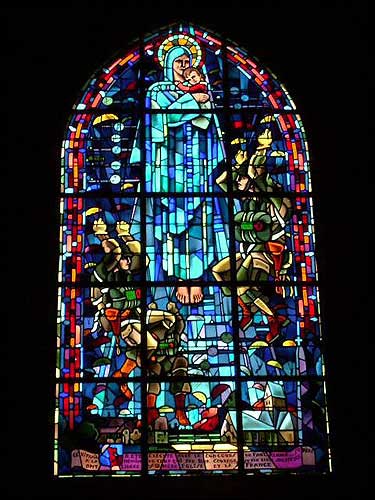
The stained-glass window in the Ste. Mere Eglise church depicts
paratroopers drifting to the earth during the D-Day invasion. The
window is dedicated to their efforts.
After dawn, Gavin ordered a group of more than 100 men to move on the French town of Chef-du-Pont and seize the bridge there so Allied forces could cross the Merderet River.
“You had to control the bridges and causeways to make sure the troops landing on the beaches could move rapidly inland,” Creek said.
The group, lead by a lieutenant colonel, had to ford a flooded field to get to the objective. The Germans saw them coming.
“The were shooting at us; the bullets were splashing water in our faces,” Creek recalled. “Tell you the truth, I was less concerned about that than stepping in a hole. I would’ve been in over my head.”
As the Americans approached the bridge, the colonel was shot, leaving Creek in command. After two failed assaults on the bridge, the soldiers tried a different method, attacking individual German foxholes until there was no more opposition.
“We took those one at a time, until we got to the bridge,” he said. “That went back and forth all day. We managed to get control by dark.”
The next morning, Creek’s men were relieved by a larger contingent from the 82nd. But Creek felt little satisfaction.
“We had a little let-down feeling,” he said. “We knew it was a long way to Berlin.”
After a pause, he added: “The smell of death was everywhere.”
‘Very stoic’
Creek didn’t make it to Berlin; he ended the war in Dusseldorf, Germany, after having survived the brutal “Battle of the Bulge” in December 1944, in which he was injured by a booby trap.
He retired from the Army in 1967, having made two tours of duty in Vietnam, at the rank of colonel.
His family moved to Kansas, where he worked for a Kansas City research company, then as an administrator for Kansas University Medical Center until his retirement in 1984. Creek and his wife, Florine, now live in Lawrence with their daughter, Cindy Maud, and her husband, Mike.
Maud said her father kept his stories of D-Day to himself for decades.
“No, not until around the 50th anniversary of D-Day, he never told any of his stories to us,” she said. “He was career military officer, and they are very stoic.”
Creek has returned to Normandy, with his family, several times. And with a wry sense of humor, he suggests that D-Day commemorations are about more than history.
“Cheese was the biggest industry (in Normandy) prior to World War II,” he said. “Tourism is now far and away the biggest industry.”
And though Creek said he was “embarrassed” at the attention the day receives, he understands the significance.
“It’s not a surprise,” he said. “There’s not a question but that it was important.”
City Government

Soccer gear honoring Lawrence history’s all-star team is now on sale as part of city’s public art exhibition
To honor public servants, Lawrence’s July 4 celebration will have a whole gallery of their photos on display; submissions open now
North Lawrence study consultants look at possibilities for a grocery store, food truck park, traffic calming and more

Algerian ambassador gives Lawrence a gift for supporting national team – a piece of art

Lawrence City Commission approves incentives for Alarm.com’s office project in downtown building