115 die in Iraq turmoil
Two U.S. soldiers among dead
Baqouba, Iraq ? In the deadliest attack since Iraq’s interim government took power from U.S.-led occupation authorities, a car careened off a busy street Wednesday and into a crowd of Iraqis applying to join the police force, exploding with a roar and killing at least 68 people.
Heavy fighting elsewhere claimed 45 more lives, including two American soldiers killed in separate roadside attacks. And two Pakistanis who had worked for a Kuwaiti contractor were executed by the extremist group that had held them captive, the Al-Jazeera satellite TV channel said.
The carnage, exactly a month after the interim government assumed power, highlighted the lack of security that remains Iraqis’ greatest worry. Even as preparations went ahead for a conference Saturday that is to select an interim assembly — a key step toward holding elections and establishing a democracy — kidnappings continue to plague the nation, and members of the interim government are being assassinated at a steady pace.
Most of the dead in Baqouba appeared to be Iraqi civilians, U.S. and Iraqi officials said. Many were young men trying to enlist in the police or passengers on a passing bus. The blast strewed corpses, tangled wreckage and puddles of blood over a busy, sunbaked street of shops and government offices. Dozens more people were injured.
“When I saw this scene,” said police commander Waleed Azawi, who came rushing from his office at the sound of the bomb to find bodies still burning in the street, “I hated even myself.”
The late-morning explosion wounded 56 Iraqis, overwhelming the hospital in Baqouba, a city 35 miles northeast of the capital. Every bed was filled, forcing many victims to sit on the floor amid pools of blood as frantic health workers treated them. One wounded man sitting against the wall held his head in his hands and wept. People ran through the corridors searching for information on missing relatives.
“These were all innocent Iraqis, there were no Americans. What was their guilt?” one man shouted at the bomb site, pounding his head in grief. Other men screamed epithets and denounced the attackers as terrorists. Television cameras captured the image of a young man howling with rage as he wandered through the pandemonium in the street shortly after the bombing. After all the suffering this nation has known, the attack was a reminder of what hasn’t changed: Iraqis still don’t live in security or peace.
“Before, (the insurgents) claimed they were fighting the Americans, but now they’re fighting their honorable brothers who joined the police to defend those people and their families,” said Aqeel Hamid, deputy governor of Diyala province. “If an elected government will rule this country, then I wonder what they’re going to say.”
At a time of rampant unemployment and widespread financial uncertainty, the men had come to the police station in hopes of signing on as officers, even though the police are frequently attacked. They had already made the first round of cuts, and were competing for a chance to earn $220 a month.
Saleh Hakim, a 27-year-old recruit, was milling on the curb with the other men. “An officer came to the door and said, ‘No, you’re not supposed to be here, go to the other side,'” he recalled, propped up on a cot in a packed hospital ward heavy with the smell of blood. It had been hours since the blast, but his shredded shirt still clung to his frame; a patch of dried blood covered the cotton bandages on his stomach and crotch.
Across the hospital room, panicked cries of “Doctor! Doctor!” went up. Family members turned a young man near the door heavily onto his side, his eyes rolled back and he vomited blood. The wailing swelled from his family, but nobody came.
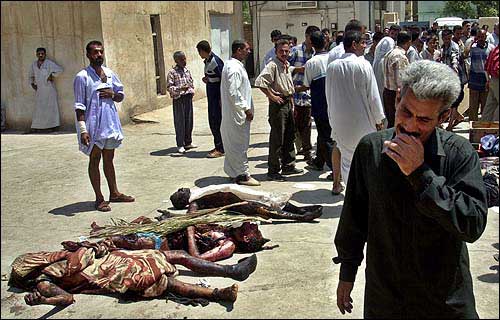
Iraqi civilians crowd around the dead to identify their relatives who were killed during a car bomb blast in Baqouba, Iraq. A suicide attacker killed at least 51 people when he exploded a bomb-laden vehicle Wednesday outside a central Baqouba police station.
Hakim turned glazed eyes to look. “My cousin,” he said. “He got shrapnel in his throat.”
In the corridor, the women in the family collapsed in a sobbing heap against the pastel walls of the hospital. The minutes slipped by. The pool of blood on the hospital floor grew.
“He’s dying,” the women repeated. “He’s dying.”
And while Baqouba struggled to recover, spasms of fighting broke out in the south and the west of the country. In one clash with militants thought to have crossed over from Iran, 35 insurgents and seven Iraqi police were killed near the south-central Iraqi city of Suwariyah. Polish Lt. Col. Artur Domanski, a multinational force spokesman, said he had no information on whether the insurgents were foreign fighters or Iraqi militants. Iran says it does not allow fighters to cross its borders, but it does not rule out that such people may cross illegally.
Also Wednesday, the military said clashes throughout Anbar province killed two coalition troops, and two U.S. soldiers were killed in separate roadside bombing attacks. Their deaths raised the toll of U.S. military personnel killed in Iraq to at least 906 since the war began, according to an Associated Press tally.
Al-Jazeera television reported that an Iraqi militant group holding two Pakistani contractors had killed the men. The group, calling itself the Islamic Army in Iraq, said it kidnapped the Pakistanis because they were working for U.S. forces.
The large number of civilian casualties in attacks has angered many and even raised questions on Islamic Web sites, where the morality of killing Muslims who work for U.S. coalition forces in Iraq has been debated.
In an audio recording posted Wednesday on one site, a speaker purported to be the spiritual adviser of an Iraqi insurgency group justified killing fellow Muslims when they protect infidels and also the deaths of bystanders in an attack.
“If infidels take Muslims as protectors and Muslims do not fight them, it is allowed to kill the Muslims,” said the speaker, identified as Sheik Abu Anas al-Shami, spiritual leader of Tawhid and Jihad, a group led by al-Qaida-linked Jordanian militant Abu Musab al-Zarqawi.
The speaker also said that if Muslims who “mingled” among infidels were killed in an attack, that would be justified because killing infidels is paramount. The tape was recorded before the June 28 handover of power.
National
Lawyers for man accused of killing Charlie Kirk try to block death penalty
Trump’s name poised to come off Kennedy Center
Suspect in Texas shooting had fired at police days earlier, officials say
Man pleads guilty to killing a top Minnesota Democrat and her husband
New tornadoes outside Chicago as severe storms pummel the Midwest