PBS sticks to conventional coverage
Other networks cutting airtime at political conventions
New York ? The national political conventions clearly aren’t what they used to be, but PBS’ Jim Lehrer isn’t sure many people in television news recognize what they’ve become.
Contrary to his broadcast competitors, Lehrer will be on the air for three prime-time hours each night of next week’s Democratic convention from Boston. He’ll do the same thing with the Republicans in a month.
“I’m not the least bit worried that we won’t have anything to talk about,” he said.
TV viewers who want to follow the conventions this summer will have plenty of choices — perhaps more than ever before. C-SPAN, CNN, Fox News Channel and MSNBC all plan extensive, even gavel-to-gavel coverage.
The biggest broadcast networks, however, are continuing their long-running reduction of live coverage. ABC, CBS and NBC will be on the air live for three hours for each convention; that’s the same as in 2000 for CBS and NBC, four hours less for ABC.
CBS’ Dan Rather, who has covered or anchored every national convention since 1964, said he used to be a proponent of full-time coverage.
“But that was at a time when something really happened there, actual people were nominated, and the nominations weren’t sewn up until we got there,” Rather told reporters earlier this year. “Now there’s virtually no defense of it.”
He said he could foresee a day where the broadcasters take a pass from live coverage altogether.
Lehrer said he sensed many at the broadcast networks were nostalgic for a time that has come and gone.
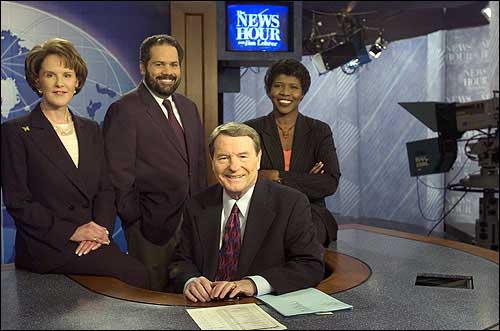
Jim Lehrer, seated, senior correspondent of PBS' The
“If they see a different kind of story and everyone sits around and moans, ‘Oh, it’s not the same old story anymore,’ so what?” he said. “It’s a different story. Go out there and cover it.”
Stage-managed or not, the conventions are still a gathering place for the nation’s political leaders and are where parties set the themes that will carry through the fall campaign, he said.
The last convention where real news was broken about the nomination process came in 1980, when Ronald Reagan briefly flirted with the idea of taking former President Ford as a running mate, said George Stephanopoulos, host of ABC News’ “This Week.”
Yet Pat Buchanan’s angry speech in 1992 made news and, Stephanopoulos said, Walter Mondale probably sealed his defeat in 1984 when he said during his acceptance speech that he would raise taxes.
“In 1988, when … George Herbert Walker Bush said, ‘Read my lips, no new taxes,’ he pretty much won the 1988 campaign and lost the 1992 campaign with one single speech,” he said.
The presence of the cable news networks is often cited by broadcasters as a reason for cutting back. That’s especially the case at NBC News, where MSNBC will offer extensive reports.
Lehrer said the broadcasters couldn’t justify their decision journalistically or reconcile it with their public service roles.
“The huge audiences for television are still at the three commercial networks,” he said, “and when they say to the American people that these conventions are not important enough to cover, they become, in my opinion, part of the message of the conventions themselves.”
National

Lawyers for man accused of killing Charlie Kirk try to block death penalty

Trump’s name poised to come off Kennedy Center

Suspect in Texas shooting had fired at police days earlier, officials say
Man pleads guilty to killing a top Minnesota Democrat and her husband
New tornadoes outside Chicago as severe storms pummel the Midwest