

Disabled waiting on lawmakers
Lawmakers grapple with services for state's vulnerable
John Beasley, 46, knows all about The Wait.
“It stinks,” he said. “That’s the only way I know how to describe it.”
A longtime steel worker, Beasley broke his neck last year after slipping on wet steps outside his mobile home in east Lawrence. He’s paralyzed below the waist.
Like thousands of working Kansans, he didn’t have health insurance, so he turned to the state Department of Social and Rehabilitation Services for help.
He was told to wait. There wasn’t enough money in the SRS budget.
Beasley, who lives south of Lawrence with his mother and stepfather, waited 18 months before help arrived.
“That’s a long time,” he said. “It gets to you after a while. You don’t know if you’ve been forgotten or if it’s because nobody cares. You’ve paid taxes all your life, you’ve never been on welfare, and then when you can’t work and you need help, the money isn’t there.”
Beasley’s situation is not unique. Today, more than 2,000 physically or developmentally disabled adults are parked on SRS waiting lists. Most will sit for at least a year. Eighteen months is not unusual.
“Somebody in the government ought to look at that and say ‘What’s the holdup?'” Beasley said. “It’s not right to put people off that long. This is Kansas; we may not be the richest state in the nation, but we sure ought to take care of our own. There are people out there suffering.”
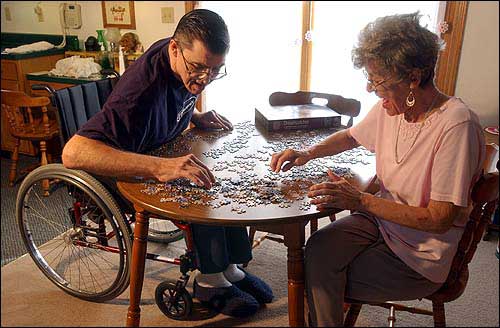
John Beasley, Lawrence, left, and his mother, Mary Ann Puckett, work on a jigsaw puzzle at Puckett's home in Lawrence. Beasley, who broke his neck last year and is paralyzed below the waist, turned to the state Department of Social and Rehabilitation Services for help but was put on a waiting list for 18 months because there wasn't enough money in the SRS budget.
Ultimate message
Beasley’s challenge topped the list of social-service priorities in both 2002 and 2003. It will in 2004, too.
“That’s our primary and ultimate message: that human needs should come first, that these are the essential services our most vulnerable citizens need to live in their own homes and not have to move into a nursing home,” said Shannon Jones, executive director at the Statewide Independent Living Council of Kansas and spokeswoman for the Big Tent Coalition, a mix of more than 80 advocacy groups.
In the waning hours of the 2003 session, lawmakers added $20 million — $8 million in state funds, $12 million in matching federal aid — to SRS’ waiting list with the understanding that almost 900 people would be moved off the waiting lists.
But within a few weeks, SRS realized that much of the money was needed to pay bills from the previous fiscal year and to offset the costs of earlier “emergency moves” off the lists. Instead of 900 people leaving the waiting lists, SRS officials predicted 250.

 State of the State
The Big Tent Coalition members spent much of the fall and winter lobbying legislators for a $4.3 million “supplemental” to replace the money that SRS used “to plug the holes left over from last year,” Jones said.
“If we don’t get that, we’ll be swimming against the grain the whole time,” she said.
For the Fiscal 2005 budget, the coalition is asking for $56.9 million, a significant increase over the $11.1 million now in the budget.
No money
| 2,000Estimated number of adult Kansans with physical or developmental disabilities on waiting lists for state aid.20 millionAmount of dollars added to the state budget at the end of the 2003 session to move 900 people off the waiting lists.85Number of advocacy groups aligned in the Big Tent Coalition, which lobbies for more social service spending.90Maximum number of days a person should have to spend on a waiting list before receiving benefits, according to a recent lawsuit.18Number of months rural Lawrence resident John Beasley waited for state assistance after he broke his neck. |
Rep. Brenda Landwehr, R-Wichita, doubts that SRS will see that much of an increase.
“Things aren’t that much different from last year; we still don’t have any money and we’re still not going to raise taxes,” said Landwehr, chairwoman of the House subcommittee that oversees the SRS budget.
A recent court ruling ordering an overhaul of the state’s school finance formula doesn’t help matters, Landwehr said.
“The challenge that comes with balancing social-service needs against K-through-12 is always a big one,” she said. “It’s going to be bigger in 2004 than it was in 2002 and 2003.”
Landwehr said SRS and the Big Tent Coalition would be lucky to break even in the 2004 budget deliberations.
“I can see us covering the caseload estimates — whatever increases there are in nursing homes, foster care, Medicaid and (Temporary Assistance for Needy Families),” she said. “But that’s it.”
Rep. Jerry Henry, D-Atchison, doesn’t share Landwehr’s assessment.
“We have (legislators) who sit there and vote no on everything, but they’re not the decision-makers,” said Henry, who’s also on the SRS budget subcommittee. “The decision-makers see the bigger picture. They know schools are important, and they know waiting lists are important, too. They don’t see this as an either-or situation.”
Redefined role
 “State of the State: The Issues” is a 10-day series of Journal-World and 6News stories to help you understand the key issues facing the governor and Legislature. It leads up to our live 6News coverage and analysis of the governor’s State of the State address Jan. 12.Monday: Expanded gambling could help the state cope with its budget crisis, and both sides are gearing up for a tough fight. “State of the State: The Issues” is a 10-day series of Journal-World and 6News stories to help you understand the key issues facing the governor and Legislature. It leads up to our live 6News coverage and analysis of the governor’s State of the State address Jan. 12.Monday: Expanded gambling could help the state cope with its budget crisis, and both sides are gearing up for a tough fight. |
Other issues expected to surface during the 2004 social service debate include whether to:
- Restore the cash-assistance and MediKan benefits for the 400 low-income, disabled adults ordered dropped from the programs’ rolls Jan. 1. A restraining order last week temporarily delayed the cuts.
- Combine the state contracts for foster care and adoption services.
- Redefine the roles of the remaining state hospitals for the mentally ill and developmentally disabled.
- Open records in cases involving children who die while in state custody.
Legislators also will be keeping an eye on a pair of lawsuits working their way through the courts.
The first, filed by the Topeka Independent Living and Resource Center, asks the court to limit time spent on SRS waiting lists to 90 days.
“The law says there has to be ‘reasonable promptness,'” said Kirk Lowry, legal counsel for the Topeka center. “It’s our position that a year to 18 months is neither reasonable nor prompt.”
The second lawsuit, filed by Interhab, a state association of community programs for the developmentally disabled, accuses the state of systematically underfunding its members.
“Not a single budget proposed by this and the previous administration has recommended a penny in rate increases for community programs,” said Interhab executive director Tom Laing. “Our rates have increased less than 1 percent a year since 1993.”
In its lawsuit, Interhab cites a cumulative shortfall of $300 million.
State Government
State legislators push back against federal energy regulators ending competitive bids
TOPEKA — Two Kansas legislators asked federal energy regulators to ensure competitive bidding occurs on ...
Senate confirms 1st of 3 Kansas nominees to U.S. District Court
Corporate income tax collections falling sharply in Kansas; Republican, Democratic leaders disagree on what it means
TOPEKA — Corporate income tax collections in Kansas have almost halved since last year, while other sources trend ...
Candidate’s campaign manager created website with documents used to attack rival
TOPEKA — Kansas U.S. Senate candidate Patrick Schmidt’s campaign manager left his digital footprint on ...
GOP secretary of state files to run for governor
