

A call for a Kansas Tennyson
Lack of state poet laureate indicative of second-class status for arts, backers say
Topeka ? From its campfires to coffeehouses, Kansas has its fair share of lyrical souls casting their “barbaric yawp” into the wind.
So why no state poet laureate?
Thirty-three states and counting have poet laureates fulfilling a host of cultural duties, not the least of which is to engage students in the act of writing about their feelings and observations.
But in Kansas, the poet is a second-class citizen on a Third-World bus.
Some folks say that needs to change.
“I see the issue of Kansas not having a poet laureate as just the tip of the iceberg of minimal support of all the arts,” said Denise Low, a nationally known Lawrence poet and instructor at Haskell Indian Nations University.
She said designating a poet laureate for Kansas would elevate the state’s culture and boost the morale of artists.
Think of Robert Frost, reciting from memory at President Kennedy’s inaugural, and Maya Angelou reading at President Clinton’s.
“America is not that old, but as we mature as a culture, we need to give some respect to the arts,” Low said.
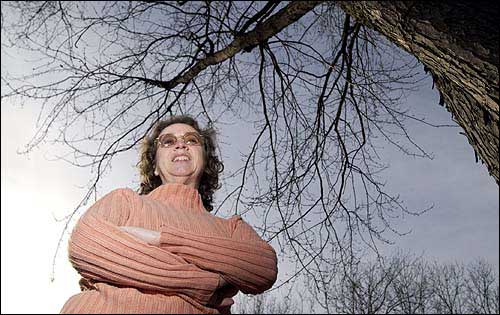
Lawrence poet Denise Low is among those who think Kansas needs to designate a state poet laureate to elevate culture and boost morale of artists in the state. At last count, 33 states had an official poet laureate.
Brian Daldorph, an assistant professor in the English department at Kansas University, said poetry was on the rise, possibly because of recent events such as the terrorist attacks and subsequent wars that have forced people to question what is important in their lives. Creative writing classes are packed, public readings are well-attended and poetry journals are flourishing, he said.
“Poetry gives people an opportunity to speak in their own voices and say what they want to say,” said Daldorph, who also writes poetry and edits a journal. At open microphone and poetry readings around town, Daldorph said, “Students like to say what they have to say and listen to what others have to say.”
Low attributes the increasing interest in poetry to people wanting a break from sitting in front of electronic screens.
“I love the movies, I love my computer, but these are very passive things,” she said. “Poetry is a very active way of looking inward and also observing the outside.”
The idea

 State Poets Laureate of the United States
Dave Wilson, executive director of the Kansas Arts Commission, said he was studying whether the state should have a poet laureate, and if so, how that person would be selected and what he or she would do.
“The question of the hour for us is what to do? Does it become an honor or something that requires something of the person?” he asked. “It would be nice to make it more than an honor. It should be an opportunity to interact with this person so that poetry gets heard.”
Low and Daldorph said a poet laureate could give readings, write poems for special occasions and speak in schools.
“It would be worthwhile,” Daldorph said.
Like Walt Whitman, whose “barbaric yawp” made poetry more accessible in the 1800s, a state poet laureate could bring poetry to the forefront for many Kansans.
Wilson said he hoped to have a plan of action this spring, but in the meantime he is focusing on state funding of the arts, which has dropped 9 percent in recent years because of revenue shortfalls. The commission’s annual budget stands at $1.6 million in state funds, down $146,067 in the past two years.
Nationally, Kansas ranks 41st in per capita funding of the arts; spending less than half the average of states. Even so, some states have cut arts funding even further than Kansas during the past couple of years. Nationally, states have lost about 23 percent of their arts funding.
Low said the funding reductions seemed to have hit poets the hardest as far as their ability to gain awards and tap into grants and fellowships.
“The writers are so demoralized, they don’t even apply anymore,” she said.
But Wilson said everyone in the arts community had been affected.
“The arts are not well-supported in this state. I would say that of all the arts,” he said.
State Government
State legislators push back against federal energy regulators ending competitive bids
TOPEKA — Two Kansas legislators asked federal energy regulators to ensure competitive bidding occurs on ...
Senate confirms 1st of 3 Kansas nominees to U.S. District Court
Corporate income tax collections falling sharply in Kansas; Republican, Democratic leaders disagree on what it means
TOPEKA — Corporate income tax collections in Kansas have almost halved since last year, while other sources trend ...
Candidate’s campaign manager created website with documents used to attack rival
TOPEKA — Kansas U.S. Senate candidate Patrick Schmidt’s campaign manager left his digital footprint on ...
GOP secretary of state files to run for governor
