Kansas’ ‘working poor’ numbers increasing
Tax claims reflect struggling families
Margaret Cameron doesn’t want help. Not from the state. Not from private charities.
But she doesn’t see much choice.
The Lawrence resident works 40 hours a week in the pharmacy of Watkins Memorial Health Center on the Kansas University campus. The roughly $1,200 a month she takes home, however, isn’t enough to support her 8-year-old son and 6-year-old daughter.
“Sometimes it’s really, really tough getting all the bills paid,” Cameron said. “Sometimes there’s problems with the groceries — I don’t have enough to keep the table full.”
So Cameron relies on public and private assistance for help. Her rent is subsidized by the federal Section 8 program. Her family’s food sometimes comes from the Ballard Community Center.
“I don’t want to go to SRS,” Cameron said. “I’m 44 years old. I shouldn’t have to be leaning on help all the time.”
She is hardly alone, though.
A new study by a national public policy think tank shows Kansas may have one of the fastest-growing populations of “working poor” in the country.
And it comes as no surprise to those who help the state’s poor.
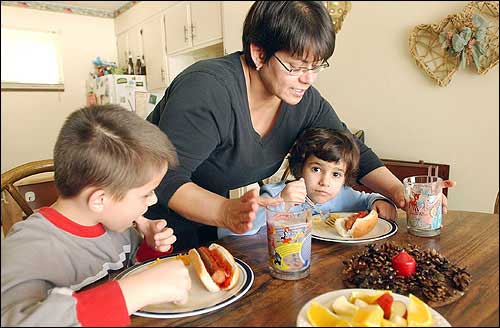
Margaret Cameron presents a lunch of hot dogs and macaroni and cheese to her children, Austin Garner, 8, and Autumn Garner, 6. Cameron, who works full time in the pharmacy at Watkins Memorial Health Center at Kansas University, says it's tough to pay all of the bills and put food on the table. A new study by the Brookings Institution shows that Kansas may have one of the fastest growing populations of working
“I know from talking to emergency providers that their requests for assistance continue to increase,” said Sister Therese Bangert, a spokeswoman for the Kansas Catholic Conference on issues affecting the poor. “They talk that the percentage of people who come to them, who are working, is increasing.”
The Brookings Institution study released last week tracked the whereabouts of the nation’s working poor by looking at data from federal income tax returns.
The study’s authors defined “working poor” as tax filers who claimed the Earned Income Tax Credit, a refund available to families who work but generally earn less than 200 percent of the federal poverty level.
The report said that in order to qualify for the credit, a full-time, year-round worker supporting two children could be paid no more than about $15 per hour. “In reality,” according to the report, “most workers claiming the (credit) earn far lower incomes.”
In Kansas

 The “State” of Low-Wage Workers (pdf)
At 11.9 percent, the percentage of Kansans claiming the credit in 2001 was relatively low, the study showed. Across the Midwest, the average was 12.3 percent. Nationally, it was 15.1 percent. And in Douglas County ZIP codes, the percentage was generally less than 10 percent.
But the numbers are rising quickly in Kansas.
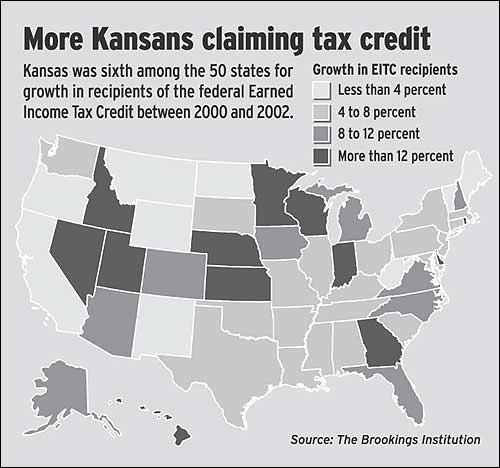
The study showed tax credit claimants in the state rose by 13.3 percent between 2000 and 2002 — the sixth-fastest growth rate in the nation.
That jump didn’t surprise Andy Brown, director of human service programs for the Ballard Community Center in Lawrence. The center offers food, rental and other assistance to the city’s poor. It’s a population Brown has seen growing in recent years.
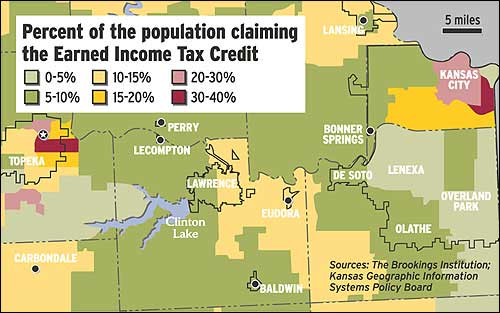
“I’d say probably somewhere in the neighborhood of 40 percent of the people we work with have a regular, full-time job that isn’t enough to provide for their families,” he said.
‘Couple of pieces’
Some advocates for the poor said the increase in tax-credit claimants in Kansas could be a good sign. Social service agencies across the state have worked with the Internal Revenue Service in recent years to publicize free tax-filing assistance for the poor, a program that makes more people aware they are eligible for the credit.
“I would like to think the reason there’s been more people applying is that there’s been more outreach,” Bangert said.
Paul Johnson, of the Public Assistance Coalition of Kansas, said the reason could be more complicated than that.
“There may be a couple pieces to this,” he said. “People might be more sensitive to the availability of the (credit) in Kansas. Second, we’ve had something of a recession in Kansas, and the quality of the jobs is downgraded.”
Bangert and Johnson both suggested that Kansans in the work force were increasingly moving from manufacturing jobs to jobs in the service sector with lower pay scales.
“I think we have a shift going on as to the quality of employment in our state, and I think we haven’t had much of a debate over that,” Johnson said.
Ed Gray, a senior research analyst for the Kansas Department of Commerce and Housing, said recent surveys found small losses in high-paying manufacturing and oilfield jobs in Kansas but big jumps in service industry jobs. The relatively well-paying construction industry also has seen a big increase.
“I think it’s kind of a mixed bag,” Gray said. “We’re up in some areas and down in some areas. But I think that’s a national trend — and that’s where the growth area is, in service jobs.”
Familiar situation
Brown looks at the increasing demands on his agency, however, and has no doubt times are getting tougher. Ballard Community Center serves Lawrence residents with incomes less than 185 percent of the federal poverty level.
And those ranks apparently are swelling. Ballard’s food pantry served 123 families in October 2000, Brown said; by October 2003, that number jumped nearly 48 percent, to 182 families.
“A lot of these are single parents who are trying to work and better themselves,” Brown said. “If they don’t get support services … they’ll end up homeless or having to move out of the community.”
Cameron is all too familiar with the situation. And though she has tried to pull herself up by her own bootstraps, she said there were limits to what she could do.
“Some of the pharmacists talk about me going to (pharmacy) school,” she said. “But that’s seven years of schooling. And that’s tough to do with two kids, not to mention I’d be over 50 and another $250,000 in debt when I graduated.”
She paused.
“That sounds like wonderful,” she said. “But I don’t see that as a reality.”
City Government

Soccer gear honoring Lawrence history’s all-star team is now on sale as part of city’s public art exhibition
To honor public servants, Lawrence’s July 4 celebration will have a whole gallery of their photos on display; submissions open now
North Lawrence study consultants look at possibilities for a grocery store, food truck park, traffic calming and more

Algerian ambassador gives Lawrence a gift for supporting national team – a piece of art
Lawrence City Commission approves incentives for Alarm.com’s office project in downtown building