

Behavior specialist trains new doctors on interaction
Salina ? Dr. Elizabeth Koerner, a first-year resident in the Smoky Hill Family Practice residency program, turned her head and covered her face with her hands.
She didn’t want to watch the videotape showing her examining Darrell Hills, a Salina real estate developer.
But Shanna Dunn-Vigare, behavioral science director for Smoky Hill Family Practice Center, wasn’t deterred. She let the tape continue, pointing out to Koerner how good it was that she had moved a chair closer to her patient.
“A lot of people would have stayed over here,” Dunn-Vigare said, pointing to a chair farther away.
But by moving closer, Dunn-Vigare said, Koerner could better maintain eye contact, and she looked more interested in her patient and his needs.
While one of the goals of the videotaping sessions is to ensure residents are checking every aspect of a patient’s condition from a medical standpoint — such as checking the feet of a diabetic patient — the other is to help the physicians improve their interaction with patients by pointing out behaviors such as lack of eye contact or awkward phrasing of questions.
“With things like diabetes, they get a lot of education about the disease and managing the disease,” Dunn-Vigare said. “They don’t get that kind of training on body language, attitude, being a good listener.”
Geriatric care
The videotaped sessions of residents treating three elderly patients — one a heart patient, one a diabetic and one with Parkinson’s disease — are one component of a grant for improvement of geriatric care that the practice received about four years ago. Dunn-Vigare said noon conferences on geriatric issues were conducted at least once a month, and a faculty member discussed a topic related to geriatrics four mornings a week. Library resources and other materials also were purchased through the grant.
Dr. Chuck Allred, director of the residency program, said previous graduates mentioned geriatrics as something they would have liked more training in as students.
“The U.S. population as a whole is aging,” Allred said. “You can see there’s going to be a giant need for training in this area.”
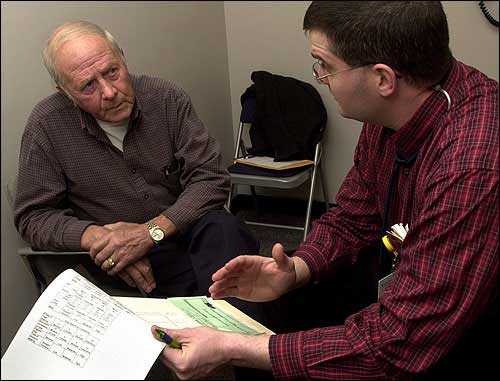
Dr. Jon Sides, a third-year resident at Smoky Hill Family Practice Center in Salina, talks with Darrell Hills about his medical history during a videotaped training session. Residents meet with real patients in videotaped exams to practice interaction as well as ensure they're covering medical issues.
Body language
The residents were videotaped examining the patients then met with Dunn-Vigare to review the videotapes. Dunn-Vigare checked to make sure the residents covered all of the medical issues listed on a review sheet, then talked with them about their demeanor.
Dunn-Vigare said she noticed that one resident asked patients such things as, “You don’t have depression, do you?” and “You’re getting exercise, aren’t you?”
She told the resident that he might elicit more and better information by saying, “Do you have depression?” and “Do you exercise?”
She pointed out to another resident that instead of looking at his patient, he tended to look down at the patient’s chart.
Dr. Scott Owings, a second-year resident, said he learned, through the videotaped sessions, the importance of being an active listener.
“Sometimes, as doctors, we tend to hurry the process, especially when we know there are a lot of patients to see,” Owings said. “We need to let the patient fully describe the complaint, and not jump the gun.”
Owings said that by watching himself and his patient, he learned a lot about how he responds to a patient and how the patient responds to him. He said he noticed that patients tended to mirror his body language — if he leaned forward, the patient leaned forward, and if he sat back in the chair, the patient sat back.
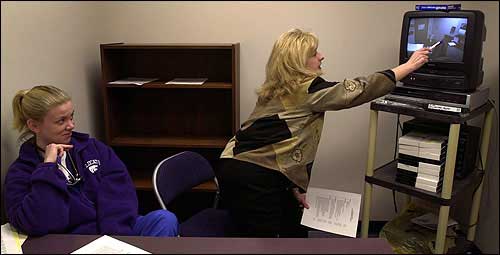
Shanna Dunn-Vigare, right, behavioral science director for Smoky Hill Family Practice Center, critiques a videotaped examination performed by first-year resident Dr. Elizabeth Koerner, left. Residents review the tapes to learn about their interaction with patients.
Dr. Chris Brown, a third-year resident, said it was important to watch yourself and have someone point out your habits.
“If no one ever points out how you have a habit of looking down at the chart and not making eye contact, you might never notice,” he said. “Interaction with the patient is such an integral part of the visit.”
He said statistics showed that 85 percent to 90 percent of the information needed to make a medical diagnosis came from the history you illicit from a patient.
“If you’re ignoring 90 percent of what’s important about the visit …” he said, lifting his eyebrows, raising his hands and letting his voice trail off. “You have to be reading their body language, too.”
State Government
State legislators push back against federal energy regulators ending competitive bids
TOPEKA — Two Kansas legislators asked federal energy regulators to ensure competitive bidding occurs on ...
Senate confirms 1st of 3 Kansas nominees to U.S. District Court
Corporate income tax collections falling sharply in Kansas; Republican, Democratic leaders disagree on what it means
TOPEKA — Corporate income tax collections in Kansas have almost halved since last year, while other sources trend ...
Candidate’s campaign manager created website with documents used to attack rival
TOPEKA — Kansas U.S. Senate candidate Patrick Schmidt’s campaign manager left his digital footprint on ...
GOP secretary of state files to run for governor
