State expected to push for commuter bus plan
Service likely to roll out in Douglas, Johnson counties
Commuters partake in all types of activities during their daily drives from Lawrence to Johnson County, but Terry Heidner is betting napping isn’t one of them.
It soon could be.
Hundreds of commuters — perhaps within the next two years — could choose to let someone else do the driving.
Heidner, director of planning and development for the Kansas Department of Transportation, said he was optimistic Lawrence and Johnson County would be chosen to launch a new commuter bus program.
“I really do think it will happen and I think it will be reasonably soon,” Heidner said.
‘Doable’ project
A system could be up and running within the next two years, Heidner said. And he thinks there’s a reasonable number of people who would be excited about giving up awkward commuter routines such as gulping coffee and doughnuts while steering with a knee, or giving a not-so-friendly wave to the driver that just cut them off.
“A lot of people would find it more relaxing and restful than having to drive themselves,” Heidner said. “Students could do a little homework or some reading, or you could even take a nap to get your day started.”
Heidner is optimistic, in part, because officials with both the Lawrence Transit System and Johnson County Transit seem to be in general agreement on the concept.
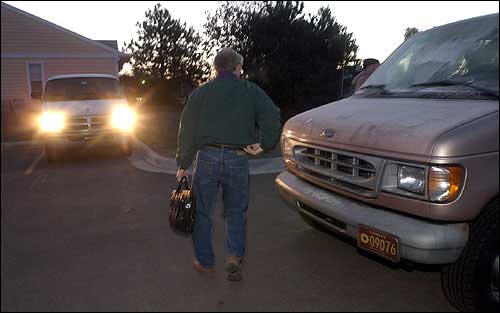
A Lawrence commuter heads to his van for his ride to work in Topeka. Several vans make the trip daily, carrying state employees to the capital city. The state is now considering a separate commuter program between Douglas and Johnson counties, which could be up and running within two years.
State officials are convinced the two transit systems should work together to provide drivers and other operational support needed to run the program. KDOT, through federal transit funds, probably would provide the money needed to buy the buses and cover other start-up expenses.
Karin Rexroad, administrator for the Lawrence Transit System, confirmed she’s had positive discussions with Johnson County officials about the idea.
“We both agree that it is a doable project,” Rexroad said.
Public money
Alice Amrein, Johnson County’s transportation director, said the project was more realistic now than it was a few years ago.
“I think there is a different philosophy at KDOT than there was five years ago,” Amrein said. “Frankly, the dollars aren’t going to be there for us to keep expanding roads, so they have to start thinking more about public transportation.”

 On the street: Would you be in favor of a commuter bus system running from Lawrence to Johnson County?
Lawrence City Commissioner Boog Highberger has been involved in some of the discussions and said he thought the project was realistic.
But it won’t be free. Hard cost estimates haven’t been determined, though Highberger said some rough figures indicated start-up costs could be in the $500,000 range and annual operational costs near $200,000. Amrein said those numbers probably were low.
Start-up costs may be funded by KDOT, but annual operational costs likely would be paid by the Lawrence and Johnson County transit systems. No one is guaranteeing that rider fees would pay for the system. In fact, Amrein said she thought it unlikely the program would be financially self-sustaining.
“But I wouldn’t let that fact deter me,” Amrein said. “I don’t know what it will cost, but it won’t cost $2 million per lane mile to build, like it does for a highway. So from that standpoint, it will be pretty cheap.
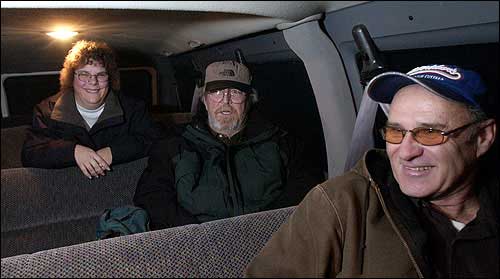
From left, Betsy Hoke, Barry Billings and Jerry Hoke wait inside their van before sunrise for their daily commute to their jobs in Topeka. Betsy Hoke, coordinator of van 9836, one of several commuter vehicles in a van pool running between Topeka and Lawrence, has been riding in the vans for 19 years.
“And it will help our air quality. We need to be looking at what public transportation does for our environment. We can’t continue to just build roads. If we do, at some point we’ll really be behind the curve.”
Highberger also said he could make a case for a public subsidy of a good commuter bus program.
“Even if you don’t ride it, if it frees up 40 spaces on the highway, that’s 40 fewer cars you have to deal with when you’re driving,” Highberger said.
City taxpayers currently provide about a $1 million subsidy each year to maintain the T, the city’s public transit service.
More study
Another unknown is just how many cars a bus service would take off Kansas Highway 10. As part of a KDOT study looking at possible expansion of K-10, it was estimated that the proposed system would serve about 150 people wanting to travel into Johnson County and about 110 people into Lawrence.
But Rexroad said that number could increase depending on where and how many stops the buses would make. Heidner said determining exactly where the buses would travel, especially in Johnson County, could be the project’s largest stumbling block.
In Lawrence, he said logical destinations would be Kansas University and the downtown area. In Johnson County, though, the list of possible stops is not as easy to determine. He said Johnson County Community College would be a likely destination but more study was needed to determine where else commuters need to go.
It is anticipated any system would require some commuters to transfer onto a bus operated by the T or the Johnson County Transit system to get to their final destinations.
Rexroad said the next step in the process should be hiring a consultant to study the idea, a step that could cost upward of $150,000.
“I know I hear talk of people wanting this type of service,” she said. “But there is a difference between wanting a service and using a service. That’s where we need more study. We don’t want to move forward on faith. We’re not going to take the ‘we’ll build it and they’ll come’ approach.”
Amrein said her office was working on a list of questions for a future study to answer. She said she would like to have a consultant hired by the end of March, but that it had not been determined who would pay for the study.
City Government

Soccer gear honoring Lawrence history’s all-star team is now on sale as part of city’s public art exhibition
To honor public servants, Lawrence’s July 4 celebration will have a whole gallery of their photos on display; submissions open now
North Lawrence study consultants look at possibilities for a grocery store, food truck park, traffic calming and more
Algerian ambassador gives Lawrence a gift for supporting national team – a piece of art
Lawrence City Commission approves incentives for Alarm.com’s office project in downtown building