City’s weatherization program faces funding freeze
Carol Taylor was getting some $300 heating bills — and paying more than $100 a bottle for her glaucoma medication.
“And I use three bottles per month,” she said. “I was thinking I was going to have to make the choice between my eyesight and my heat bill.”
So Taylor turned to the city of Lawrence, which uses part of a federal grant to insulate homes for people who meet guidelines for income and other factors.
But the annual grant has been shrinking in recent years, and the city may have to insulate fewer homes.
“We could just say, ‘We’re only going to be able to say we’re going to help the first 20 households, the first 30 households.’ I mean, it could happen,” said Margene Swarts, the city’s community development manager.
Dwindling resources
For 2001, the city received about $1.125 million from the U.S. Department of Housing and Urban Development — the largest amount Lawrence ever received.
The city has received a smaller grant each year since then, down to $963,000 this year.
The grant funds are spent on community development and neighborhood revitalization projects.
Besides the insulation program, the money goes toward helping some first-time homebuyers fix up their new homes. It also finances part of the operating expenses of agencies such as the Salvation Army and Douglas County AIDS Project.
As the grant has dwindled in recent years, the city has trimmed funding for such programs, Swarts said.
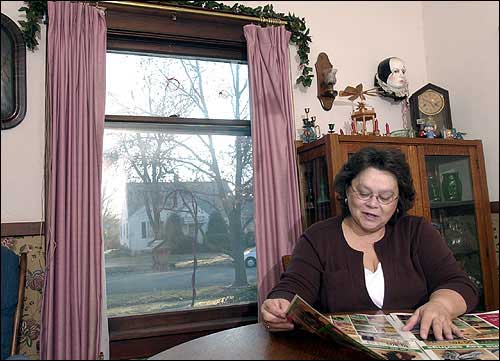
Carol Taylor lives in an older home on New Hampshire Street that didn't have enough insulation. Because Taylor qualified for a federally funded program operated by the city that helps people reduce their heating bills, her home received attic insulation, storm windows and weather stripping. Grants for the program, however, are shrinking.
A committee of neighborhood representatives and landlords recommends how the City Commission should spend the grant, she said.
Lawrence has been getting less money because more cities are becoming eligible for the grants as their populations increase. Despite the growing demand, Congress hasn’t increased money to the program, Swarts said.
“There used to be a corresponding increase in the appropriation,” she said. “(Now) you have more people getting a piece of the pie so … everybody gets smaller pieces.”
Swarts said she did not expect the situation to improve.
“Nothing makes me think (Congress is) going to increase this program and cut something else,” she said. “I just look at the economy, and I look at what’s been going on in the world.”
But not everyone thinks the program is worth its price.
Karl Peterjohn, executive director of the Kansas Taxpayers Network, an anti-tax group, said Lawrence already collected plenty of money through its property taxes. Besides, he said, the government makes spending mistakes.
“These programs coming out of Washington aren’t very efficient,” said Peterjohn, of Wichita. “The federal Department of Housing and Urban Development has a pretty long and sad history of performing poorly at a very high cost.”

 Weatherization program information (pdf)
Winterizing options
The city of Lawrence has budgeted $35,000 to fortify 45 homes this winter. During the past few years, the city has spent $35,000 to $40,000 each year to winterize homes.
The homes can get three things — storm windows, attic insulation and material around the edges and bottoms of doors to keep out drafts. Not all homes get all three.
Usually, everyone who applies and meets the guidelines is accepted for the winterization program, Swarts said. The city accepts applications each August.
Taylor, who has many disabilities, said the grant was a great help to her.
She received $300 natural gas bills during the early months of 2003. Then, from December 2003 to March 2004, workers contracted by the city of Lawrence put insulation into her attic, installed about 15 storm windows and put materials along the bottom of her front and back door panels to keep out drafts.
Before the workers came, Taylor’s 1920s-era home on New Hampshire Street had minimal insulation in one section of the attic and no insulation in two other sections.
“It’s amazing to me. Every year I go out and find houses that don’t have (attic) insulation,” said Larry Hamm, the city’s housing projects coordinator. “It just starts beating them to death when they have to pay $200, $300 heating bills.”
Taylor said she had wanted more insulation for her attic but couldn’t afford it or do it herself.
“It’s kind of like, what can I afford to do: make my house payment, pay my drug bills, those kinds of things,” said Taylor, who is an administrative support worker at nonprofit organization ECKAN. “The income I have just doesn’t go far enough.”
Taylor said the new insulation was making a difference.
“I haven’t hit a high heat bill yet,” she said. “And trust me, I keep my heat awful low.”
City Government

Soccer gear honoring Lawrence history’s all-star team is now on sale as part of city’s public art exhibition
To honor public servants, Lawrence’s July 4 celebration will have a whole gallery of their photos on display; submissions open now
North Lawrence study consultants look at possibilities for a grocery store, food truck park, traffic calming and more
Algerian ambassador gives Lawrence a gift for supporting national team – a piece of art
Lawrence City Commission approves incentives for Alarm.com’s office project in downtown building