Signing off
Retiring NBC anchor symbolizes fading era in network news
When he takes his leave of “NBC Nightly News” today, Tom Brokaw says it will be short and sweet, not “an opus of any kind but more a personal farewell.”
But that kind of a simple leave-taking, though very much in the Brokaw style, will belie the seismic changes in network television news that his departure represents.
When he makes his exit after 22 years, the 64-year-old Brokaw will become the first of the second generation of TV news anchors — those who followed Walter Cronkite, Chet Huntley and David Brinkley — to relinquish one of television’s most visible jobs. Last Tuesday, CBS’ Dan Rather announced he will become the second in March, when he gives up his anchor chair after 24 years. Peter Jennings remains at ABC, but he’s been on the job for 21 years and few inside the network expect him to stay on for more than a couple.
The triumvirate has been in place since 1983, and the departures are viewed by many as a reflection of the changing nature of how Americans get their news. Buffeted by cable news and the Internet, the audience for the three nightly news show has plummeted from 47 million viewers in 1991 to last week’s 28 million. During the past presidential campaign, according to a recent survey by the Pew Research Center for the People & the Press, more voters chose cable than the broadcast networks for their main source of election news.
Vanity Fair media writer Michael Wolff goes as far as to suggest that the exits of Brokaw and Rather are harbingers of the death of network news, hastening the day when ABC, CBS and NBC “can get out of this business.”
Change of heart
Brokaw won’t go that far. But he does acknowledge the changes taking place.
“When I started in this business, there were really only two planets in the evening sky: NBC and CBS. Now there are so many more choices out there,” he said in an interview just after Rather’s announcement.
But, Brokaw insisted, “the evening newscasts are still the big engines because of the audience they draw. When there are big events, they come to us.”
Certainly, though, things have changed a lot since the days when network anchors were iconic TV figures, inspiring trust and raising the aspirations of some who watched them.
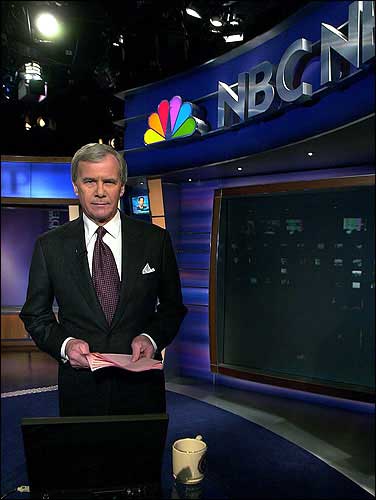
Tom Brokaw, shown here in 2001 on the set of NBC
Brokaw, for one, still can recall the night of television that changed his life and set him on the road to the anchor’s chair.
“I came out of high school as kind of a whiz kid, and everybody had very high expectations,” Brokaw remembered. “Then I drove myself off a cliff. I majored in beer and coeds the first couple of years, dropped out for a time. I was seriously adrift.
“Then in 1960, I was at my parents’ home between jobs, and I watched the election night with Chet Huntley and David Brinkley that went until 1 o’clock in the morning. At the end of that, I thought, ‘That’s something that I’d like to do, to become a network correspondent.”‘
That night led Brokaw back to college, a distinguished career as a TV news reporter, a spot as host of “The Today Show” and, in 1982, to being the man behind NBC’s anchor desk every weekday night and for every major news event.
At ease with decision
The adrenaline rush of those big stories is not something he will miss, Brokaw said.
“Look, I’ve covered epic news stories: natural disasters, the fall of the Berlin Wall, Sept. 11, the release of Nelson Mandela, Tiananmen Square,” he pointed out. “How many of those do you need on your scorecard?
“I don’t want to be like Jack Nicholson in the film ‘About Schmidt,’ when he goes back to the office and realizes he’s not wanted.”
Arts and Entertainment
Watkins Museum to open special exhibit detailing how Douglas County celebrated America’s Bicentennial

Go, See, Do: Kaw River Roots Festival, markets and more

Soccer gear honoring Lawrence history’s all-star team is now on sale as part of city’s public art exhibition

Nominations, call for artists open for Lawrence’s 2026 Phoenix Awards
Go, See, Do: ‘Addams Family’, PRIDE parade and a host of library events among offerings