Al-Sadr pledges fight to death
U.S., Iraqis will attack holy mosque to end conflict, if necessary
Baghdad, Iraq ? The rebel Shiite cleric leading the battle against U.S. Marines in Najaf, Iraq, vowed Monday to fight “to the last drop of my blood,” and U.S. officials said they were prepared to attack the city’s sacred mosque in order to crush his militia, setting the stage for a potentially explosive confrontation.
The governor of Najaf has authorized U.S. forces to move against the Imam Ali mosque, the holiest shrine in Shiite Islam, where members of the Shiite militia loyal to cleric Muqtada al-Sadr have taken refuge, according to a senior U.S. military official.
Al-Sadr surfaced at the mosque Monday, his first public appearance since the bloody battles erupted last week, giving a news conference at which he rejected any possibility of a settlement with the U.S. troops closing in on him.
Looking pale but defiant, the youthful cleric told reporters he was prepared to die in the defense of the city.
“I am going to resist and I am going to stay in Najaf and I am going to defend the holy city of Najaf until the last drop of my blood is spilled,” he said.
“I am an enemy of America, and America is my enemy until the last judgment day,” he added.
As he spoke, fierce battles raged in and around the sprawling cemetery adjoining the mosque, where U.S. Marines continued to hunt militia fighters hiding out among the tombs and mausoleums.
U.S. and Iraqi officials said a decision had been made that al-Sadr’s militia will have to be defeated militarily, even if that means launching an assault on the gold-domed Imam Ali Mosque in the heart of the ancient city.
“This determination has not been made by the Americans; it has been made by the government of Iraq,” said George Sada, spokesman for interim Prime Minister Ayad Allawi.
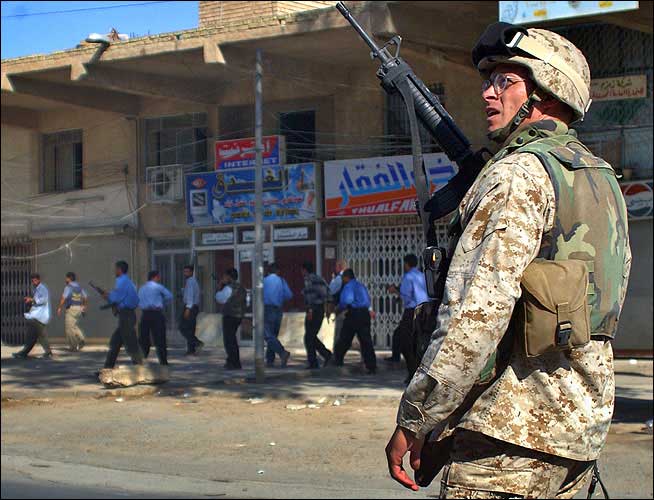
Marines from the 11th Marine Expeditionary Unit and Iraqi police, rear, are seen during fighting against Shiite cleric Muqtada al-Sadr's militia members in the holy Shiite city of Najaf. The troops, pictured Thursday, have intensified fighting in the region, but al-Sadr announced Monday that he would not give up his stronghold on the region.
U.S. officials said four Marines and about 360 militia fighters have been killed since Thursday.
Elsewhere, a suicide bomber slammed into a convoy of vehicles in the predominantly Sunni town of Balad Ruz, north of Baghdad, killing seven Iraqi police officers and wounding the deputy governor of the province, who was the presumed target of the attack.
Political crossfire
Charges issued by an Iraqi judge Sunday against Ahmed Chalabi and his nephew set off a mystery that bewildered many Iraqis and U.S. officials, fueling suspicion Monday that the warrants may have been designed at least in part to affect the country’s politics at a pivotal moment in its transition.
The charges — against Ahmed Chalabi for counterfeiting and lawyer Salem Chalabi for murder — were refuted Monday. Both men pledged to fight the allegations. Ahmed Chalabi, a former Pentagon favorite, charged both the CIA and followers of Saddam Hussein were out to discredit him.
National

Lawyers for man accused of killing Charlie Kirk try to block death penalty
Trump’s name poised to come off Kennedy Center

Suspect in Texas shooting had fired at police days earlier, officials say
Man pleads guilty to killing a top Minnesota Democrat and her husband
New tornadoes outside Chicago as severe storms pummel the Midwest